

Author: Da He

We often hear people say "the financial burden is heavy," and how many people in a county town have to be supported by the "financial budget."
But have you ever wondered how huge the team of "financially supported personnel" is?
How many people are considered reasonable, and how many are considered too many?
Many studies in the past have felt that there are a few too many people in our public sector, and there is still a lot of room for streamlining institutions.
Previously, scholars found that the size of the public sector and economic growth are like an inverted "U" shape: at first, more people can promote development, but if there are too many people, it will become a drag, and even take away the jobs of others in society.
Simply put, our huge personnel scale not only puts a lot of financial pressure, but also doesn't seem to improve the operational efficiency of the entire country.
Of course, not everyone sees it that way.
They feel that the problem is not that there are "absolutely" too many people, but that "people are crowded in places where they shouldn't be, and no one is working where they should be," it's a structural problem.
Unfortunately, it's too difficult to figure out the specific numbers, because after 2009, the official data is no longer published.
This makes subsequent research feel a bit like "blind men touching an elephant," relying on sporadic surveys, it's hard to piece together a complete picture.
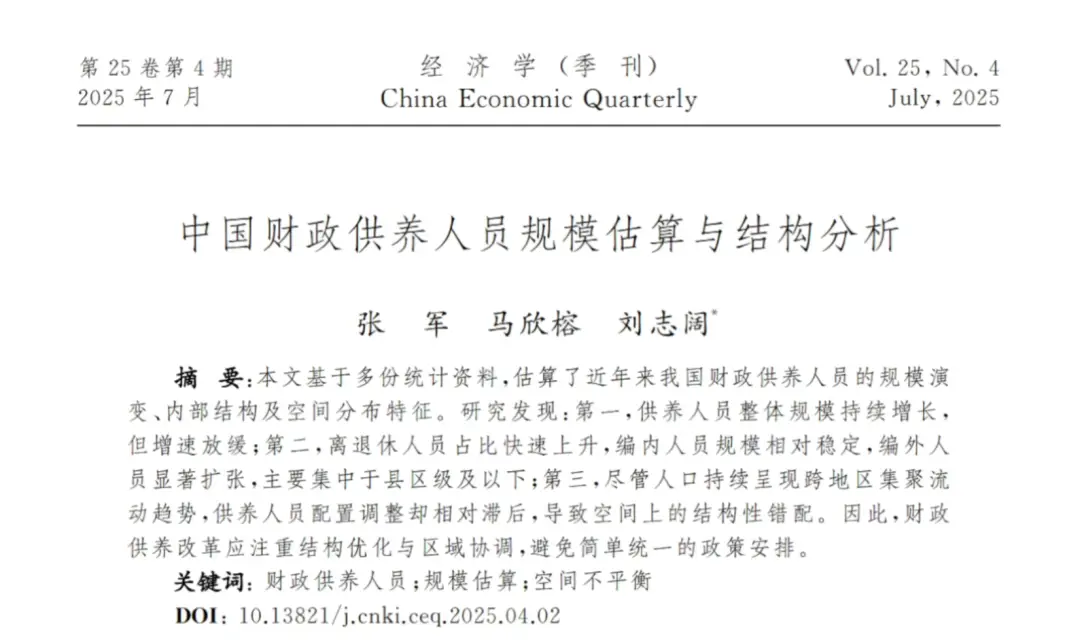
Fortunately, three scholars from Fudan University (Zhang Jun, Ma Xinrong, Liu Zhikuo) recently published a research report. They collected data from all sorts of official statistics, estimated the real scale and structure of China's financially supported personnel, and finally filled in the data gap of these years.
Today, I will use the insights from their research to discuss this topic with you.
Before starting the discussion, we must first know who is included in the financially supported personnel, and not simply equate them with civil servants.
Financially supported personnel, in layman's terms, are those whose salaries or welfare are directly paid by the national treasury (i.e., the taxes paid by the people).
Their work units belong to government departments or public institutions, equivalent to the group of people who "eat from the public purse."
However, this concept has different scopes, and we can understand it from three levels:
First, the most core "iron rice bowl" - civil servants and personnel in the establishment of public institutions
This part of the people is the "main force" of financial support, characterized by formal establishment, and their wages and benefits are all covered by the financial budget.
First of all, we often talk about civil servants, such as clerks in the government, police officers in the public security bureau, judges in the court, etc. Their salaries, bonuses, and social security all come from the financial budget.
Regarding the total number of civil servants in the country, the Ministry of Human Resources and Social Security has only announced statistics twice, in 2015 and 2016.
The report shows that as of the end of 2016, there were 7.19 million civil servants.
Since then, the Ministry of Human Resources and Social Security has not continued to release relevant data, which is obviously not due to data loss or insufficient statistical capabilities.
Secondly, there are personnel in the establishment of public institutions, such as teachers in public schools, doctors in public hospitals, and librarians.
However, public institutions are also divided into three categories:
The first category is fully funded, and the salaries are all paid by the treasury.
For example, elementary school teachers in county towns, no matter how many students there are in the school, their monthly salary is paid on time.
The second category is the difference-funded, the treasury pays a part, and the unit earns a part itself.
For example, doctors in Grade III hospitals, their basic salary is guaranteed by the treasury, but their performance bonuses depend on the hospital's medical income. They can get high salaries when the benefits are good, and may be discounted when the benefits are poor.
The third category is self-supporting, the treasury doesn't care, the unit earns money to pay salaries, and this type is gradually being transferred to enterprises, such as some guest houses, hotels, design institutes, and newspapers.
Then, there are the "pan-system" personnel - retirees and non-establishment personnel.
Although these people do not have an establishment, their welfare or salaries are still borne by the treasury.
Retirees don't need to say much, retired cadres and employees of government agencies and public institutions, their pensions are paid by the treasury.
And non-establishment auxiliary personnel, such as auxiliary police officers, sanitation workers, and community grid members. They do not have an establishment, but their salaries are actually borne by the treasury.
Here, I want to specifically mention that many people confuse the employees of state-owned enterprises, such as employees of PetroChina and State Grid, their money is earned by the enterprises themselves, and they are not considered to be eating from the public purse.
There are also some temporary workers hired by government departments through third-party companies, such as the chef in the canteen, which is not counted.
So, how many financially supported personnel are there?
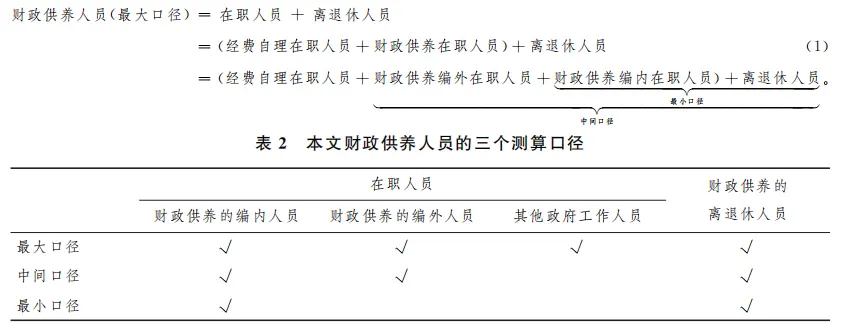
This research is based on official statistical data from multiple sources and gives three statistical calibers.
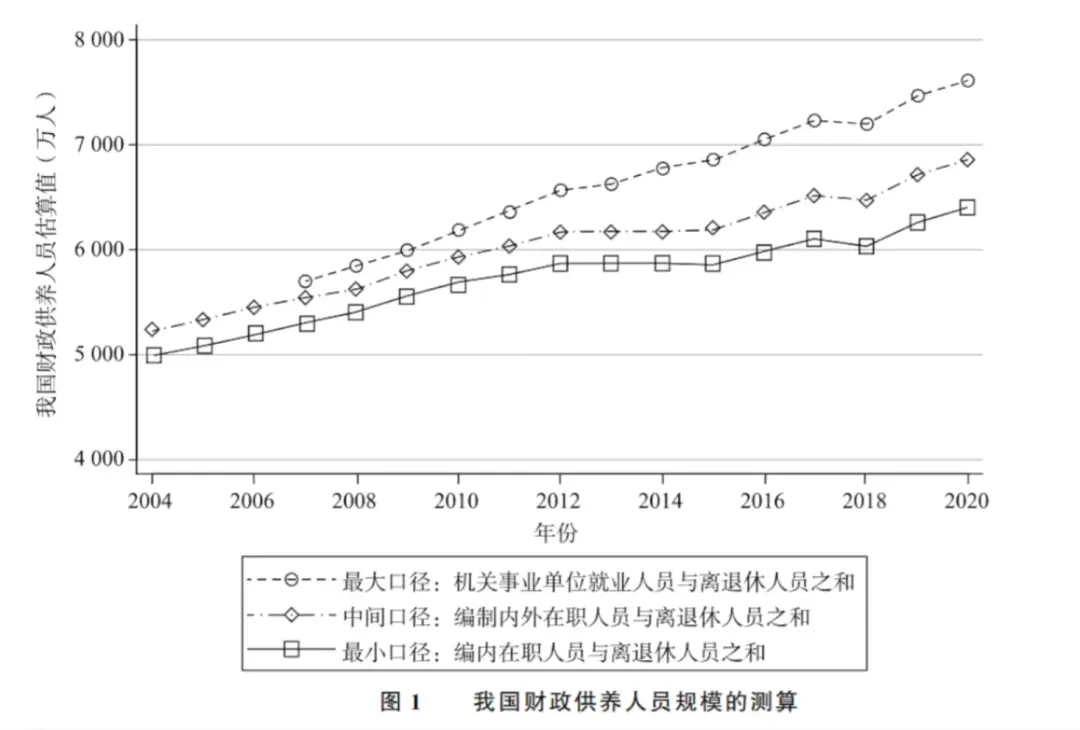
The largest caliber includes retirees and non-establishment auxiliary personnel, with an estimated value of 76.06 million.
The middle caliber is the sum of in-service personnel inside and outside the establishment and retirees, with a total of about 68.46 million.
The smallest caliber only counts in-service personnel inside the establishment and retirees, with an estimated value of 63.85 million.
However, this data can only be counted until 2020, and the data after that cannot be counted because it is incomplete.
However, we can still see some trends from this research report.
The first trend: more and more people, and the structure is becoming more and more "strange."
Although it is said that the establishment "only decreases and does not increase," this year's government work report also emphasizes the need to "strictly control the scale of financially supported personnel."
But in fact, this growth trend has not been truly stopped.
From 2004 to 2020, the financially supported personnel (middle caliber) increased from 52.12 million to 68.46 million, with an average increase of more than 1 million people per year.
By 2020, almost 5 out of every 100 Chinese people are supported by the financial budget.
This means that more and more labor force is flowing into government agencies and public institutions.
Why is this happening?
On the one hand, there are more retirees, and on the other hand, it is a typical "there are policies above, and countermeasures below."
Let's look at retirees first.
In 2020, nearly 40% of those who eat from the public purse are no longer in their posts.
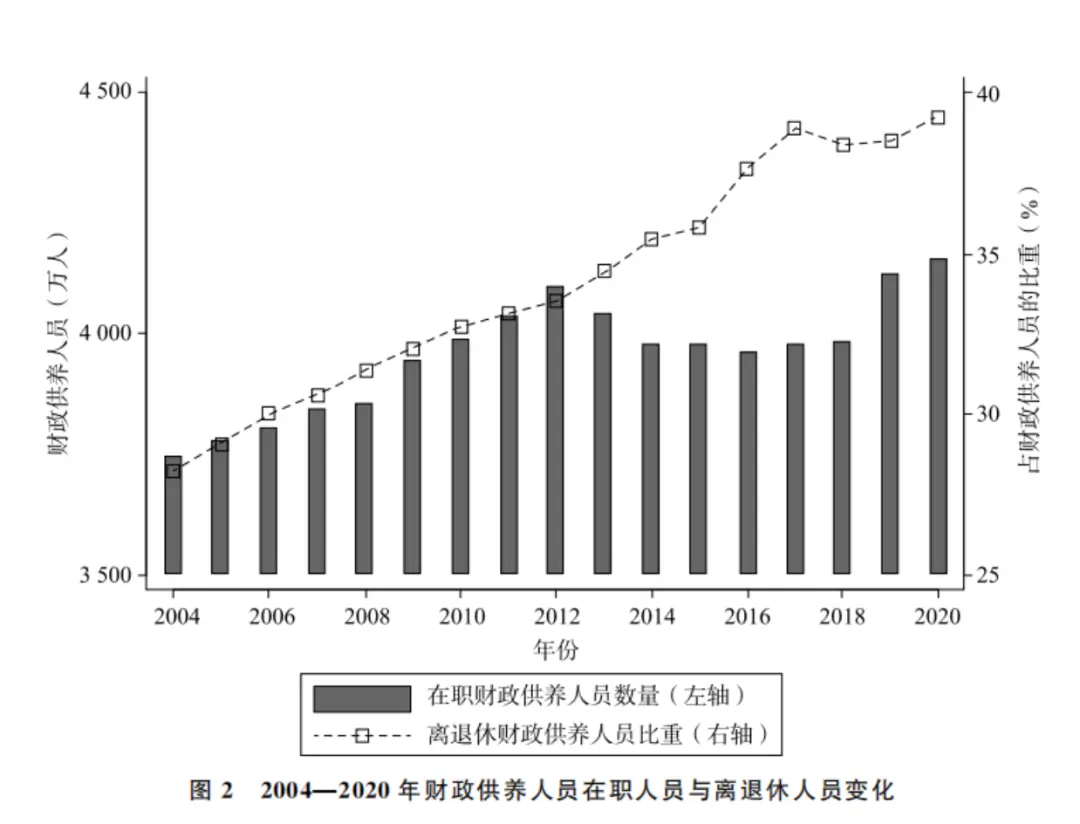
The number of retirees increased from 14.68 million in 2004 to 26.87 million. Moreover, the average pension of government agencies and public institutions in 2022 is close to 6,000 yuan, which is twice that of enterprise retirees.
With the aging population, this expenditure will only become heavier and heavier.
Let's look at "countermeasures."
For a long time, the focus of reform has been to strictly control the "establishment," but what is the result?
The "front door" of the establishment is closed, but the "back door" outside the establishment is opening wider and wider.
In 2004, there were only 2.15 million non-establishment personnel in the country, and by 2018, it had soared to 4.42 million, more than doubled. These people do not occupy an establishment, but their salaries still have to be paid by the treasury.
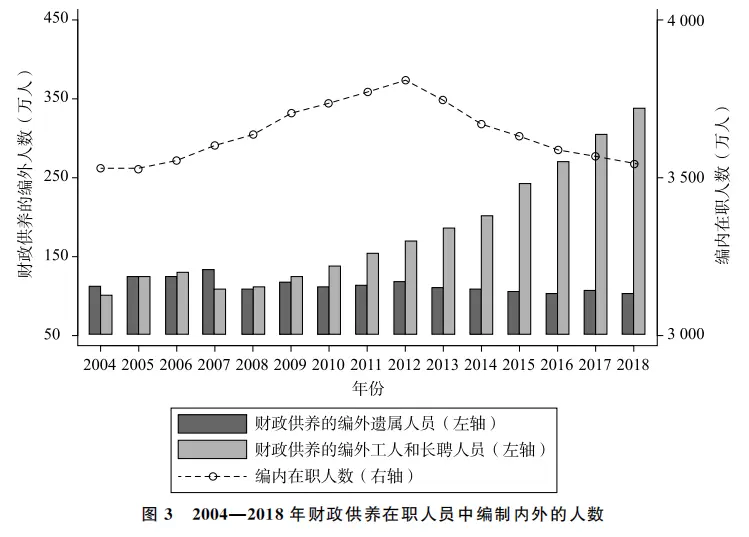
This practice is actually just moving the problem from the left pocket to the right pocket.
The second trend: people are all at the grassroots level, forming a huge "pyramid."
Where are so many people?
The answer is - most of them are at the grassroots level.
Research shows that the distribution of financially supported personnel at the provincial, municipal, and county levels is more and more like a pyramid.
Taking the finance and taxation system as an example, more than 70% of the personnel are crowded in the county-level units at the bottom.
This shows that the institutional reform in recent years has been "tight above and loose below," and the more grassroots, the more people.
This also reveals several problems.
First of all, the poorer the place, the more people who eat from the public purse.
Many small-population counties have already seriously imbalanced financial situations.
Last year's report by "Half-Month Talk" about County A in the Wumeng Mountains is a vivid example: the annual tax revenue is only 414 million yuan, but it costs 2.6 billion yuan just to pay the salaries of personnel within the system, which is more than 6 times the tax revenue!
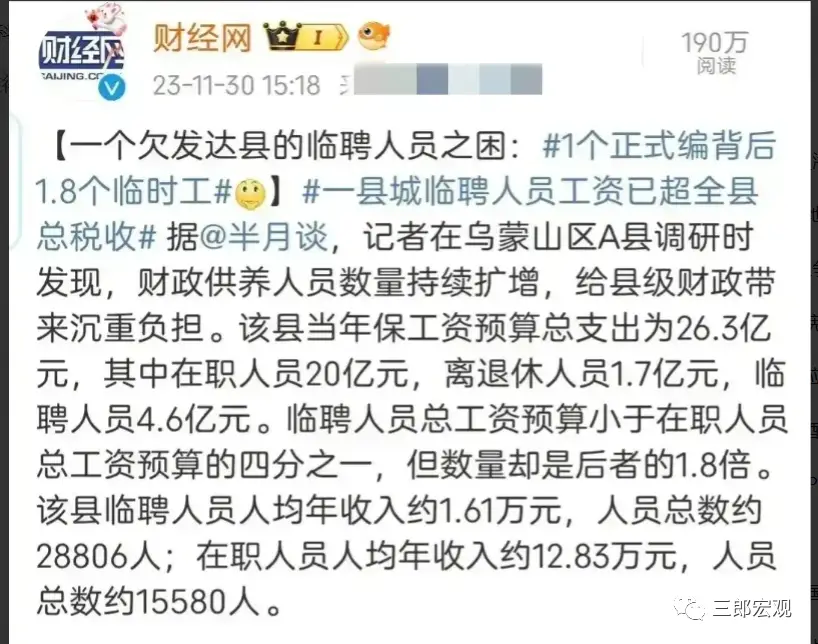
Where does the money come from? Relying on the central government's "blood transfusion."
In 2023, the central government's "transfer payments" to local governments exceeded 10 trillion yuan for the first time.
In 22 of the 31 provinces in the country, more than half of their income relies on central subsidies, and in provinces like Tibet and Qinghai, it even exceeds 70%.
This reveals two cruel realities:
On the one hand, a considerable number of economically underdeveloped areas do not have their own financial resources and basically rely on the central government's blood transfusion to maintain operations.
On the other hand, although the bulk still relies on financial transfer payments to maintain, the problem is that transfer payments are not to say how much the gap below is, the above will give how much, nor is it specifically used to pay salaries within the grassroots system, the gap in the middle still needs to be filled by the county itself.
In the current situation where land finance is unsustainable, the pressure on local governments to fill the gap is increasing, and the pressure on the above to maintain the existing scale of transfer payments is increasing.
This can also be linked to the recent investigation by the National Audit Office, which found that 66 counties had misappropriated student meal subsidies, and many regions are figuring out how to obtain more income, and various bizarre things caused by local government "revenue generation" are also emerging.
These are not isolated cases, but rather a microcosm of the general situation.
Writing here, I seem to not know what to say anymore,
Then let's give you another basic common sense:
That is, the government does not create wealth, wealth is created by the people themselves.
Civil servants do not actually produce wealth, their responsibility is to distribute wealth, to maintain the operation of the machine. To give an example, they can be the coolant, oil, brakes, and gearbox of a car, but they are not the engine and gasoline of the car.
Of course, these parts are indispensable for a car, but if the car wants to run, it still has to rely on the engine and gasoline.