

Shenzhen, as the locomotive of the country's largest economic province, the city with the largest exports in the country, and the capital of high-tech industries, has seen its economy suddenly decelerate in 2025.
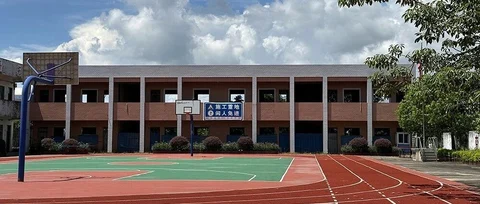
First, let's look at a piece of online news. As shown in the figure below, the salaries of teachers in public schools in Luohu District, Shenzhen, are about to be delayed in May. I heard more than a year ago that the finance of a certain district in Shenzhen borrowed money from other districts for emergency purposes, so I believe this news should be credible.

This situation reflects that, under the current circumstances, even Shenzhen, a first-tier city, is facing financial difficulties, and some districts and units are already struggling to make ends meet.
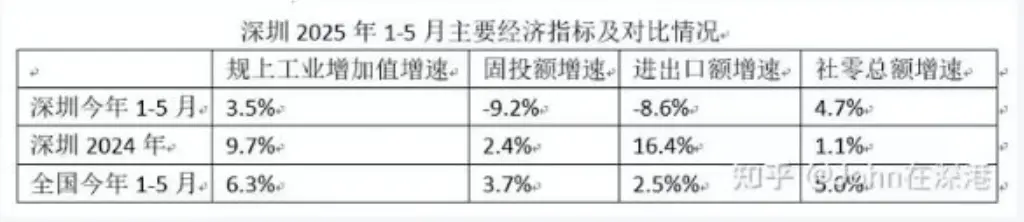
Let's go back to Shenzhen's latest economic data from the micro perspective. The following figure shows the four main economic indicators for Shenzhen from January to May.
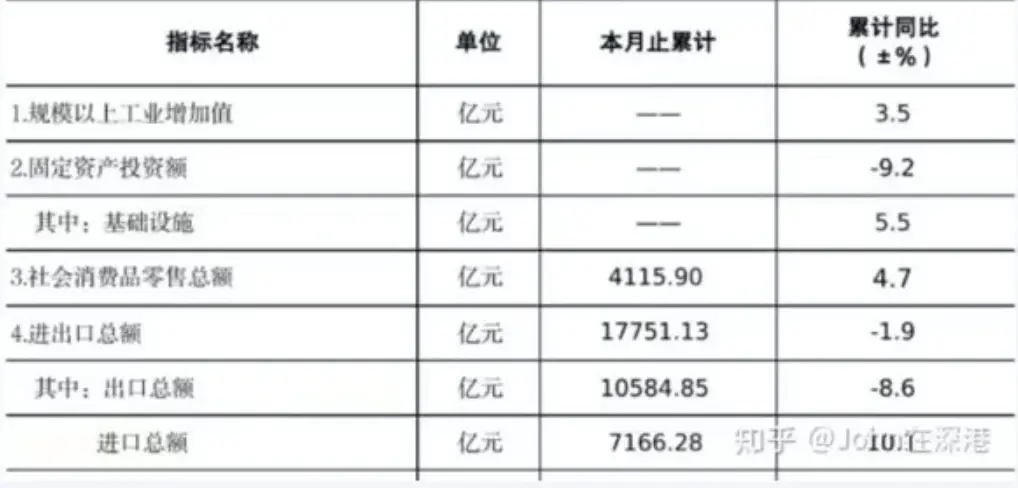
The first indicator, the added value of industrial enterprises above designated size, as the core indicator of the added value of the secondary industry, its year-on-year growth rate is only 3.5%, significantly lower than the national average, and 6.2 percentage points lower than the growth rate for the whole year last year.
The next indicator, fixed asset investment, has plummeted by 9.2% year-on-year, while the growth rate for the whole year last year was still 2.4%, which is nearly 13 percentage points lower than the national average.
Then, the total import and export volume fell sharply by 8.6% year-on-year... Although, as everyone knows, the tariff war is the main reason, and Shenzhen, as the city with the largest export scale, has been hit the hardest in the tariff war.
The last indicator, the total retail sales of social consumer goods, is the only passable indicator, benefiting from national subsidies, the growth rate has increased significantly compared to last year, but it is 0.3 percentage points lower than the national level.
Next, let's delve deeper into the details behind the indicators.
First, let's talk about fixed asset investment. For many years, Shenzhen has been known for its strong financial strength, with a steady stream of tax revenue from the real economy, and soaring real estate prices, resulting in a large income from land sales. With money, the government can naturally carry out large-scale construction. Even if a road looks pretty good, it is still demolished and rebuilt, so there is a joke online that Shenzhen has a specialty called "Dang Dang Dang". Therefore, government infrastructure investment plus investment from real estate developers has always pushed Shenzhen's fixed investment figures very high, and the growth rate is far ahead in Guangdong Province.
But last year, the situation began to change. The growth rate for the whole year last year dropped to only 2.4%, and this year's investment data directly showed negative growth. In the first quarter of this year, fixed asset investment decreased by 2.1%, worsened to a decrease of 8.5% from January to April, and continued to worsen to a decrease of 9.2% from January to May. The trend is getting worse month by month.
By analyzing the statistical monthly reports, it can be seen that in fixed investment, from January to April: investment in state-owned economy decreased by 14.2%, which is even more severe than the decline in private investment. In the first half of 2024, investment in state-owned economy once reached double-digit growth, offsetting the negative growth of private investment, thereby maintaining the positive growth of total investment for the whole year.
Why did investment in state-owned economy suddenly collapse this year? Obviously, it is related to the lack of money in Shenzhen's state-owned assets system and the negative growth of Shenzhen's finance. This to some extent confirms the news at the beginning about the inability of public schools to pay salaries.
Another example that many people know is that in the first half of this year, in order to save Vanke, Shenzhen's state-owned assets have injected a total of 21.1 billion yuan into Vanke through Shenzhen Metro Group. In other words, the money of state-owned assets was forced to be used to repay debts and resolve debts, and it could not take care of new project investment and construction.
Then look at the industry. Shenzhen has always had strong industrial strength, driven by high-tech industries, not only with a fast growth rate but also with good efficiency. But this year, the industrial growth rate has declined sharply, and the economic benefits have also declined, with a large number of enterprises suffering losses.
The statistical monthly report shows that the total industrial profit from January to April decreased by 4.3% year-on-year, and the loss-making rate of enterprises reached 39.5%, an increase of 1.2 percentage points year-on-year. This loss-making rate is already relatively close to the situation of nearly half of the listed companies suffering losses in 2024, but I believe that the actual loss-making rate should exceed that of listed companies, that is, at least half of the industrial enterprises should be suffering losses.
The specific reasons are, first of all, of course, the decline in exports leading to a lack of orders for industrial enterprises, which in turn leads to losses for enterprises; another reason, I believe, is the recent hot topic of "involution".
In the past few years, Shenzhen's industrial growth rate has always been in double digits, with the rapid rise of new energy products represented by piles, lithium batteries, and photovoltaic devices, and the sales were hot. This year, the situation has reversed, and the new energy field has become a red sea market, with severe overcapacity and a large number of companies suffering losses, so Shenzhen's industrial data has suffered as a result.
In line with the industrial slowdown is the sharp decline in freight volume data. From January to April, Shenzhen's freight volume fell by 8.6%, of which the railway freight volume fell by 18.9% and the waterway freight volume fell by 12.7%.
Let's look at imports and exports. In the first quarter of this year, the city's export volume decreased by 8.7%; from January to April, exports decreased by 7.0%; and from January to May, exports decreased by 8.6%. I believe that exports are largely due to the impact of US tariffs. Trump has repeatedly imposed additional tariffs on China and canceled the tax exemption policy for small parcels from February to April, which has had an immediate impact on Shenzhen, as the city with the largest exports and the capital of cross-border e-commerce.
From the data from January to April, from the perspective of the main body of exports, the exports of private enterprises decreased by 11.7%, and the exports of foreign-funded enterprises increased by 3.0%; from the perspective of export regions, exports to the United States decreased by 12.5%, exports to ASEAN decreased by 14.2% (mainly through re-exporting through Vietnam and other countries), and exports to the European Union increased by 2.2%. These data obviously confirm the impact of tariffs.
Finally, there is consumption. Because of the large population size, mainly consisting of migrant workers, Shenzhen has always had weak consumption. In the past two years, even though a large number of Hong Kong people have come over for cross-border consumption, after pulling the data for one or two years, the increase has not been much. This year, it mainly benefits from national subsidies, which is similar to the situation across the country. The total retail sales of social consumer goods includes two major categories: catering and commodity retail. Catering does not have national subsidy policies, so the growth rate from January to April was only 1.2%.
At the beginning of this year, Shenzhen set a GDP growth target of 5.5% for 2025, which is higher than the national target of 5%. I believe the original intention was to contribute to the national economic growth, but the decision-making officials in Shenzhen did not expect the situation to reverse so quickly. This year, Shenzhen's economy is likely to drag down the country.
Behind the data, it is related to millions or even tens of millions of ordinary workers, related to whether their jobs can be preserved, whether their salaries can be paid normally, and whether countless families can continue to live peacefully? The situation is severe, and I hope Shenzhen can hold on.