
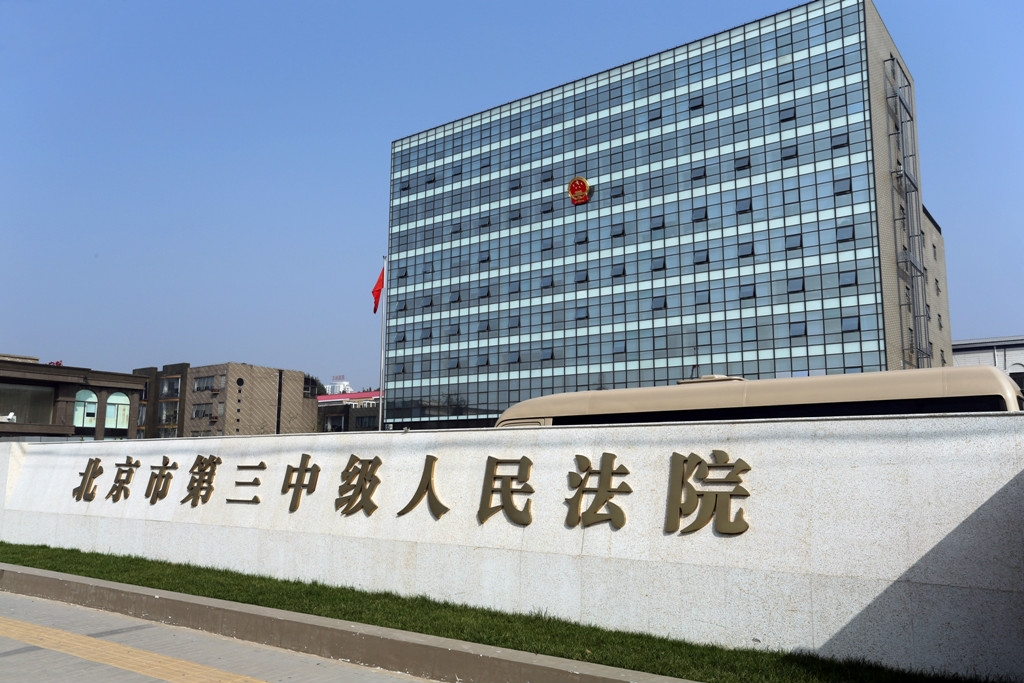
Just after the “May Day” holiday in 2025, a shocking piece of news circulated within Beijing’s legal circles: “A major scandal has emerged from the Beijing No. 3 Intermediate Court, where an executive assistant judge embezzled hundreds of millions of yuan in execution funds and fled to Japan.”
Caixin learned that before “May Day,” a judge from the Beijing No. 3 Intermediate Court (hereinafter referred to as “Beijing No. 3 Intermediate Court”) did indeed flee the country. This person’s name is Bai Bin, a native of Xinzhou, Shanxi, born in the 1990s. In the summer of 2014, he joined the Enforcement Bureau of the Beijing No. 3 Intermediate Court and was an executive assistant judge before the incident.
Bai Bin studied law at a university in Beijing and was considered a relatively outstanding student during his university years. On July 17, 2014, the dean of the law school at the time, in his speech at the 2014 graduation ceremony, besides commending eight doctoral students and 71 master’s students, specifically mentioned that the performance of this year’s undergraduate students was particularly excellent, with a postgraduate admission rate of 50% and a passing rate of the judicial examination of over 40%, far exceeding the national average of 18%. “The units of the classmates who went directly to work are also very good… Bai Bin went to the newly established No. 3 Intermediate Court. With such training achievements, I, as the dean, am really happy.”
The speech, titled “Afraid You Can’t Help But Be Proud,” was published on the websites of the law school and the China Law Society. After the incident, the article on the China Law Society’s website is still there, but the sentence “Bai Bin went to the newly established No. 3 Intermediate Court” has been removed. Information about Bai Bin is currently unavailable on the website of the Beijing No. 3 Intermediate Court.
The aforementioned well-informed source said that at the beginning of the year, Bai Bin submitted his resignation to the Beijing No. 3 Intermediate Court, but it had not been approved before the incident. Bai Bin had prepared for his escape long ago, not only transferring all the money abroad but also obtaining Greek citizenship. The incident occurred because his girlfriend bragged to her best friend, and the privacy was leaked, leading to a report. After Bai Bin found out, he fled to Japan with his whole family before “May Day,” and their current whereabouts are unknown.
Regarding the amount involved, there are several versions circulating, some saying 130 million yuan, others saying around 200 million yuan, and some even saying close to 300 million yuan.
Multiple interviewees stated that the large sum of money transferred abroad by Bai Bin came from the execution funds of one or more illegal fundraising fraud cases.
Execution funds refer to the funds (or property) involved in a case that the parties apply to the court for execution based on an effective legal document. This includes compensation, property, liquidated damages, repayment of loans, litigation fees, appraisal fees, and other expenses.
Because the person subject to execution needs to pay the execution funds to the court, the court transfers them to the winning party on their behalf. However, there are no uniform rules for the management of execution funds, and courts at all levels basically collect execution funds by establishing execution fund accounts. The situation of intentionally or unintentionally delaying the payment of execution funds (or property) often occurs.
In the summer of 2005, the Tianjin Maritime Court experienced a major case of financial personnel embezzling and embezzling over 120 million yuan in execution funds (see Caixin.com’s “The Case Within the Cheng Wei Case” and “The Cheng Wei Case Opens”). The occurrence of the Cheng Wei case exposed the internal loss of control and the failure of supervision within the Tianjin Maritime Court, and also highlighted the lack of a management system for court execution funds.
In June 2006, the Supreme People’s Court issued the “Provisions on the Management of Execution Funds and Property (Trial Implementation)” (hereinafter referred to as the “Trial Provisions”), requiring courts at all levels to open special accounts for execution funds, to manage execution funds specifically and pay them specifically. The execution institutions and financial departments are responsible for the management of execution funds and property, with division of labor, cooperation, and mutual supervision.
The “Trial Provisions” require that the court’s financial department register each case’s execution fund receipts and payments and establish detailed accounts; the case handler
registers the execution fund transactions of each execution case and files them.
Subsequently, the Supreme People’s Court revised the “Trial Provisions,” and on May 1, 2017, the revised “Provisions on the Management of Execution Funds and Property” (hereinafter referred to as the “Provisions”) was officially implemented.
In addition to reiterating the court’s execution funds being accounted for on a case-by-case basis and paid specifically, the “Provisions” also require monthly reconciliation. It adds that “the execution notice or relevant legal documents must specify the name, account number, and account holder of the court’s execution fund special account or case fund special account, and when making payments, the execution case number, the name of the person subject to execution, the name of the payer, and the purpose of the payment should be noted.”
The “Provisions” also changed the original “If court execution personnel directly receive cash or bills, there must be no less than two execution personnel present” to “Execution personnel should, in principle, not directly receive cash and bills; if it is indeed necessary to receive them directly, there should be no less than two execution personnel present, immediately issue a receipt to the payer, and at the same time make a receipt record, which should be signed by the payer and the personnel present,” etc.
The revised “Provisions” seem complete, but in practice, Bai Bin still exploited loopholes, leading to a major case. A former judge who had worked in the Beijing court execution system for many years said that after the case was concluded, the applicant applied to the court for execution, and the execution judge, with the court’s execution notice, either went to the bank of the person subject to execution to freeze the account for execution or went to the public security to seize the account for execution.
The “Provisions” require a double-person, double-certificate system for applying for execution, but the execution bureaus of the courts have always been understaffed, and single-person execution situations sometimes occur. “As long as the executor holds the judge’s certificate and the execution notice, the bank usually allows it. The person subject to execution and the applicant have a litigation relationship and generally will not actively inform the applicant that the property has been executed, and the law does not stipulate that the execution funds must be transferred to the applicant’s account, and the applicant must be present.”
“In addition, in the past, the execution notice had to be approved and signed by the leader, and when the execution funds were transferred, the financial personnel also needed to stamp and approve. If the execution personnel had ulterior motives, they needed to forge the leader’s approval signature and forge the official seal of the unit. Now, everything is digitized, and the execution notices are all color printouts, which can be printed anywhere.”
According to well-informed sources, Bai Bin had been in the Execution Bureau for ten years, and although he was an assistant execution judge, in reality, many administrative assistants had more power than judges.
Multiple sources said that Bai Bin discovered the above-mentioned loopholes during the execution and transferred execution funds to his privately set-up accounts by uploading execution orders online.
“It’s never too late to mend the fold after the sheep are lost.” After the Bai Bin incident, Zhu Ping, who was then the Standing Committee member of the Beijing Xicheng District Committee, Secretary of the Discipline Inspection Commission, and Director of the Supervision Commission, “parachuted” into the Beijing No. 3 Intermediate Court at the end of May 2025 and officially took office as the vice president on the 30th.
Public information shows that Zhu Ping is currently 51 years old (born in October 1975), a native of Wuhan, Hubei, and started working in July 2000. He holds a doctorate in criminal law from the School of Criminal Justice, China University of Political Science and Law. He has long been engaged in discipline inspection and supervision work, and has served as the deputy director of the Trial Office of the Beijing Discipline Inspection Commission, the deputy head of the Discipline Inspection Team of the Municipal Finance Bureau, the director of the Twelfth Investigation Office of the Beijing Discipline Inspection Commission and Supervision Commission, the Standing Committee member of the Changping District Committee, Secretary of the Discipline Inspection Commission, and Director of the Supervision Commission, and the Standing Committee member of the Xicheng District Committee, Secretary of the Discipline Inspection Commission, and Director of the Supervision Commission.
Sources said that Zhu Ping had been very effective during his tenure in Xicheng and was intended to be promoted to a key position, and the internal discussion had been passed and was about to be announced to the public; unexpectedly, the Bai Bin incident occurred, which seemed to be a “crisis appointment.”
On the same day that Zhu Ping was elected as the vice president of the Beijing No. 3 Intermediate Court, the website of the Beijing Discipline Inspection Commission and Supervision Commission announced that Zhang Meixin, the former vice president of the Beijing No. 3 Intermediate Court, was suspected of serious violations of discipline and law and was being investigated by the Beijing Discipline Inspection Commission and Supervision Commission. It is worth noting that he had also served in the court’s execution position.
Public information shows that 64-year-old Zhang Meixin (born in April 1961) is a native of Beijing and started working in December 1979. He has a college degree (majoring in law from Beijing Broadcasting and Television University) and has long worked in the judicial system. He has served as the deputy head of the Guangwai Tribunal of the former Xuanwu Court, the deputy head of the Economic Tribunal, a deputy-level judge, a member of the Party Group of the Xuanwu Court, the head of the Discipline Inspection Team, the director of the Political Department, a member of the Adjudication Committee, a member of the Party Group, and the vice president, the director of the Office of the Beijing High Court, and a judge. In September 2009, the Execution Tribunal of the Beijing High Court was changed to the Execution Bureau, and Zhang Meixin became the first director of the Execution Bureau and served as a member of the Adjudication Committee of the Beijing High Court, clearly at the deputy bureau level;
In September 2015, he served as a member of the Party Group and vice president of the Beijing No. 3 Intermediate Court until he retired at the age limit.
According to public information, it was during Zhang Meixin’s tenure as the director of the Execution Bureau of the Beijing High Court that the “Beijing Execution Work Standards” was issued;
In addition, he also participated in the live broadcast of the China Court Network to introduce relevant work situations.
The news of Zhang Meixin’s investigation was announced after the Bai Bin incident, and there is no further information on whether there is any connection between the two.
Discover more from 自由档案馆
Subscribe to get the latest posts sent to your email.