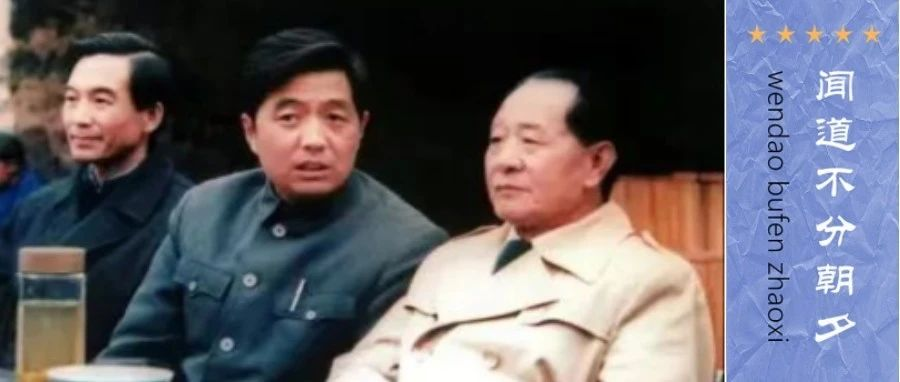
Hu Yaobang’s son, Hu Dehua, unfortunately passed away on the evening of March 30, 2025, at the age of 77. In the circle of friends, people expressed their condolences, but we know that commemorating Hu Dehua is actually because of gratitude towards Hu Yaobang.
Starting in 1981, Hu Yaobang presided over the rehabilitation of over 3 million unjust, false, and wrong cases, clearing the names of 550,000 “problematic individuals.” The victims of these cases finally got rid of their discriminated status and gained equal opportunities for education and employment.
The rehabilitation of unjust, false, and wrong cases was not solely due to his individual efforts, but it is an undeniable fact that he contributed the most, showed the most courage, had the most resolute attitude, and made the fairest judgments.
It’s hard to imagine how long many people would have had to endure humiliation and oppression without Hu Yaobang. As a leader during that special historical period, Hu Yaobang’s historical merits and demerits will be judged by future generations. He was not a perfect person or a saint, but he was a good person and a true person. “Living in people’s hearts means eternal life.”
Now, I am reprinting a short article to commemorate the Hu father and son.
CDT Archive Card
When I have nothing to do, I often chat with friends.
The topics of conversation are naturally many, covering all corners of the world, but most of them are related to anecdotes of celebrities. Once, I asked a friend: Do you still remember Yaobang?
Somewhat unexpectedly, he asked me back: Who is Yaobang?
I was speechless for a moment, not knowing what to say. But after thinking carefully, I don’t find it strange. After all, not many young people since the 1990s can still remember him.
History is constantly moving forward.
But some people, some things, are always remembered. Hu Yaobang made two groundbreaking contributions to China’s reform. The first was the discussion on the standard of truth, and the second was the rehabilitation of unjust, false, and wrong cases. Later generations mostly evaluate Hu Yaobang’s main achievements as: first, he liberated thought, and second, he liberated people. And the people whose thoughts and bodies were liberated eventually became the main body of the reform.
Of course, accomplishing these two major events was not the work of Hu Yaobang alone, but it is an undeniable fact that he contributed the most, bore the most risks, and was the most courageous and resolute.
While “rehabilitating unjust, false, and wrong cases,” Hu Yaobang also quietly abolished the “five categories of people” and other marginalized classes. It was estimated that there were hundreds of millions of people in China, including the “five categories of people” and their children. Hu Yaobang’s achievement is no less than Lincoln’s emancipation of black slaves.
In this great transformation in China, Hu Yaobang was a tragic hero. And the traces of a tragic hero in history are undoubtedly more profound.
Some people are dead, but they are still alive. The following data left by Hu Yaobang will be forever remembered by history: In 1978, he corrected 450,000 “rightists,” restored the public positions of 270,000 of them who had lost their jobs, and arranged for them to work or live again. At the same time, policies were implemented for the 315,000 people who were classified as “middle-rightists” and “anti-socialist elements” and their relatives.
The “four categories of people” (landlords, rich peasants, counter-revolutionaries, and bad elements) after the “land reform” were all stripped of their hats, and their children were no longer considered to be from landlord, rich peasant, counter-revolutionary, or bad element families. This meant that tens of millions of citizens across the country and their hundreds of millions of relatives were no longer “outcasts.” In rural areas alone, more than 4.4 million people had their landlord and rich peasant hats removed.
The “workers” status was restored for 710,000 small merchants, vendors, and small handicraft workers, who were no longer considered bourgeois industrialists and businessmen.
The confiscated savings of capitalists were returned, and the deducted salaries were restored and paid, and the occupied private houses were returned. The original industrialists and businessmen were treated the same as cadres and workers politically.
Policies were implemented for 400,000 KMT uprising personnel and defectors, and KMT county and regiment-level party, government, military, and special personnel were released with leniency, and policies were implemented for the mainland families of those who went to Taiwan.
The “Sixty-One Traitor Group Case” was exonerated, the hats of Ulanfu, the “Inner Mongolian People’s Party,” and other “local nationalist elements” were removed, and the Tibetan leaders Cuike·Dondrub Tsering, Sampo Tsewang Rigzin, Jamyangling Tenzin Gyatso, and Banda Dorje were rehabilitated. The 1959 Tibetan “participating in rebellion” personnel were leniently handled, their civil rights were restored, and they were not discriminated against politically.
A review was organized for the 10,402 people who were sentenced to death for “counter-revolutionary crimes” during the “Cultural Revolution,” as well as those who were executed for other serious cases. It was found that there were quite serious cases of wrongful killings, and corrections, revisions, and rehabilitations were carried out.
According to incomplete statistics, from 1978 to the end of 1982, a total of over 3 million cadres’ unjust, false, and wrong cases were rehabilitated nationwide, and over 470,000 Communist Party members had their party membership restored, and tens of millions of innocent cadres and masses were liberated.
Such a large-scale rectification and rehabilitation of unjust, false, and wrong cases, along with the historical reconciliation with all sectors of society, almost rebuilt the social foundation of the country. This momentum, this atmosphere, like the thawing of spring, turned the ice and snow accumulated since 1949 into spring water.
Among these astonishing numbers, some people questioned that Hu Yaobang corrected too much. In response, Hu Yaobang immediately asked: Why didn’t you think it was too much when you arrested them in the first place?
The late senior Xinhua News Agency reporter Dai Huang wrote:
In 1994, Du Daozheng, the president of the magazine “Yanhuang Chunqiu,” asked me to write about Hu Yaobang, and he had already thought of the title, which was “Hu Yaobang and the Rehabilitation of Unjust, False, and Wrong Cases.” I readily agreed.
In November 1995, on the occasion of Yaobang’s eightieth birthday, “Yanhuang Chunqiu” published a part of what I wrote, and then dozens of newspapers such as “Southern Weekend” also reprinted it.
But it was very difficult to publish a book. The first to sign a contract with me to publish the book was the People’s Publishing House. As a result, after they had basically edited the manuscript, they canceled the contract themselves. Later, the president of the Central Party School Press and an editor also came to me, and I gave them the manuscript. They finished editing the hundreds of thousands of words in three days, but later the president of the publishing house told me: It cannot be published for the time being, and my manuscript should be kept there, and so on. When will it be? So I went to the Central Party School Press to get the manuscript back, and they were very reluctant to give it back.
The manuscript was then sent to the Xinhua Publishing House. Sun Weixi, a retired female comrade who helped in this publishing house, asked Feng Jian, the retired former deputy director of Xinhua News Agency, to read it. Feng Jian read it overnight, was overjoyed, and said it was very good, and suggested that the leaders of Xinhua Publishing House publish it quickly.
In this situation, Mr. Xu Simin, the founder of Hong Kong’s Mirror News and a member of the National Committee of the Chinese People’s Political Consultative Conference, learned about my manuscript through some channel. He came to Beijing in the spring of 1997 to attend the National Committee of the Chinese People’s Political Consultative Conference and stayed in the VIP building on the west side of the Beijing Hotel. He called me and asked if I was willing to give him the manuscript so that he could take it to Hong Kong for publication. Of course, I was willing.
The first edition was published in September of that year, and the internal bookstore of the Beijing Xinhua Bookstore also sold it. The price of the book was HK$88, and when it was sold internally in mainland China, it was more than 150 yuan, and it was also snapped up.
In any case, Hu Yaobang is a figure that cannot be avoided in contemporary Chinese history. And “Hu Yaobang and the Rehabilitation of Unjust, False, and Wrong Cases” truly records a magnificent and thrilling section in the process of contemporary Chinese history, and it vividly reproduces the most unforgettable and touching years of Hu Yaobang’s life.
Discover more from 自由档案馆
Subscribe to get the latest posts sent to your email.