With spring plowing imminent, Li Jidong, a farmer in Nuomizhuang Village, Luanzhou City, Hebei Province, is unable to turn over his land. In his 70 mu of farmland, there are scattered pieces of broken plastic film that have drifted from outside the farm, covering the farmland like residual snow, or entangled in dead branches and straw. The plastic film even drifted into Lao Li’s cattle shed.
Lao Li can only take a few workers to pick up the plastic film fragments in the cattle shed. “This film is light and broken, like ultra-thin, substandard film.”
If not treated, the plastic film will mix with the soil during the plowing process, which will not only affect the growth of this crop, but also will never be recycled and difficult to decompose. It can only slowly break into plastic fragments in the soil, or even be absorbed by crops in the form of microplastics.
How could Lao Li, who doesn’t use plastic film, become a victim of plastic film pollution? It turned out that since December 25th of last year, a temporary processing plant was built 100 meters away from his field. This small factory, which occupies only a few dozen square meters, purchases a large amount of peanut stalks from surrounding farmers, then crushes them and processes them into coarse feed for livestock. Because the plastic film was not removed when the peanut stalks were purchased, the plastic film was entangled with the peanut stalks and fed into the machine together. The crushed plastic film drifted to the surrounding farmland with the wind, including Lao Li’s land.
This processing plant was only temporarily built after the peanut harvest, and the place where it was built was originally the basic farmland of the village. Due to the simple conditions, there were no additional protective measures at the processing site, resulting in the plastic film scattering everywhere.
On January 1, 2025, Lao Li called the 12345 mayor’s hotline to report the pollution problem. After that, he also submitted written explanations to the local street office, the Ecological Environment Bureau, the Agriculture and Rural Affairs Bureau, and other departments to reflect the situation.
More than two months have passed since the incident. The season for sowing spring wheat is coming soon, and Lao Li also plans to plant vegetables such as peas, garlic, rapeseed, and Chinese cabbage at the same time, which will become the main source of his annual income after they mature. But the plastic film in the land has prevented him from sowing for a long time, and he is about to miss the sowing season and delay his annual income.
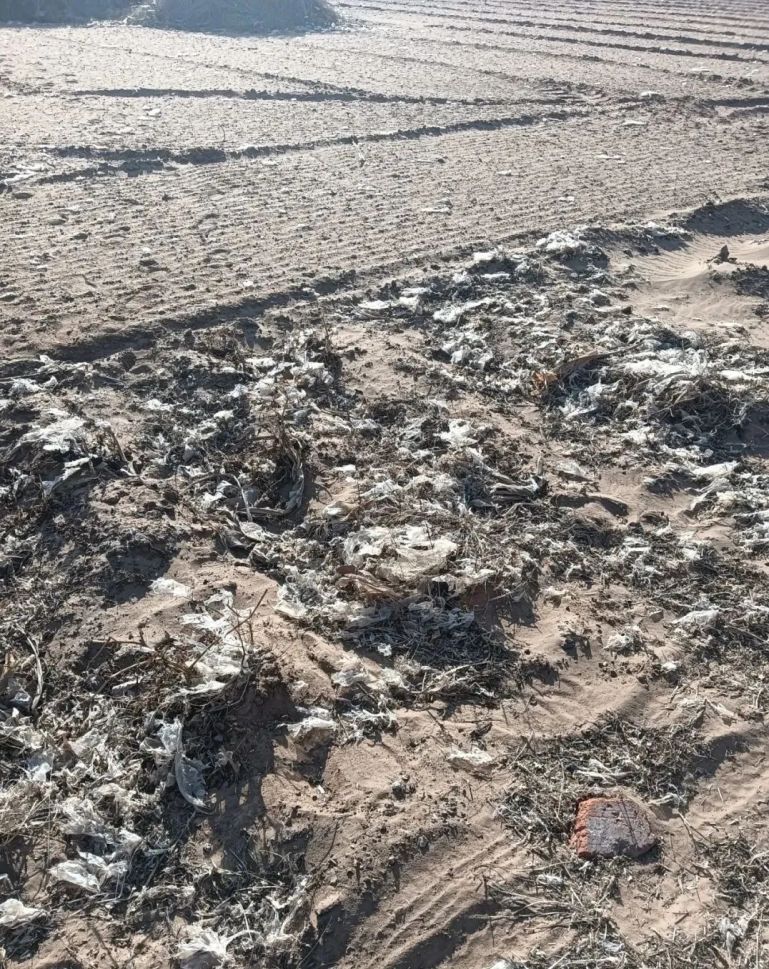
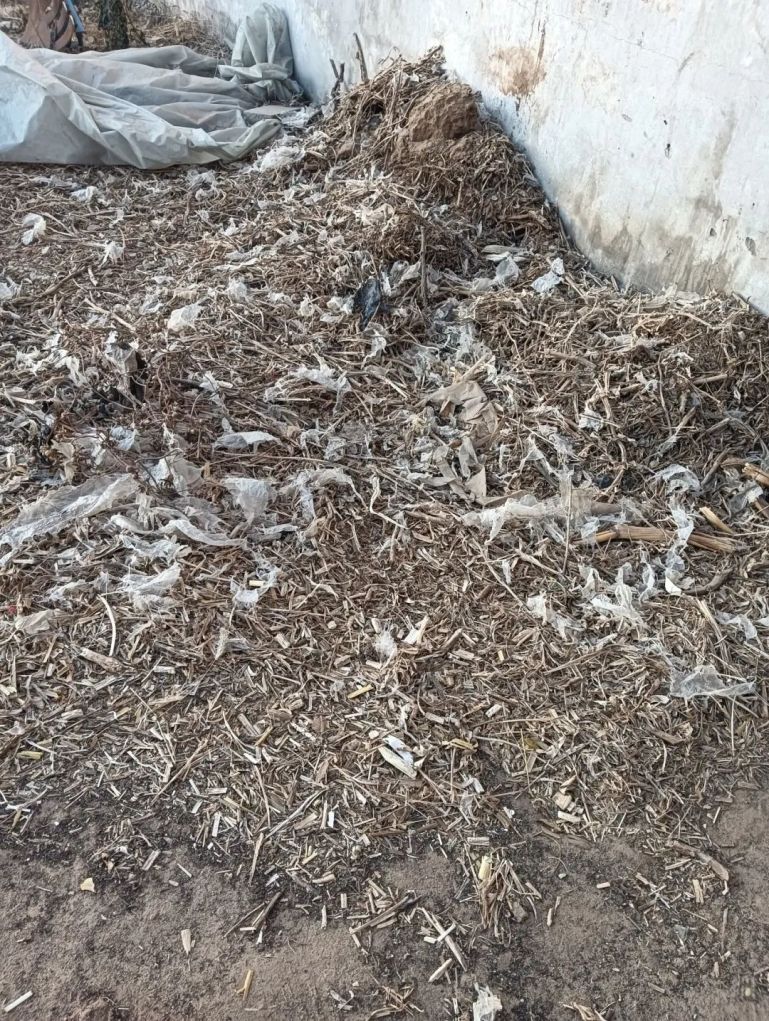
● The broken plastic film covers and permeates Lao Li’s land like residual snow, which is very labor-intensive to pick up and difficult to clean.
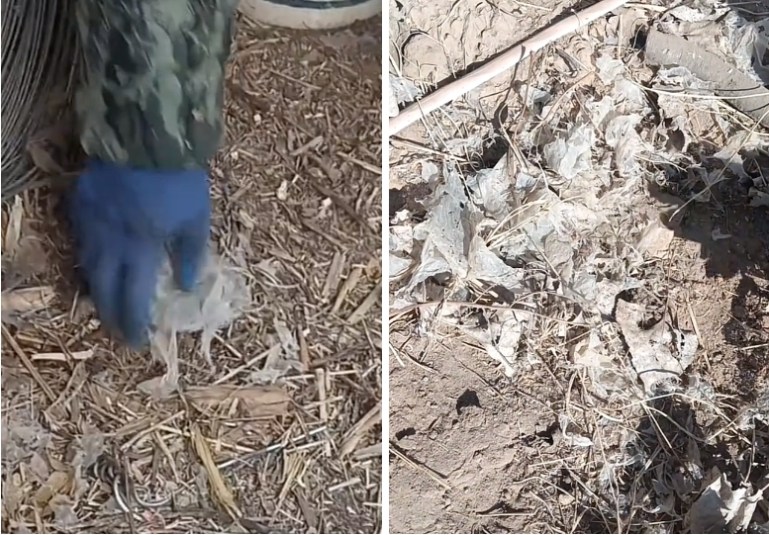
● Lao Li and the workers are cleaning up the plastic film fragments in the cattle shed.
Lao Li used to be an agricultural materials dealer and has seen the harm of pesticides, fertilizers, and plastic film to people and land. Fifteen years ago, he transferred farmland in his hometown of Nuomizhuang Village and used ecological agriculture methods, without pesticides, fertilizers, and herbicides, to grow grains and vegetables. These 70 mu of farmland are a piece of pure land that he has worked hard to protect for many years. For this reason, he is deeply distressed by the plastic film pollution that many farmers take for granted.
The processing plant refuses to take measures, so Lao Li can only pay out of his own pocket and give 2,000 yuan to the village secretary to transfer to the other party. Then the other party did a simple cover on the edge of Lao Li’s farmland. The processing plant also promised to pay for the village collective to hire people to pick up the plastic film that drifted into Lao Li’s farmland, but it didn’t last for a few days, and the reason was “can’t afford to pick up every day”. The enterprise is unwilling to stop work, but as long as it continues to process, plastic film will drift over every day. Lao Li, who has nowhere to go, can only continue to complain to the government.
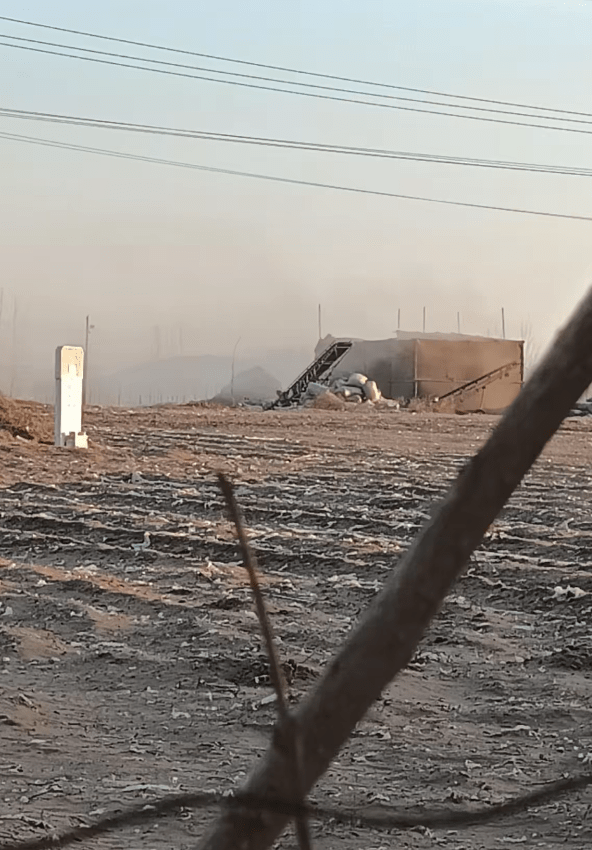
● The current processing site of the enterprise involved.
2 The two departments of agriculture and environment “fight” across the air
After receiving the complaint, the Shenzhou City Agriculture and Rural Affairs Bureau and the Ecological Environment Bureau and other departments sent people to the scene to investigate the situation, but the replies they gave made Lao Li laugh and cry: The two departments cited the same laws and regulations, but came to completely opposite conclusions.
Both of them pointed out in their replies that the pollution problem caused by the plastic film was not within their own scope of responsibility, so they could not enforce the law on the enterprises involved and should be solved by the other department.
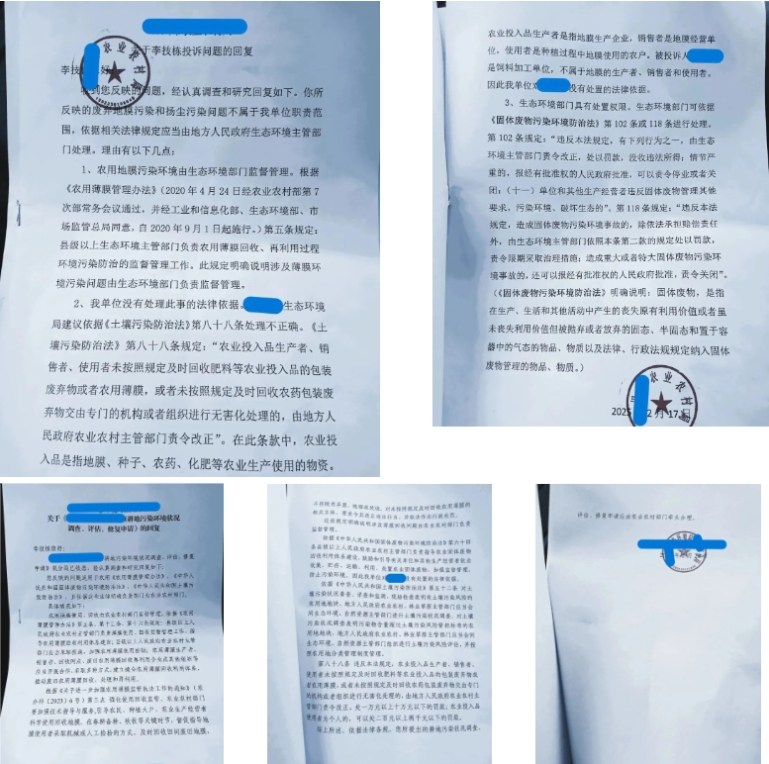
● The replies from the Luanzhou City Agriculture and Rural Affairs Bureau and the Tangshan City Ecological Environment Bureau Luanzhou Branch to Lao Li.
First of all, both sides cited Article 5 of the “Management Measures for Agricultural Film”. The Ecological Environment Bureau cited the first sentence: “The agricultural and rural affairs departments of the people’s governments at or above the county level are responsible for the use and recycling supervision and management of agricultural film, and guide the construction of the agricultural film recycling and utilization system.”
The Agriculture and Rural Affairs Bureau only cited the fourth sentence: “The ecological environment departments of the people’s governments at or above the county level are responsible for the supervision and management of environmental pollution prevention and control in the process of agricultural film recycling and reuse.”
In other words, in the chain of plastic film recycling failure and pollution, they only saw the other party’s dereliction of duty and turned a blind eye to their own responsibilities.
Secondly, a point of contention between the two sides across the air is: Is the plastic film that pollutes Lao Li’s farmland still “plastic film”?
The Ecological Environment Bureau suggested that Article 88 of the “Soil Pollution Prevention Law” should be used to deal with it: “Producers, sellers, and users of agricultural inputs have not, in accordance with regulations, promptly recycled the packaging waste of agricultural inputs such as fertilizers or agricultural film… the people’s government at the county level shall order them to make corrections.”
However, the Agriculture and Rural Affairs Bureau responded that the feed processing enterprise does not belong to the producers, sellers, and users of plastic film, so “our unit has no legal basis for disposal”. And cited Article 102 of the “Law on the Prevention and Control of Environmental Pollution by Solid Waste”, believing that this is “solid waste pollution” and should be punished by the ecological environment department.
In other words: In this case, what flew into Lao Li’s land is no longer plastic film in the legal sense, but solid waste.
“Solid waste” refers to items generated in production, life, and other activities that have lost their original use value, or although they have not lost their use value but are discarded or abandoned.
But the Ecological Environment Bureau “outsmarted” and defeated the “Solid Waste Law” with the “Solid Waste Law”, citing Article 64 of the law: “The agricultural and rural affairs departments of the people’s governments at or above the county level are responsible for guiding the construction of the agricultural solid waste recycling and utilization system, encouraging and guiding relevant units and other producers and operators to collect, store, transport, utilize, and dispose of agricultural solid waste in accordance with the law, and strengthen supervision and management to prevent environmental pollution.”
Translate: Although solid waste is under my control, agricultural solid waste is still the responsibility of the Agriculture and Rural Affairs Bureau.
Lao Li was at a loss for what to do after receiving these two replies. So he continued to reflect the problem through government website messages, telephone hotlines, and other channels. There has been no progress so far.
3 Who is in charge of agricultural solid waste?
Back to the key question of this incident: Who should be in charge of agricultural solid waste? Environmental lawyer Wu Anxin believes that the competent department should be the ecological environment department, because the peanut stalks entangled with plastic film are raw materials, and feed processing belongs to the category of industrial production, and the pollution during the processing process is supervised by the ecological environment department.
However, the reason why the waste plastic film appears in the processing scene is inevitably the result of the failure of field plastic film recycling. In 2023, the Chengde Procuratorate of Hebei Province ordered the local agricultural and rural affairs department to perform its duties of supervising the use and recycling of plastic film because a large area of plastic film was used in a village, causing farmland pollution.
The principle of recycling and pollution is so simple: if it is recycled, there is no pollution; if it is not recycled, it will cause pollution. But at the government level, recycling is the responsibility of the agricultural and rural affairs department, while pollution involves the environmental department, and the responsibilities and powers of the two departments are like two sides of a coin. When a pollution incident occurs, the links for which the two departments are responsible must have problems, both have certain responsibilities, and both have reasons to take action to supervise.
And the status quo is that “both should be in charge” has turned into “neither is in charge.” Although the state has issued a series of laws and regulations such as the “Solid Waste Law”, the “Soil Pollution Prevention Law”, and the “Management Measures for Agricultural Film”, it seems that the more articles there are, the more reasons the relevant departments can find to shirk their responsibilities.
An expert who studies solid waste believes that the management of agricultural solid waste in the “Solid Waste Law” is relatively vague, which leads to the fact that the management system of agricultural solid waste is still blank.
Agricultural film, including plastic film, is the fourth largest agricultural production material after seeds, pesticides, and fertilizers. Due to the long-term emphasis on use and light recycling, the problem of plastic film pollution in China is serious – nearly 300 million mu of land are covered with plastic film every year, with a usage of nearly 1.45 million tons, accounting for about 75% of the global plastic film usage.
Due to various restrictions such as recycling technology and equipment, the recycling and utilization rate of agricultural film in China has been less than 2/3 for a long time. In 2017, the former Ministry of Agriculture issued the “Agricultural Film Recycling Action Plan”, and launched the construction of 100 plastic film treatment demonstration counties in the northwest region, proposing that the recycling rate of plastic film in the demonstration counties should reach more than 80% in the current season within 2 to 3 years.
Although the treatment of plastic film finally has specific actions, this is only “current season” recycling. The accumulated plastic film residue in China has exceeded one million tons.
According to the monitoring data of the Ministry of Agriculture in 2016, all the farmland soils covered with film in China have different degrees of plastic film residue, and the average residue per mu in some areas reaches 4-20 kilograms, and even more than 30 kilograms in individual plots, which is equivalent to 6 layers of plastic film. The residual plastic film will destroy the soil structure, affect crop emergence, hinder root growth, and lead to crop yield reduction. There is no authoritative data statistics on the direct economic losses caused by the long-term accumulation of plastic film across the country.
According to a 2019 article written by Zhang Bin and others from the Rural Economic Research Center of the Ministry of Agriculture and Rural Affairs, the plastic film residue problem in areas outside the national project area is very prominent, and ultra-thin plastic film is still widely available in the market, and farmers are not enthusiastic about recycling residual film.
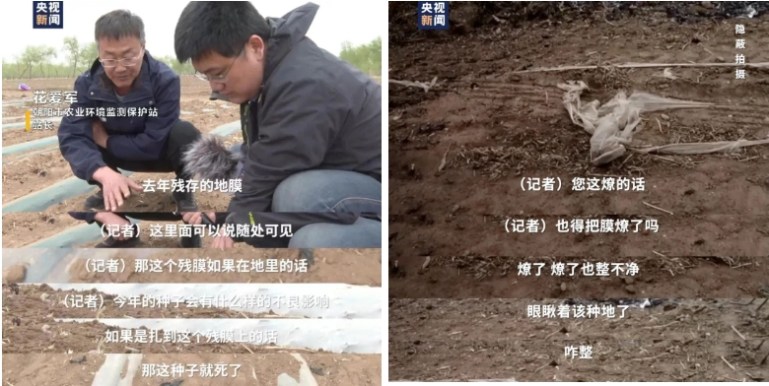
● In 2023, a CCTV reporter went to the western Liaoning region to investigate and found that the used plastic film was either abandoned in the field or burned, producing a large amount of smoke. Not only are farmers unwilling to recycle due to labor costs, but recycling companies are also losing money. Although they have obtained government subsidies, it is difficult for them to make a profit.
Yan Changrong, a researcher at the Chinese Academy of Agricultural Sciences, once estimated in an article that in order to use peanut stalks as livestock feed and carry out film removal treatment, the processing cost per mu is about 30-50 yuan. And often no one pays this cost, which means that the plastic film is scattered into the environment and becomes an important source of plastic pollution.
And when plastic film is mixed into the feed, it also has many effects on the health of animals, and in serious cases, it even endangers life and damages the economic interests of the breeders.
Plastic film not only harms the soil and agriculture itself, but the plastic film that drifts with the wind also endangers public infrastructure. During the May Day holiday in 2021, when the Beijing-Guangzhou high-speed railway traveled to the Dingzhou section of Hebei, it was shut down because the plastic film was hung on the contact network, and dozens of high-speed trains were therefore shut down and delayed.
News like “plastic film causes high-speed train shutdowns” is only the tip of the iceberg that the public can understand. The staff of the street office and the Agriculture and Rural Affairs Bureau have told Lao Li that there are too many similar plastic film pollution incidents nearby, and they simply can’t manage them.
At present, Lao Li’s main appeal is to evaluate the pollution of his and the surrounding farmers’ farmland, and to repair the soil on the basis of scientific evaluation, including not only the visible plastic film fragments, but also the invisible plastic microparticles.
He said: “I have been persistently reflecting on this matter, not only for myself, but also for the surrounding villagers, and even for the well-being of future generations. We, this generation, should not leave only a wasteland for future generations.”
For Lao Li, seeking help online is a last resort after he is unable to solve the problem, but at the same time, the new situation in the past few days has made him more and more anxious: after he sought help from the government departments, the enterprise involved in the incident accelerated the processing pace, and the plastic film that drifted out also increased. He speculated that the other party was thinking of finishing processing this batch of raw materials and running away. Because the processing plant was temporarily built on farmland, they could just walk away.
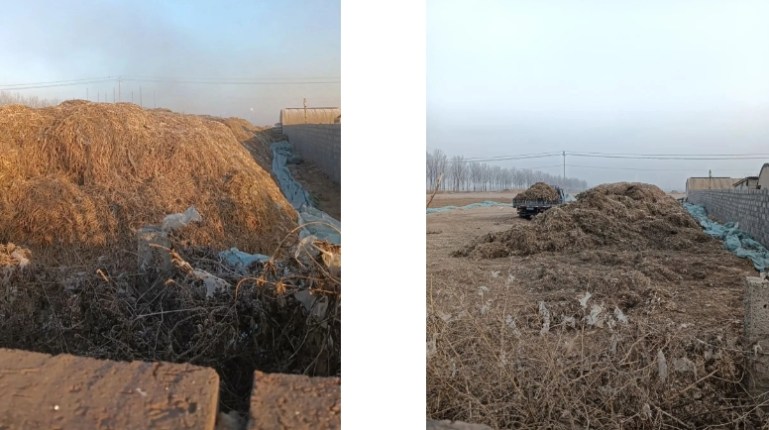
● Comparison chart of the front and back of a peanut stalk stacking site of the enterprise involved on January 12 and March 7. The photos show that the processing is nearing the end. Mixed white plastic film can be seen in the raw material pile.
If the government departments are still arguing about who should be responsible when the plastic film recycling is not effective and the enterprise causes pollution, then how can the environment and the vital interests of farmers be effectively protected? When the facts are clear, allowing the enterprises involved to continue polluting, should we wait until they slip away, and then use the excuse of “the pollution subject is not clear” to continue to be inactive?
The problem of plastic film pollution control requires not only a clear division of responsibilities between government departments, but also reasonable solutions and detailed management measures.
Who will manage? What to do? Lao Li needs an answer, and the polluted land also needs an answer.
Discover more from 自由档案馆
Subscribe to get the latest posts sent to your email.