


Well-known commentator Gu Yuan was taken away by the police, suspected of being related to his criticism of JD.com and Liu Qiangdong. As of the time of publication, Gu Yuan has been out of contact for six hours.
On April 28, Gu Yuan, the owner of the WeChat public accounts "Boss Gu" and "Boss Gu's Nest", was suspected of being taken away by the police for repeatedly criticizing JD.com and Liu Qiangdong.
(Unrelated to the text)
Recently, JD.com has aggressively entered the food delivery market, and the battle between JD.com and Meituan is in full swing.
Consumers are considering whether the new entrant, the catfish, has lowered the price of my takeout, increased the speed, and improved the quality;
Riders are weighing whether Liu Qiangdong's high-profile social security declaration has indeed improved their real overall welfare.
Another competitor, Ele.me, has taken no action other than planning a crayfish promotion (implying a [瞎]搞, or 'messed up' in Chinese).
According to the author, Ele.me's business is stable and has not been significantly affected. Its management team is closely observing the situation and is urgently formulating a response strategy.
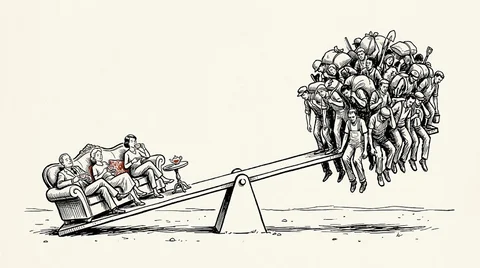
Historical experience shows that every time there is a fierce competition among market leaders, the unlucky ones are always the small fry.
Wanglaoji and Jiaduobao's business war, and Heqizheng almost withdrew from the market. Coca-Cola and PepsiCo competed in China, and Feichang Cola disappeared. Apple versus Samsung, Nokia fell.
There are exceptions to everything.
This time, the first to fall was not Ele.me, but a bystander who had nothing to do with Meituan, Ele.me, or even the entire food delivery industry.
According to sources from the roadside news, around 11 a.m. on April 28, "Boss Gu", a self-media person who recently frequently criticized Liu Qiangdong and JD.com's food delivery strategy and communication strategy, was visited by six police officers at his company. As of the time of publication, Boss Gu is still out of contact.
Economics is not just knowledge, but also an explanation of life
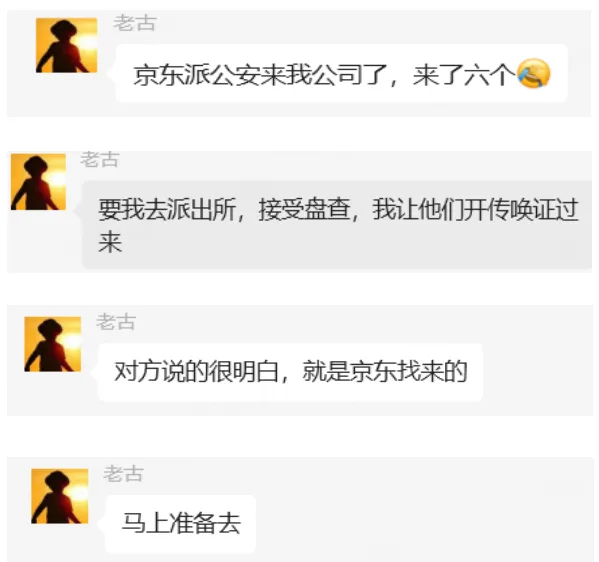
According to the author, Lao Gu, commonly known as Gu Yuan in the industry, is a self-media person who has gained considerable momentum in recent years in the field of economics and business analysis. However, he is not a professional writer. His main business is business consulting, diagnosing operational, sales, and communication problems for companies and providing solutions.
Self-media writing is purely out of his personal interest.
According to Gu Yuan's past self-description, Gu Yuan came from an ordinary family in a grassroots province in mainland China. In his childhood, the difficult and painful life of his family and relatives was an unforgettable experience for him.
Nearly thirty years ago, he graduated from university and entered society, starting from the lowest level of sales, and has been involved in many industries and fields, experiencing countless ups and downs in the business world. He has witnessed the development of China's market economy and the great changes in Chinese society from poverty to prosperity with his own first half of his life.
In his middle age, Gu Yuan's career has been quite successful, and he has some spare energy. He began to combine his own experiences, systematically study economics, especially the principles of market economy, and extensively read works on political science, history, and sociology, trying to use this knowledge to analyze and explain the era he has experienced in a more logically consistent manner.
Coinciding with the rise of the self-media era, Gu Yuan began to shift from input to output, embarking on the path of writing WeChat public accounts. Since then, he has become unstoppable. In just a few years, he has written millions of words of articles, and some selected works are about to be published.
Gu Yuan's academic-ideological line is very clear. In his early years, he admired the Chicago School of Economics. In terms of purely Chinese authors, he has studied the works of Xue Zhaofeng and Zhang Wuchang, and he greatly appreciates the school's decades-long efforts to call for market economic reform.
In recent years, Gu Yuan has begun to turn to the Austrian School of Economics, more fiercely and resolutely criticizing various anti-market economy concepts and dissecting various misunderstandings of market principles.
Love and worry behind diligent comments
Gu Yuan is not a member of the system, nor is he an academician. In terms of his writing topics, the vast majority of them have no direct connection with his personal interests.
The reason for writing is entirely out of the interest and concern of an ordinary citizen.
Gu Yuan believes that it was reform and opening up and the market economy that improved the material life of ordinary people like him, and even completely changed his life's destiny.
Moreover, in his opinion, this kind of change in his personal life, unlike those ordinary people who are fortunate enough to work in government departments, teach in universities, and have various 'iron rice bowls', relies on institutional welfare—that is, sacrificing the interests of others—to improve their own situation, but completely relies on their own intelligence and diligence to provide services for others.
In other words, it is achieved through voluntary win-win cooperation in market competition.
He believes that the wider and deeper this mechanism is, the easier it will be for ordinary people like him to get a lasting and real improvement.
He hopes, and even wants everyone from top to bottom to understand this truth and support such a mechanism.
At the same time, on the other hand, based on Gu Yuan's understanding of economic principles and logic, even though China's market economy is already extremely popular today, bringing unprecedented economic prosperity to the Chinese people, there are still many very serious anti-market and anti-economic principles in the market, in the public opinion field, and even behind some economic and social policies.
Correcting these widely circulated errors is also one of his important motivations for writing.
Just as he said in his articles, if he wants his children to live in a more free, prosperous, and safe society, he has to confront these errors head-on.
Therefore, his writing style is clear and transparent, without the cumbersome and difficult problems of scholars, and can be understood without hindrance by friends with only a middle school level. Moreover, his articles are always clear in their viewpoints, firm in their stance, detailed in their information, meticulous in their reasoning, and extremely prolific.
Many friends and readers jokingly call him Gu AI.
Gu Yuan does not have a writing team. All articles and viewpoints come from him alone, and one person is a team.
Due to his passionate criticism of reason and his refusal to compromise on the viewpoints and concepts he believes are wrong, Gu Yuan has also sparked many controversies in the community.
He has always faced the challenge head-on, never retreating, and can maintain rationality and logic even in the face of abuse. He has fully opened up the reader comments on his articles, no matter how harsh the insults and how intense the criticism.
The last time Gu Yuan fiercely wrote articles to criticize was Sima Nan.
But this time, he kicked an iron plate.
JD.com's public relations department and legal department did not write articles to criticize and refute Gu Yuan's views, but directly resorted to police power. This can be said to be a bad habit in China's public opinion space.
Mises, an Austrian School economist whom Gu Yuan admires, sharply stated in his book "The Free and Prosperous Commonwealth":
"In order to transform the slave consciousness into citizen consciousness, people need to conduct long-term self-education. A free person should tolerate others' unwillingness to think and do what they do not do. They should overcome the habit of calling the police whenever they feel something is inappropriate."
But we are not living in the world of books, but in the real reality.
AI tells you what Boss Gu wrote
According to the current substantive law, did Gu Yuan's articles insult or defame JD.com? It is the job of professional lawyers and courts to ascertain this issue.
However, Gu Yuan's suspected "crime tools" are very open and transparent.
In the past half month, he has written several articles commenting on Liu Qiangdong and JD.com's business model. As of the time of publication, all readers can publicly view them. I used Tencent Yuanbao AI to summarize the main points of each article, and you can also click on the article title to open the original webpage for self-reading. I believe that all readers have their own judgment.
These articles are:
《Exposing Liu Qiangdong and JD.com's"God-making" routine》:
This article reveals the operational logic of JD.com and Liu Qiangdong packaging business behavior as a "moral benchmark" through systematic public relations strategies. The article points out that the core lies in occupying the moral high ground, such as shaping the image of "industry conscience" with slogans such as "full payment of rider social security" and "takeout net profit not exceeding 5%", but in fact, it harvests public opinion dividends by blurring the scope of implementation and using information asymmetry. Liu Qiangdong's "grassroots counterattack" and "brotherhood" personae are precisely designed as marketing tools, strengthening the pro-people label through dramatic scenes such as personally delivering takeout and sending out red envelopes during the Spring Festival, while also inciting emotions and shifting the focus of business competition with controversial remarks (such as "communism can be realized"). The article criticizes that the essence of this "god-making" is the two-way binding of public opinion manipulation and business interests, which not only serves market capitalization management but also exposes the deep-seated contradictions of corporate strategic hollowing and the unsustainability of moral narratives.
《JD.com will definitely fail!》:
This article criticizes that JD.com's takeout business is doomed to fail due to strategic misjudgment and execution chaos. Its core problem lies in the blind national expansion and the neglect of the city-level scale effect of instant e-commerce—failing to concentrate resources to capture a single market, leading to insufficient order density and low rider income and loss. At the same time, subsidies rely on merchants and consumers to share (the delivery fee accounts for as high as 50%), triggering the collapse of transportation capacity and the deterioration of user experience. The article points out that JD.com lacks both the algorithm scheduling and dense transportation network accumulated by Meituan over ten years, and has not built a stable merchant ecosystem. System crashes and arbitrary changes in rules accelerate the collapse of trust. The author believes that JD.com only relies on capital burning money and populist attacks on competitors (such as hyping Meituan's social security issues), but avoids the construction of core competitiveness (merchant ecosystem, fulfillment efficiency), and will eventually be eliminated due to cost out of control and unsustainable models.
《JD.com takeout exceeds10000,000orders, but it will still fail!》:
This article points out that although JD.com's takeout has broken through tens of millions of orders per day and covers 166 cities, the burning money model that relies on subsidies of 5-10 yuan per order is unsustainable, with more than 700 million yuan burned per day, and only 60,000 orders per day in a single city, far from reaching the scale threshold of 40% of the takeout market share. The article says that it neither has the algorithm scheduling and transportation network accumulated by Meituan over ten years, nor is it trapped in management chaos (system crashes, rider unit prices falling to 3 yuan, merchants being forced to share subsidies), and user experience deteriorates. The author believes that JD.com confuses capital consumption with core competitiveness, ignores the essence of supply and demand efficiency of instant e-commerce, and will eventually be eliminated by the market due to cost out of control and the loss of transportation capacity, repeating the capital bubble.
《Unexpectedly, Dong Ge has become Dong Zi so quickly》:
This article satirizes the collapse of Liu Qiangdong's public opinion image from "Dong Ge" to "Dong Zi", revealing the collapse of his business logic: by inciting populism (attacking competitors' monopolies, hyping the "righteous person" persona) to harvest traffic, but JD.com's takeout business collapsed due to subsidies (merchant costs soared from 30% to 100%), rule chaos (price lock policy, system crashes) and rider income plummeted (unit price fell to 3 yuan), and merchant losses increased, rapidly losing market trust. The author criticizes Liu Qiangdong for distorting business competition into a "public opinion war", using populist means to harvest emotional dividends, but ignoring supply and demand efficiency and fulfillment capabilities, and ultimately merchants are angry, riders flee, and consumers abandon, from "Dong Ge" to "Dong Zi" ridiculed by the whole network, predicting that he will be backlashed by the market.
《Liu Qiangdong is not fighting a normal business war!》:
This article criticizes Liu Qiangdong for distorting business competition into a populist public opinion war, deviating from the market principle of putting consumers first. The article points out that JD.com, by inciting opposing emotions (such as accusing competitors of "choosing one out of two" but without evidence), creating moral judgment (using social pain points to hype platform exploitation, monopolies, etc.), and implementing double standards (selective criticism of its own and competitors' social security issues), is trying to politicize business issues and replace value creation with public opinion pressure. Although this strategy harvests traffic in the short term, it distorts market mechanisms, erodes the foundation of business civilization, and ultimately leads to the loss of consumer trust, the compression of merchants' living space, and the unsustainable predicament of the enterprise itself due to the loss of core competitiveness.
《Behind Liu Qiangdong's incitement of public opinion, there are others》:
This article reveals that Liu Qiangdong is using public opinion warfare to divert attention from the problems of JD.com's takeout business: his public accusations against Meituan of "choosing one out of two" and "exploiting riders" are actually piecing together scattered criticisms from the public, deliberately creating a moral high ground to cover up the reality that JD.com lacks core competitiveness. The article points out that the merchants' dissatisfaction with Meituan's commissions and advertising fees stems from their own inefficient operations and vicious competition (such as low-price involution), rather than platform exploitation, but Liu Qiangdong packages the structural contradictions of the industry as "capital oppression", inciting riders and public emotions to compete for the market. This strategy is essentially a business-driven public opinion manipulation, which, by creating opposition, diverts public attention from JD.com's management defects (such as insufficient protection of riders' rights), and ultimately serves capital expansion rather than solving industry problems.
《Liu Qiangdong is launching a trade war!》:
This article criticizes Liu Qiangdong for using the name of "protecting workers" and "supporting small and medium-sized merchants" to intervene in the market with mercantilism, the essence of which is to use public opinion to pressure the government to distort market competition rules, at the cost of sacrificing consumer rights and overall economic efficiency to protect the privileges of specific interest groups. The article points out that Liu Qiangdong's attacks on Meituan's "exploiting riders" and "choosing one out of two" are actually piecing together scattered contradictions, covering up the reality that JD.com's takeout business lacks core competitiveness, and its logic is the same as the US trade war strategy—by creating opposition to divert market contradictions, it distorts business competition into a "protectionist war" of power intervention. The author emphasizes that such remarks are essentially replacing market choices with moral kidnapping, and if such intervention is condoned, it will lead to resource misallocation, stagnation of innovation, and ultimately harm the well-being of the whole society.
《Liu Qiangdong, anti-intellectual!》
This article criticizes Liu Qiangdong's anti-intellectual economic view in his vision of the popularization of robots, pointing out that his imagined society of "government-allocated distribution" ignores the core laws of economics—the eternal scarcity of material products and human desires, as well as the dynamic needs of human beings that are never satisfied. The article believes that even if technology achieves a great abundance of materials, resource allocation still needs to rely on price signals and market choices, while Liu Qiangdong's advocacy of "planned distribution" is essentially a utopian fantasy that is divorced from reality, which cannot solve the diversity of needs (such as different colors of sweaters, regional differences in medical resources), and even leads to economic calculation failure due to the lack of price mechanisms, and eventually falls into resource misallocation and innovation stagnation. The author emphasizes that Liu Qiangdong simplifies complex economic issues into moral narratives, and the essence is to cover up business logic defects with anti-intellectual remarks. His remarks not only violate the principles of the Austrian School of Economics, but may also mislead the public's understanding of market mechanisms.
There are also two articles that have been deleted by the platform (the powerful Tencent Yuanbao still miraculously summarized their main points):
《Liu Qiangdong, has become Sima Nan!》
This article criticizes Liu Qiangdong for adopting populist public opinion strategies similar to Sima Nan in business competition, using moral kidnapping, emotional incitement, and selective narratives to divert market contradictions. The article points out that Liu Qiangdong packages himself with the persona of "brother", simplifying the platform economy controversy into a binary opposition of "exploitation" and "anti-exploitation", accusing Meituan of "choosing one out of two" and "ghost takeout" as fictitious or exaggerated contradictions, which not only covers up the reality that JD.com's takeout business lacks core competitiveness, but also avoids its own double standards in protecting the rights and interests of riders (such as the lack of social security for Dada riders). This strategy is essentially replacing business competition with moral judgment, harvesting traffic and consolidating power alliances by creating opposition, which ultimately leads to market rationality giving way to the populist public opinion field, harming industry innovation and consumer well-being.
《JD.com complained to me, the double-standard JD.com!》
This article reveals the double standards and public opinion manipulation of JD.com in business competition: it complains to self-media that analyze its business strategy on the grounds of "infringement", but has long taken the initiative to launch moral criticism (such as accusing Meituan of "exploiting riders") through open letters, founder speeches, etc., and distorts business competition into a sensational narrative of "capital VS workers". The article points out that JD.com uses legal tools to suppress criticism (such as accusing self-media of "malicious interpretation"), which actually covers up its controversial strategies such as low-profit market grabbing and public opinion warfare matrix operation (such as bundling sales and marketing), which is essentially replacing business logic with moral judgment, which not only violates its declared value of "customer-centric", but also consolidates its market advantage by manipulating public emotions, ultimately harming industry transparency and consumers' right to know.
When will Lao Gu be able to come out?
As of the time of publication, Lao Gu has no news.
According to past experience, after Lao Gu's personal safety is ensured, he will definitely publish an article to introduce the cause and effect. The author will not make any presumptions for the time being, so as not to take things out of context.
It is worth mentioning that although Lao Gu is diligent and prolific, and has an ideal complex, he is still just an ordinary person. He is very clear about this. He has repeatedly stated that I can write so many words without any damage, because no matter what, China still has room for speech, which benefits from the social atmosphere and market mechanism.
But one day, if the public opinion environment is too bad, I will completely stop writing. I am not a warrior, and I don't want to be a hero.
In this regard, senior group chat experts and deeply poisoned public account article readers in the vast WeChat groups have expressed:
Regardless of how many debatable points there are in Gu Yuan's articles, I hope this day will not come so soon. I hope Lao Gu is safe. And I hope that this society can be more tolerant and give rise to more Lao Gus.