

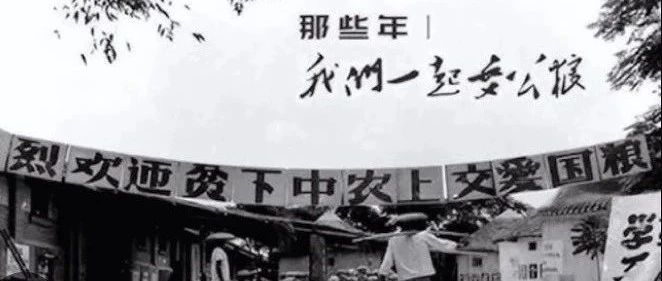
The previous article had many comments about the matter of delivering public grain back then, which I think is very good, so I excerpted and organized a single article. I also hope to use this as a starting point for everyone to talk about it together.
When I was young, I looked down on my father very much, thinking he was too cautious. Now I admire him very much. My father is known as "Peng the Three Hundred Jin", who can carry a load of three hundred jin up a dozen steps of stairs; the villagers went to a neighboring village to plant rice seedlings together, and were made things difficult by the locals (intentionally planting quickly, so that the people of our village could not keep up and be embarrassed), my father came forward, chasing the people of the neighboring village staggering, and many years later, people still praised him. My father was a carpenter and often went out to repair houses for people. My mother took on the heavy physical labor at home. Others watered sweet potatoes only once, and our family had already watered them twice. I also followed along and complained a little about my mother. I had my own small manure bucket at the age of ten, and a lump grew on my shoulder from carrying it. As I grew older, I admired my parents more and more. First, I had my own children and knew the difficulty of supporting a family, and second, I finally had some understanding of the environment my parents were in back then.
As children of farmers, we should say more when we can speak. Some things, if not spoken out, will be annihilated, and as long as they are spoken out, the facts are spoken out, it will naturally make people understand. The following are the reader's comments I have organized (the small font is the reader's comments, not what I said, a reader misunderstood in the previous article, I would like to clarify):
——————————————————
In 1994, I went to a town in Shijiazhuang, a major grain-producing area, as a deputy secretary. At that time, grain ordering and "three withdrawals and five unifications" were the main burdens of farmers. Grain ordering (delivering public grain) was like this: wheat sold to merchants at the door of the house was 0.8 yuan per jin, and brought to the grain station was 0.4 yuan per jin. The state ground it into flour and supplied "eating commodity grain" was 0.18 yuan per jin of wheat flour. One mu of land had to pay 180 jin of wheat, and also a small amount of corn, miscellaneous grains, and cotton. A total of 200 jin of wheat was no problem, which means that in the 1990s, the common people had to contribute more than 80 yuan per mu of land to the state! It was equivalent to my monthly salary at that time! The three withdrawals and five unifications were the funds to maintain village activities. I have never heard of urban people having to pay money to maintain national management expenses! This is the contribution of the old farmers to the country. It is a matter of course to issue insurance to farmers who have paid public grain! (Lao Kang)
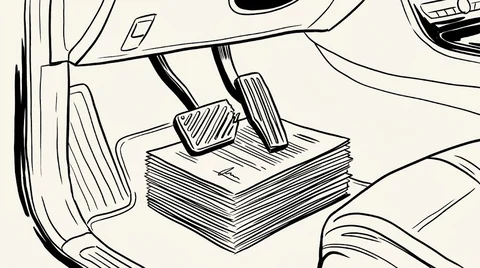
The blogger of that video about delivering public grain said it truthfully. I was afraid of this job of delivering grain every year. Not only did I have to carefully select good grain, but I also had to carry it on my shoulders and pull it by cart for more than ten miles to the grain station. This was not the most difficult thing. The difficult thing was that you finally lined up, and they said your grain was not dry enough and had to be dried. You had to find a place nearby to dry it. No one would drag it back again, because not only were you already exhausted, but if you dragged it back and came again tomorrow, you would have to go through this procedure today. It was difficult to find a place to dry it, because everyone had to dry it and everyone had to抢地方. The scene of him handing cigarettes to the person in charge was too vivid. It's also strange, I and the blogger are separated by thousands of miles, why is this scene of handing cigarettes and the stationmaster's pocket storing a lot of loose cigarettes so similar? (Liu Chengdang)
I remember when I was about 10 years old, I went with my parents to the grain station to deliver public grain. It took a full 7 days to line up (you all know the taste of traffic jams, right? Here, you have to unload the bags of rice and put them on the ground. The one in front weighed it, and the one behind moved forward a little. That was the weight of more than twenty or thirty bags of more than 80 jin each!). Those 7 days were really too long. That was the best rice in our family! My father dried it again and again, and winnowed it again and again, but when it arrived there, the quality inspection still failed, saying that the water content was not up to standard and there were impurities. So we dried it again in the open space provided by the grain station, and after drying it, we went to the wind machine, and then to the vibrating screen. Every process here required lining up. There were too many people delivering public grain, and the staff of the grain station went to work and left work on time. The common people were really too difficult. (Fukang Garden)
When I was a child, I went with my father to the township fifteen miles away to deliver public grain. I picked the best and dried it. I pulled it to the place with sweat all over my body. The staff there still spoke to us fiercely. My father just spoke to them humbly, how pitiful. (Wanyou Zhenyuan)
When delivering public grain, the people at the grain station were super disgusting. Our family was a little better as village cadres. They scolded and picked on others, poked holes in the grain bags to take grain, it was either too damp or there were too many empty shells, and they weighed it down. Every year, they had to fight. (Pipi Xin)
I am sixty-one years old this year. When I delivered public grain back then, our family had five people. We delivered twelve bags of wheat, about one hundred and ten jin per bag. But when we got to the grain station, they lowered the grade, lowered the price, and lowered the weight. The weight of a bag of wheat was less than one hundred jin, and you couldn't argue with them. If you argued with them, someone would fix you and give you small shoes. (Family Harmony and Everything Prospers)
The memory is clear. The staff at the grain delivery place were very fierce. This was not good, that was not good, and they were very fierce. They sent a full cart, and came back with an empty cart. The family on the road was full of grief. (The Only One)
I was born in 86, and I went to the township with my father to deliver it. If the inspection failed, I had to dry it in the big square myself. It was a mountain road of more than 10 kilometers from my home to the township, and it took 4-5 hours to walk. The impression was very deep. (Zizheng Yuan)
For families with a large population, those who did not have grain to deliver public grain, or those whose grain quality was poor and could not pass the inspection, had to pay the difference. What does that mean? Your family needs to deliver 500 jin of public grain, the market price is 8 cents, the public grain price is 5 cents, you can not deliver public grain, but you have to make up the difference of 3 cents, 150 yuan. I was so happy when I was a child. (Jason Zhao)
When I was a child, I also followed my father and grandfather to deliver public grain. The grain collectors also made things difficult for the farmers. The grain had to be dry and good, and even a little bit of barnyard grass was not allowed. Therefore, the farmers were very happy to deliver public grain, and there were troubles if they could not deliver it. (Maple Forest)
As a major grain-producing province, my family has 7 acres of land, and at the highest time, I had to hand over 1500 jin of wheat as public grain! (Flower Tree Life)
I was born in the 70s. I remember that I helped my father carry rice to pay public grain when I was sixteen years old. I should have paid more than 200 jin. My father could not carry so much by himself. In fact, my family had five people at that time, with paddy fields and mountain fields totaling less than 20 dan (3.8 dan per person, one mu = 6 dan). We could only harvest about 5000 jin of rice in a year, and about one-twentieth of the public grain was paid. Of course, we only plant one season now. At that time, we also had to pay special product tax, agricultural tax, village retention, township pooling, etc., more than one hundred yuan. This one hundred yuan was all paid by selling rice. At that time, rice was only a few cents per jin. It was not until 96, 97 that rice sold for about 1 yuan. (Meet)
I experienced it myself when I was a child. If the grain harvested by my family was a bumper harvest, nearly half of it was delivered as public grain, and nearly two-thirds of it was handed over when the harvest was poor. My parents now receive a pension of one hundred and twenty yuan per month. (True Water Without Fragrance)
I remember when I was a child, when I delivered public grain, 100 jin of rice passed the machine and 80 jin remained qualified. The unqualified ones were screened out by the machine and taken home to eat. (Summer Rui)
Farmers not only have to pay public grain, but also have to pay live pigs. Only after paying live pigs can they get meat tickets. I remember that before the 1990s, there was also a mutual aid fund for the elderly in the countryside. (Chen Rong)
In addition to public grain, there was also a grain purchase task, the price was far lower than the market price, and the task was heavy. If it was not completed, a difference of 6 yuan per 100 jin had to be made up, and there was also one live pig per household per year. If it was not completed, a difference of 45 yuan per pig had to be made up. (Gengdu Chuanjia)
I remember when I was a child, my family had to pull a tractor of grain to deliver public grain, and the bad ones were not wanted. We elementary school students also had to hand in a certain amount of soybeans and wheat to the school. In fact, farmers are very content. My parents often said with satisfaction that they now get more than one hundred yuan a month. (Qing)
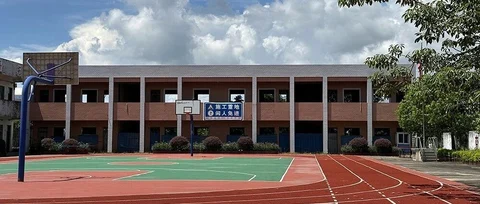
I was born in 79. I paid agricultural tax, and I also paid wheat, and I also paid apples. When I was a child, I paid tuition fees to the teacher, paid for the maintenance of the school buildings, paid for the use of desks and chairs, paid for late fees, and also paid for the teacher's summer vacation travel fees. The teacher ate at the students' homes, and the students' parents took turns cooking. (Chang Z Ru)
I have a deep impression when I was a child. After selling the rice harvested by our family that year and paying agricultural tax and other taxes, after deducting the money for pesticides and fertilizers, there was almost no surplus! (Da Bing)
I clearly remember that in those years, due to the flood, there was almost no harvest, and then my family borrowed money to pay public grain. (Li Fenghui)
I passed by when I was a child delivering public grain. The rice was grown, and half of it was delivered to the grain station, and the other half was left for the family to eat. Basically, it was barely enough for the family to eat for a year. (Pocket Money)
At that time, there were no fertilizers. Who knew how many jin of wheat one mu of land could produce? After paying the public grain, there was almost nothing left. It was a luxury to want to eat a bowl of white noodles. How sad to think about life at that time... (Home in the Heart)
The memory is indeed fresh in my mind. The whole village was drying rice and corn in the threshing ground, and the best ones were screened out to deliver the remaining public grain, and the rest was for the family to eat. There were always a few months in a year that were not enough to eat, and they had to borrow grain with small pockets to cook. (He Fengping)
In the 80s, there was a year in our area when everyone had a poor harvest due to the drought. After paying the public grain, we couldn't borrow it everywhere. There was a family in our area who committed suicide by taking rat poison. Our family drank porridge every day, basically like rice soup, and survived like this. (bobby bo)
I still remember the scene of going to deliver public grain with my parents when I was a child. Everyone lined up to deliver public grain as soon as they finished harvesting the grain, and then went to pay the children's tuition fees. They may not be able to eat a meal of meat all year round. (Xin Xin Suo Xiang)
My mother comes from the countryside. She said that one year, she didn't eat meat for a whole year. (SKY)
Sweet potatoes come out to eat sweet potatoes, broad beans come out to eat broad beans. ~~ My ninety-year-old grandmother now eats millet mixed with sweet potato paste, for fear of wasting the millet. (hej-99006)
Does anyone know that farmers exchange the wheat they grow for public grain and then exchange it for corn to eat? (Spring)
This was a very common thing in our hometown back then, coordinate Fujian, take rice to exchange for sweet potato rice. I am fortunate that my parents spoiled me too much, and my family belonged to the one who exchanged rice, and exchanged it for me to eat. (Ding San)
——————————————————
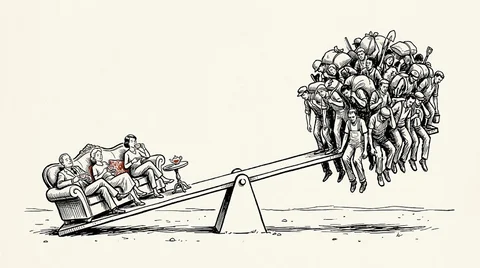
In the previous article, I said "According to the calculation of historian Gao Wangling, the agricultural surplus owned by the landlords was probably between 10% and 12%", some people don't understand, you can find Mr. Gao Wangling's works on tenancy relations to take a look. Simply put, "the landlords own less than 40% of the total cultivated land area, and the actual rent collection rate is as mentioned above, about 30%, then this value should be 12%, or even lower". And the imperial power does not reach the county, so it is easy to conclude that "in terms of the ability to extract surplus from farmers, no dynasty can compare with these few decades".
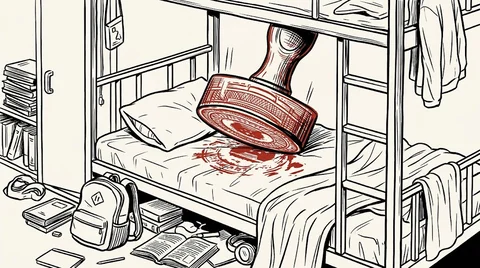
In the previous article, I also saw many comments saying "farmers were allocated land". This sentence has almost become a collective unconscious, but this is not the case. It is better to say "farmers were tied to the land" than "farmers were allocated land". Looking back at history, there were indeed a few years when farmers were allocated land, but it was taken away before it was warm (using violence to replace the things obtained by buying and selling, it is also easy for others to take it back). Whether it is state-owned land or collectively owned land, in essence, all farmers become tenant farmers and work for a landlord. And since they began to lose, they will definitely lose more. With further "transformation", farmers soon lost the right to free migration and free trade, and delivering public grain and unified purchase and sale were carried out in this context.
Today, we are striving to improve the basic pension for farmers. In essence, we are striving for equal national treatment, and we are going to climb out of the historical deep pit that we fell into. We, the children of these farmers, may have already walked far away from the countryside, walked to the city, and even become members of the system, but sometimes looking back at the road we have traveled, we may understand: our parents and classmates are not not diligent and not smart, but they are unlucky, and their lives should not have been like this, and those who can walk out of the countryside are not only because of their own efforts, but also because of luck. A reader commented yesterday: "Although I am in the system, I am cheering with you.""
I bought a small item for my mother, an old ox pulling a plow, and a longevity star accompanying ???? My mother immediately understood, and said to my nephew that the ox pulling the plow was hard, and the rural ox was not killed when it was old, it had worked hard all its life. And said to my nephew that grandma used to live worse than the old yellow ox. My nephew asked, and my mother said that the old ox also had a rest at night, and we had to earn work points in the fields during the day, and in the evening we had to feed the big ones and breastfeed the small ones, and settle down and sleep, and sit up and twist hemp ropes and make shoe soles and make shoes. When my mother said this, I changed my habit of interrupting and listened quietly to my mother. (Wang Huijing)
We should all have moments to listen quietly to our parents talking about the past. It happens to be the Spring Festival. If you haven't set off on your return journey, you can ask your parents about the past of delivering public grain, and then leave a message below, thank you. We always say "history is written by the people", but if we don't write, history is another way of writing.