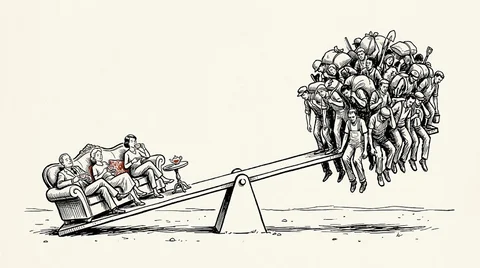


1. Transformation and Cyclical Pressure
Around 2018, China's economic growth model gradually shifted away from relying on debt-driven infrastructure and real estate, towards relying on technological progress and industrial upgrading. During the economic transformation, some industries rose while others declined. A slowdown in overall economic growth can be understood and imagined, belonging to the growing pains of the transformation process. More comes from cyclical disturbances rather than the cost of transformation.
We use all listed companies as a basis (A-shares, Hong Kong stocks, and U.S.-listed Chinese companies), and divide these companies into three categories: 1) Support category, 2500 companies, supported and encouraged by the government, guiding the direction of economic transformation; 2) Restriction category, 500 companies, the government is trying to regulate and restrict, and the industry itself is declining; 3) Neutral category, 2600 companies, in commerce, retail, and social services, not closely related to the transformation process, and generally neutral. The operating income of listed companies accounts for over 50% of the total GDP in 2024, which is representative to some extent.
From 2016 to the present, the proportion of operating income/total market value of neutral industries has remained generally stable. Between 2018 and 2020, the proportion of restricted industries shrank significantly, while the proportion of support industries expanded significantly. Industries that the government tried to restrict were shrinking, while industries that the government tried to support were expanding, both in terms of operating income and total market value. This indicates that economic transformation is happening with certainty. Regardless of how economic growth fluctuates, the proportion of neutral industries has remained unchanged, unaffected by restrictive and supportive policies.
Since 2018, the stock prices of support sectors have risen, while the stock prices of restricted sectors have fallen sharply. The gap between the two is something not seen in the past decade. This shows that the government's efforts to guide economic transformation have been reflected in the pricing of the financial market. From 2010 to 2018, the stock performance was completely opposite, further confirming the turning point of the government's guidance of economic transformation.
We strip away the impact of transformation and policies by observing the performance of neutral industries. Since 2017, the operating income of neutral industries has declined significantly. From this indicator, the decline in operating income of neutral industries is not the impact of transformation, but the power of the cycle; the same is true from the data of employed employees.
At this point, we have completed the discussion of the first part. The economic transformation has achieved certain results. At the same time, the trend of economic growth has declined. This decline has little to do with the transformation, but more reflects the cyclical trend.
2. Consumption and Income
Looking at data from more than 30 provincial-level administrative regions in China, the vertical axis is the consumption growth before the pandemic, and the horizontal axis is the degree of population aging.
Before the pandemic: The proportion of young people is not related to consumption.
After the pandemic: Provinces with a higher proportion of young people have worse consumption.
The younger a province's population, the slower the consumption growth; the older a province's population, the faster the consumption growth. This conclusion is somewhat counterintuitive and is summarized by market participants in three sentences: vibrant elderly people, lifeless young people, and despondent middle-aged people.
For the elderly, the predictable future pension can be paid on time, grow steadily every year, and be higher than the inflation level. Income expectations are not affected at all, and they can continue to enjoy the sunset years and dance in the square.
For young people, income expectations have been significantly revised downward, the certainty of income growth has been significantly revised downward, they cannot find jobs, the jobs they find are significantly different from expectations, and young people are cutting back on spending and eating instant noodles in the dark.
Let's look at another data point: the consumption situation of provincial-level administrative regions and the increase in the second-hand housing prices in provincial capital cities. Before the pandemic, consumption and housing prices were almost unrelated. After the pandemic, consumption is worse in areas where housing prices have fallen severely. We tend to believe that after the pandemic, home buyers are generally young people. The less confident young people in a region are about the future, the weaker their consumption will be, and the less willing they will be to buy a house. Without income expectations, without consumption capacity, and also not daring to buy a house.
The results obtained from this model, and the results of our observation of regional population aging, point to similar conclusions: young people's income expectations have declined, and their consumption confidence and willingness to buy houses have been significantly suppressed; but the income expectations of the elderly have not been restricted, and their sense of happiness is strong.
Why does this happen?
3. Employment
We observe the unemployment rate. In 2022, the two rounds of city lockdowns caused a pulse-like rise in the unemployment rate. The unemployment rate has steadily declined. In 2024, the unemployment rate is similar to that of 2022 and 2023. The overall employment pressure is not significant.
Observing the average wage growth within the system, that is, non-private units, there has been some decline in wage growth after the pandemic, but it is far less significant than the decline in consumer confidence.
Observing the growth rate of urban employed population, there was a rapid decline after the outbreak of the pandemic, followed by a rebound after the end of the pandemic, but it is still below the long-term trend level.
Observing the total number of employed persons, the cumulative gap between the solid line (actually found a job) and the dotted line (trend line) is 47 million people. In other words, a cumulative 47 million labor force cannot find jobs normally. Where did these people go?
We observe the data of urban and rural employed persons. The rural employed population has increased by a cumulative 41 million people, which is quite close to the decrease in the urban employed population.
One possible explanation: the significant deterioration of the ability to create jobs in urban areas after the pandemic, a large number of employed people returned or stayed in rural areas. After returning home, the urban unemployment rate data does not show, but it is reflected in the total employed population.
Another part may have left the labor force. In their forties, they lost their jobs, their companies went bankrupt, they drove Didi, they traded stocks at home, or they stayed at home, and they are not visible in the employment and unemployment data.
What is the performance of these data on economic output? In terms of total data, the urban areas mainly absorb employment in the tertiary industry. Due to technological progress and capital accumulation, the manufacturing industry has been experiencing negative employment growth for the past decade. We observe the proportion of the added value of the tertiary industry. After the pandemic, the proportion of the tertiary industry also showed a large gap with the trend line, which corresponds to the missing urban employed population.
We observe the quality measurement indicators of the existing employment in the country. Not only has the employment data decreased, but the quality of employment has also deteriorated. It is not just the financial industry that has seen a deterioration in employment quality due to a sense of shame.
We observe the payment ratio of the five insurances and one housing fund, which has also shown a significant deterioration compared to the historical trend. This echoes the previous listed company data and consumption data, and cannot be reflected as the troubles of transformation, but the power of the cycle.
4. Total Data
We observe the price data through the output gap and core CPI. The vertical axis is the core CPI, which is the CPI excluding highly volatile components such as food and energy. The horizontal axis is the difference between China's economic growth and potential growth capacity, called output capacity.
General economic theory believes that there is a very close relationship between the two. We tend to believe that China went through the second Lewis turning point around 2013, and the relationship between the output gap and prices has indeed become very close.
But there are two abnormal points, both exceeding the level of two or three times the variance. These two abnormal points are 2023 and 2024.
In China's total data, the most credible is the price, which can be sampled, and it is difficult for various forces to manipulate. The reliability of some other data is weaker and is prone to be disturbed by non-statistical factors.
We look at the relationship between the growth rate of urban employed persons and the actual GDP year-on-year. Economic growth will likely create more jobs, and the expansion of output will be accompanied by an increase in employment.
If we believe in the employment data, then the economic growth rate will...
If we believe in the economic growth rate data, then the employment data will...
The relationship between employment and growth in the past two years, the four years since the 2020 pandemic, is taken as a time period, and 2019 takes the same time period, comparing the consumption of goods before and after.
Before the pandemic, consumption growth was similar to economic growth, and consumption growth was even slightly faster.
After the pandemic, consumption growth is much lower than economic growth.
Before the pandemic, economic growth and investment growth were similar.
After the pandemic, economic growth is much faster than investment growth.
Combining all the data, the growth of consumption and investment has some relationship with economic growth, and this relationship has become significantly abnormal after the pandemic.
Based on the data before the pandemic, after the pandemic, either the consumption growth is underestimated, or the economic growth is overestimated, and this absorption relationship is not seen in other items.
The last level of the problem, we know that China's real estate entered a period of significant decline after August 2020, and it has been more than three years now, which is one of the main reasons for the current economic difficulties, which is a widely accepted fact.
Many people believe that China experienced the collapse of the real estate bubble after 2021, and this conclusion makes sense from the data of construction and sales.
We compared the economic growth rates of China and the countries that experienced real estate crises in the three years before and after. The economic growth rate experienced a significant decline, with an average growth rate of -7% over three years, a median of -3% to -4%, and at least -2%. China's economic growth rate only declined by 0.2%, almost no decline. In the absence of reverse expansion of government finances, the economic growth rate did not decline significantly.
Combining this comparison with the detailed comparison of prices, employment, and GDP, once the real estate bubble comes, the GDP growth rate is overestimated by 3 percentage points every year, with a cumulative overestimation of 10 percentage points, which corresponds to the loss of 47 million urban employed population.
After revising down these 3 percentage points, all the data are consistent.
What is the good news?
The 926 meeting began to face the problem, face the problems existing in the economic growth level, and prepare to take strong measures to solve the problem.
The current problem is not the troubles of growth but the pressure of the cycle, and the next step is to take measures to solve these problems.
How do we evaluate these measures?
1. After the bubble bursts, it takes an average of 9 years for the economic growth rate to return to a normal level.
2. After the bubble bursts, the economy shrinks, and the government provides assistance. It also takes 3-4 years for the absolute level of output to recover to the level before the bubble burst.
Based on this model, it will take a relatively long time for China's economic growth to recover to the level before the bubble burst. It will also take 3-4 years in a positive state. We have different views on whether the intervention after the bubble burst is positive. Even if it is very positive, it is not very realistic to fully recover quickly.
We have to face the relatively weak growth in the post-bubble era. We have to move from the crisis stage to the relatively weak normal growth, which is an important challenge in the post-bubble era of bubble management.
General intervention measures include large-scale interest rate cuts, stabilizing the balance sheets of financial institutions, and the expansion of the balance sheets of government departments. Whether the scale is large enough, whether it is timely enough, and whether it is strong enough. Our government has done a lot of work. There is still a lot of work to be done on interest rate cuts, which should include shadow financial institutions in addition to financial institutions, and government departments also need to expand more.
From international experience, the economy will also turn into relatively moderate growth, and it can only recover to a relatively normal level after maintaining moderate growth for a relatively long time.
In summary, 2025 may be an important turning point. From the abnormal data points of 2023 and 2024, to the turning period of maintaining moderate growth, the imbalance brought by the bubble has been corrected, and the government's policies are also more positive and effective, which also means that the operation of the stock market has a stable and predictable macroeconomic environment.