

【Silent Press】The two articles published today, the first from The Atlantic and the second from The Guardian, were first translated by the "Rixin Says No. 2" public account, and are silently preserved for reprinting. The third article is from Ximen Bu'an, who provides a concise review of the recent constitutional crisis in South Korea.
The Fragility of Democracy
A right-wing authoritarian president—accused of abusing his power for personal gain, suppressing the media, and using his authority to obstruct corruption investigations into his family, and who seems to have only vague plans to address national inflation and healthcare issues—today announced the implementation of martial law.
By: Brian Klaas
Edited by: AK
This is not a dystopian frenzy that the United States might face, but rather a rapidly deteriorating political crisis in South Korea. South Korean President Yoon Suk-yeol, citing North Korea and a domestic "potential military threat," hastily announced the implementation of martial law, shocking the entire nation. On Tuesday evening, Yoon stated in Seoul that the South Korean National Assembly was a "den of criminals" and accused the National Assembly of undermining national governance. He claimed that martial law was needed to prevent "anti-national forces from plundering the people's freedom and happiness."
Hours later, protests erupted around the National Assembly building, and members of the National Assembly unanimously voted to reject Yoon's martial law proposal. Since the announcement of martial law, clashes between protesters and law enforcement have escalated, and the protest wave may further expand, with protesters calling for Yoon Suk-yeol's resignation.
Carl Friedhoff, a Korea expert at the Chicago Council on Global Affairs, told me: "I think Yoon Suk-yeol's political career is over. In his view, this may be a power struggle, but the bigger reason is his incompetence."
South Korea's civil society is extremely strong, and large-scale protests have long been a distinctive feature of its political culture. Carl Friedhoff humorously pointed out: "If you've been to South Korea and haven't seen a protest, then you haven't really been to South Korea."
Since the legislative elections in April 2024, Yoon Suk-yeol has effectively become a lame-duck leader, and his party suffered a major defeat in the elections. Compared to headwinds such as global high inflation, Yoon's low approval ratings mainly stem from his own governance issues. It is reported that one of Yoon's main power brokers is suspected of accepting bribes to ensure the party nominates a candidate to run for a legislative seat; this scandal involves Yoon's wife, who is accused of interfering in the election.
In addition, Yoon's phone recordings were recently exposed, making headlines. Yoon was also accused of abusing his power to prevent investigations into his family's alleged corruption. In addition to failures in public service and economic management, these scandals have greatly damaged Yoon's credibility. A recent poll showed that his approval rating has dropped to 19%.
South Korea is the 12th largest economy in the world and an important democracy in East Asia, second only to Japan. However, it is also a relatively young democracy. It was not until the summer of 1987, after the people's uprising of the "June Democracy Struggle," that South Korea broke free from authoritarian rule. This is especially important because martial law is not only a historical concept for older Koreans, but also evokes vivid memories of the past authoritarian regime.
The last time a coup occurred in South Korea was in 1980, when a general announced the expansion of martial law and became president. That coup was resisted by the people, but was eventually suppressed, and authoritarian rule continued for eight years. (Many Korean experts and political scholars did not consider the Republic of Korea to be a fully consolidated democracy until 2002.)
Since then, South Korea's democracy has made remarkable progress, becoming one of the models of anti-authoritarianism success in the late 20th and early 21st centuries. However, this process is still fragile, and South Korea's institutions have shown signs of stress. Although the backgrounds are different, these stress factors are not unfamiliar to the United States. Gi-Wook Shin, a professor of contemporary Korean studies at Stanford University, pointed out in 2020 that South Korea is facing "democratic depression," specifically manifested as "demonization of opponents, weakening of democratic norms, and increasing political polarization." Politicians have not tried to ease tensions, but instead have advocated "chauvinistic nationalism." (It is worth noting that the difference between South Korea and the United States is that two living former presidents of South Korea have been imprisoned for violating the law and actually served their sentences before being pardoned.)
Yoon Suk-yeol's attempt to seize power seems destined to fail in the end. However, even if martial law is implemented for only a few hours, the damage it will do to democratic norms will be lasting. One of the core principles of democratic governance is civilian rule, that is, the military's duty is limited to providing security and does not interfere in political governance. When this boundary is broken, such as when a coup occurs, the democratic system will collapse.
Even a failed coup or attempt at martial law is enough to undermine the barrier between the military and the people, reminding everyone in the political system that power-hungry politicians or selfish officers can destroy decades of democratic progress in an instant. Establishing the principle that the military does not get involved in politics is the result of years of joint efforts by both the military and the civilian sides, and undermining this principle may only require one wrong decision.
South Korea's recent turmoil also reflects the "dangers of presidentialism" proposed by the late political scientist Juan Linz. Linz pointed out that in democratic experiments, when the president holds executive power instead of being exercised by the prime minister under the checks and balances of the parliament, democracy often fails. In 1990, Linz warned: "When democracy relies on the personal qualities of the leader—if you will, the virtues of the politician—this is a risky approach, because one can never be sure whether one can find such a person to serve as president." Linz explicitly pointed out that the United States was a notable exception to this theory.
President Yoon Suk-yeol's attempt to consolidate power through martial law seems doomed to fail, but this event sends a warning to Washington, which is about to usher in a second term for Trump.
Sometimes, incompetent dictators will clumsily implement a coup plot, which, although unsuccessful in the process, is enough to undermine democratic institutions and norms.
Sometimes, the coup plan will succeed—because presidential democracy is not protected by magical constitutional provisions, it relies more on the actions of those who value ideals more than power to get through the most dangerous moments. As Linz warned, there are not always many such people.
Author
Brian Klaas is a contributing writer for The Atlantic and an associate professor of global politics at University College London. His latest book is Fluke: Chance, Chaos, and Why Everything We Do Matters.
Source of the article: The Atlantic
The Anger of the South Korean People
On Wednesday afternoon, the martial law announced by South Korean President Yoon Suk-yeol shocked the entire nation, but it was also quickly thwarted. In the hours after the decision was made, the air in front of the South Korean National Assembly was filled with anger and confusion.
This sudden turmoil caught many South Koreans off guard. Those who missed the news due to fatigue learned after waking up that their democratic system was facing the most severe test since the 1980s.
However, under the bright winter sun, hundreds of angry citizens gathered on the steps of the National Assembly to denounce the government's misconduct. In other streets of the capital, people also took to the streets to hold rallies, demanding that Yoon Suk-yeol step down.
By: Raphael Rashid
Edited by: AK
Son Jeong-hee from Gyeonggi-do was one of them, and she came from her home, which is an hour's drive from Seoul. She excitedly said: "I couldn't sleep all night last night, and I was paying attention to the progress of the situation. My heart was pounding with worry."
Son Jeong-hee believes that as an "ordinary citizen," she has a responsibility to protect the National Assembly, the "last line of defense." She was holding a pink, handmade sign with the slogan demanding the impeachment of Yoon Suk-yeol.
"I feel extremely ashamed. We thought that South Korea's democracy had matured, but today such a ridiculous thing happened," she said. She pointed to the people around her and added: "Look at these people who work hard for their lives, how can the president so wantonly go against the will of the people?"
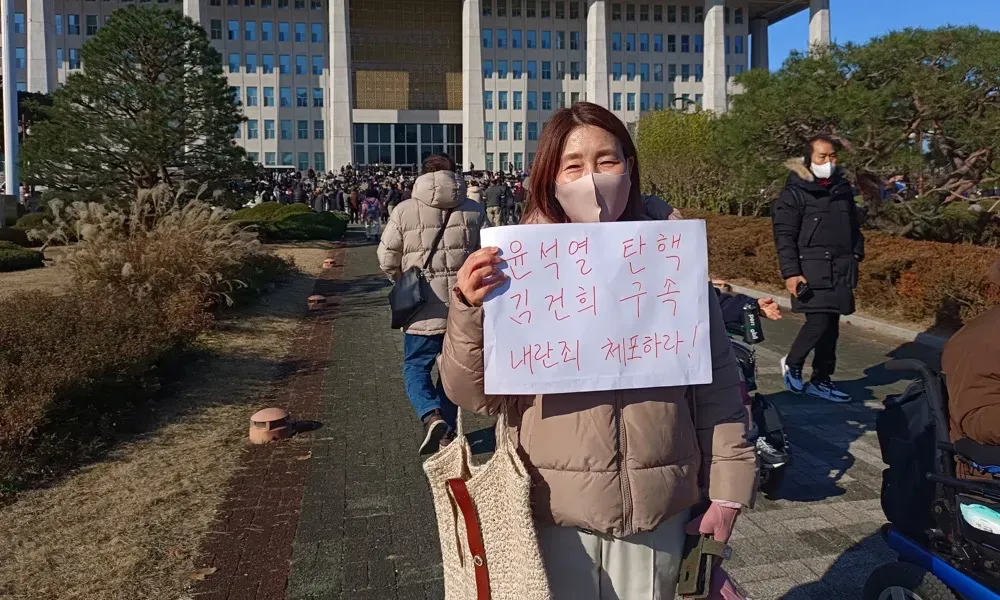
Son Jeong-hee (손정희) went to Seoul to protest against President Yoon. Photography: Raphael Rashid/The Guardian
The night before, the National Assembly building was surrounded by hundreds of police officers, the military entered the building, and military helicopters hovered in the air, the whole scene was more shocking and real than any drama movie.
For 60-year-old Zhao Taeyi, the events of the past half-day made him recall the painful history.
"I witnessed the whole process of the Gwangju Democratization Movement," Zhao Taeyi recalled. He was referring to the decisive democratic movement in 1980, however, this movement was eventually suppressed by the military, and hundreds of innocent people were killed.
"Democracy should not be like this. Trust between the people and the government is crucial, but the current government obviously cannot do this at all," he said emotionally.
Yoon Suk-yeol's reason for announcing martial law was "to protect the free Republic of Korea from the threat of North Korean communist forces," and "to eliminate pro-North Korean anti-national elements."
However, these words are obviously in line with the past methods of using panic to consolidate power, and are similar to the wording of South Korea's controversial National Security Law, which has long been used to prohibit so-called "anti-government behavior." This vague term has been used repeatedly in history to suppress government critics, and a series of repressive measures have been implemented under the name of "preventing the North Korean threat."
Although North Korea's provocations are indeed worrying, and the relationship between the two countries has been tense since the Korean War, the claim that there is a significant "pro-North" movement within South Korea can only be regarded as a far-fetched political argument at best.
"National Shame"
Yoon Suk-yeol's statement immediately triggered strong reactions from all political factions in South Korea, especially within the conservative camp. Although the Chosun Ilbo has consistently supported the Yoon Suk-yeol government, the newspaper published a strongly worded editorial, stating that Yoon Suk-yeol had "seriously overstepped the line" and calling the move a "national disgrace." The newspaper emphasized that as a top ten democratic country, South Korea should not tolerate such behavior.
A Seoul university student who wished to remain anonymous excitedly said: "This is just like a coup, I thought this kind of thing only existed in textbooks... It's completely unimaginable... It's so embarrassing."
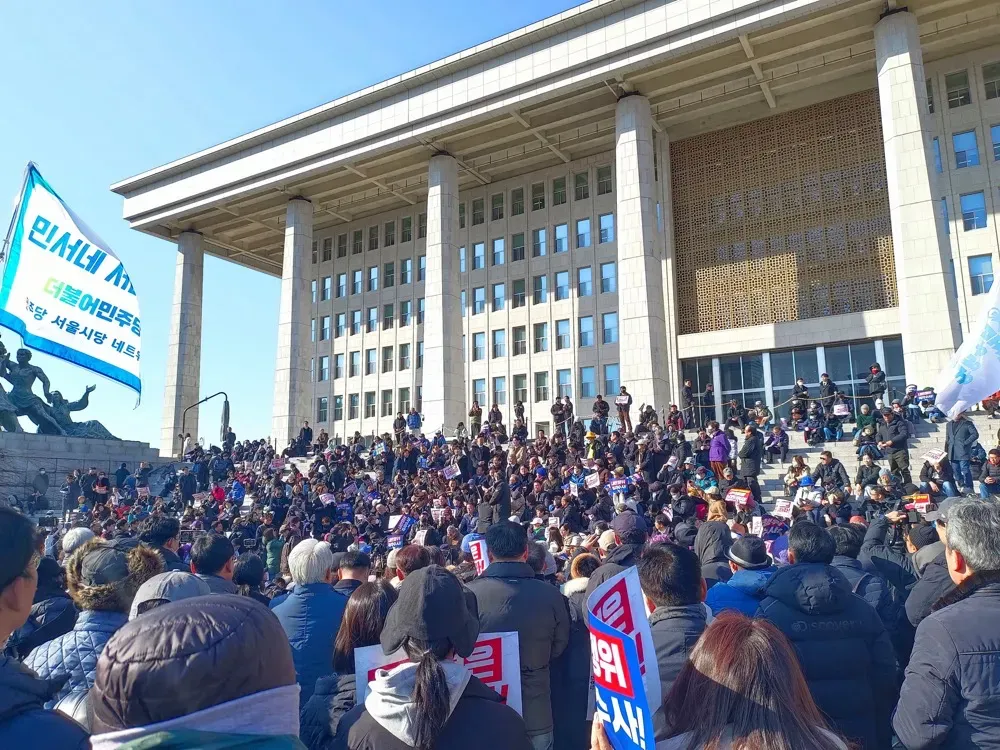
People protest outside the National Assembly building in Seoul, demanding that President Yoon Suk-yeol resign. Photography: Raphael Rashid
But in fact, this crisis was not without warning. In September of this year, Democratic Party lawmakers such as Kim Min-seok warned that Yoon Suk-yeol had repeatedly appointed his high school classmates to important security positions, including key positions in the Ministry of National Defense and the Defense Counterintelligence Command.
They pointed out at the time that President Yoon's personnel appointments, as well as his increasingly frequent use of the term "anti-national forces" to attack critics, showed that he might be preparing to announce martial law. However, these warnings were dismissed as alarmist at the time.
Professor Ko Min-hee, an associate professor of political science at Ewha Womans University, is deeply concerned about this, and she called Yoon Suk-yeol's decision "very bad and meaningless."
She pointed out: "The president seems to completely misunderstand the representation of political parties and does not understand the function of the National Assembly," she further warned, "The country will once again experience great turmoil, and the calls for the president to resign or be impeached are rising rapidly."
Although the opposition parties have called for the impeachment of Yoon Suk-yeol, the prospect of this process is still complicated and heavy. In order to obtain a sufficient two-thirds majority in the parliament, the opposition parties need the support of at least eight members of President Yoon's party. However, the Constitutional Court currently has only six judges, instead of the usual nine, which means they lack at least seven judges to hear such cases.
Scandals in the Yoon Suk-yeol government have been continuous, especially his wife, Kim Keon-hee, who was accused of receiving a Dior handbag worth 3 million won (approximately 1,675 pounds) from a pastor. Yoon Suk-yeol and his supporters deny these accusations, insisting that they are political defamation against them.
International observers have also noted that under Yoon Suk-yeol's leadership, South Korea's democracy has regressed. A recent report released by the V-Dem Institute shows that South Korea's free democracy ranking has plummeted from 28th last year and 17th in 2021 to 47th in the world.
The Global Civil Society Alliance Civicus also warned that since Yoon Suk-yeol took office, South Korea's civil liberties have been severely eroded, especially in the suppression of media freedom and the crackdown on trade unions.
Professor Ko Min-hee of Ewha Womans University said: "I think the president does not know how to deal with these pressures through political means—deliberation, persuasion, and communication." Yoon Suk-yeol, as a former prosecutor general, must have gathered a group of highly homogeneous people around him, and they are all in a strict hierarchical system. This culture is full of persecution, is usually black and white, and tends to denigrate and punish those who hold different opinions.
For many South Koreans, Yoon Suk-yeol's brief attempt at martial law confirms their concerns about his government's authoritarian tendencies.
Outside the National Assembly, protester Son Jeong-hee is also reflecting on the future path: "No one thought this situation would happen again... but we have to defend our democracy again in the warm sunshine."
By: Raphael Rashid
Source of the article: The Guardian
Seoul Winter, the First Lady and the Martial Law Past
By/Ximen Bu'an
At 2 a.m. on December 4th, there were still more than 1,000 people watching the film "Spring in Seoul" on Bilibili, and I woke up at dawn and watched the live broadcast on Phoenix.com in my Moments, and the latest news from netizens. This martial law, which has led South Korea to a coup in 44 years, has attracted the attention of many Chinese people. A friend said that Chinese people are more interested in the US election and the South Korean coup than domestic issues. That's true, now besides discussing Fu Peng and Gao Shanwen's speeches, what else can we talk about in domestic issues?
At the beginning of the martial law, some people said that the South Korean First Lady was a femme fatale, and I don't quite agree with this statement.
Superficially, it is related to the investigation of Yoon Suk-yeol's wife, but the National Assembly, which was established in June this year, has already impeached ten government officials, and the opposition party's majority position in the parliament has brought Yoon Suk-yeol and Lee Jae-myung's political struggle to the level of hand-to-hand combat. The struggle between the conservatives and the progressives has reached the level of a bayonet fight. Yoon Suk-yeol bypassed the internal consultations of the ruling party and directly asked the military to issue a martial law order. This kind of desperate behavior is difficult to understand, but there are also deep reasons behind it.
01
South Korea's Previous Martial Law Orders
Let's take a look at the martial law orders issued by South Korean presidents from the Third Republic to the Fifth Republic.
In the modern political history of South Korea, the promulgation of martial law is often accompanied by political turmoil and social unrest.
In the Park Chung-hee era, the military coup in 1961 and the subsequent martial law began a long period of military dictatorship. Park Chung-hee dissolved the National Assembly, banned political activities, and firmly controlled power in his hands. This dictatorship, which sacrificed economic development, although it made South Korea's economy gradually take off, also sacrificed democracy and freedom.
In 1972, Park Chung-hee issued martial law again, further strengthening the dictatorship. During this period, domestic social contradictions continued to accumulate, and the people's calls for democracy gradually rose in repression. And the United States, out of Cold War strategic considerations, gave support to the Park Chung-hee regime.
In 1979, a series of martial law orders before and after Park Chung-hee's assassination plunged South Korean politics into extreme chaos. Chun Doo-hwan launched a military coup in 1980 and expanded the scope of martial law, continuing military dictatorship.
The two presidents who issued martial law were the number one and number two dictators in South Korea's modern history. One died from the shooting of his subordinates, making a huge contribution to the prosperity of South Korean films, such as "The President's Men" and "Spring in Seoul." The other one had a good ending, but made an even greater contribution to South Korean films, and there are nearly ten classics about the Gwangju Uprising alone.
After Chun Doo-hwan, South Korea has not issued a martial law order for 44 years.
02
The Political Struggle Between Yoon Suk-yeol and Lee Jae-myung
The political struggle between Yoon Suk-yeol and Lee Jae-myung has been the focus of South Korean politics in recent years. After Yoon Suk-yeol took office, he was pro-American in diplomacy and actively participated in military exercises led by the United States, strengthening military deterrence against North Korea. This has greatly reduced South Korea's diplomatic autonomy and caused concern among many people of insight in the country. Domestically, the two-party struggle between Yoon Suk-yeol and Lee Jae-myung, the leader of the largest opposition party, is in full swing. Yoon Suk-yeol is trying to suppress the opposition through judicial and other means, which has sparked widespread controversy over the checks and balances of power and political manipulation.
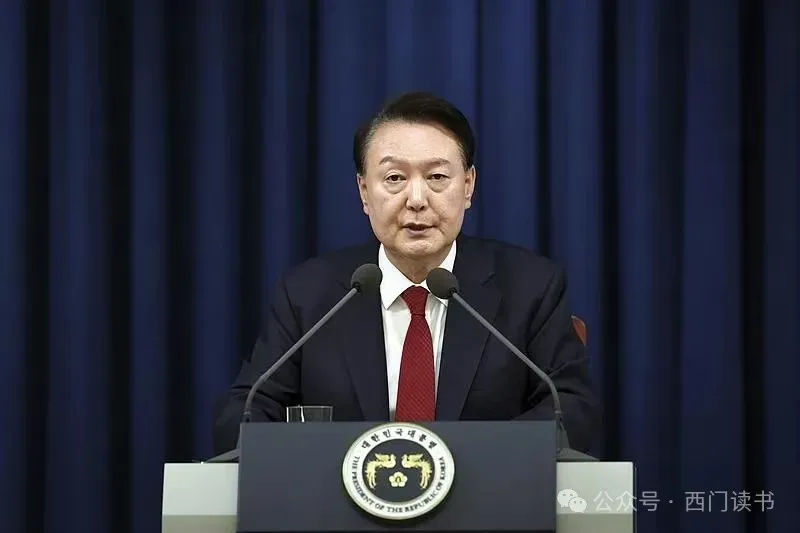
△ South Korean President Yoon Suk-yeol
Lee Jae-myung, on the other hand, has been tit-for-tat, criticizing and questioning the Yoon Suk-yeol government on economic and people's livelihood, diplomatic policies, and other aspects, leading to a serious division in South Korean society and an increasingly prominent phenomenon of political polarization. Lee Jae-myung's rise has been called the South Korean version of "Trump," and his political influence has not diminished due to his defeat in the election, but has instead gained more sympathy and support because of the narrative of "political persecution."
The current Yoon Suk-yeol is a lame-duck president. The parliament has 300 seats, and the opposition Democratic Party and its satellite parties have a total of 175 seats, while the ruling People Power Party and its satellite parties have only 108 seats. At the parliamentary level, the president's struggle with his political enemies is always at a disadvantage, but he has found an excuse for his coup, warning of the national security problems brought about by the North Korean regime to the current South Korea.
03
Why Go All In
The underlying reasons for Yoon Suk-yeol's issuance of martial law are complex and diverse.
First, the Yoon Suk-yeol government is facing tremendous pressure from the opposition parties. Since the government took office, the National Assembly has initiated 22 motions to impeach government officials, and since the 22nd National Assembly was established in June this year, it has launched impeachment actions against the 10th official. Yoon Suk-yeol believes that the National Assembly intimidates judges, impeaches a large number of prosecutors, paralyzes judicial work, and attempts to impeach the Minister of Public Administration and Security, the Chairman of the Broadcasting and Communications Commission, the Auditor General, and the Minister of National Defense, even paralyzing the entire administrative system.
Secondly, the Yoon Suk-yeol government's failure in economic, people's livelihood, and price control, as well as the related controversy of First Lady Kim Keon-hee, have led to a continuous decline in its public support. The investigation of Kim Keon-hee has seriously damaged the image and credibility of the Yoon Suk-yeol government, intensified the public's concerns about corruption at the high level of the government, and the public's trust in its government has plummeted, greatly weakening its legitimacy to govern.
Furthermore, the conservative People Power Party led by Yoon Suk-yeol is at an impasse with the Democratic Party over the 2025 budget bill. He has also consistently refused to conduct independent investigations into scandals involving his wife and senior officials, which has drawn rapid and strong condemnation from his political opponents.
04
After the Coup
After Yoon Suk-yeol announced the implementation of "emergency martial law," many parties expressed their opposition. Han Dong-hoon, the leader of the ruling People Power Party of South Korea, said: "The president's declaration of martial law is wrong, and we will stop it together with the people."
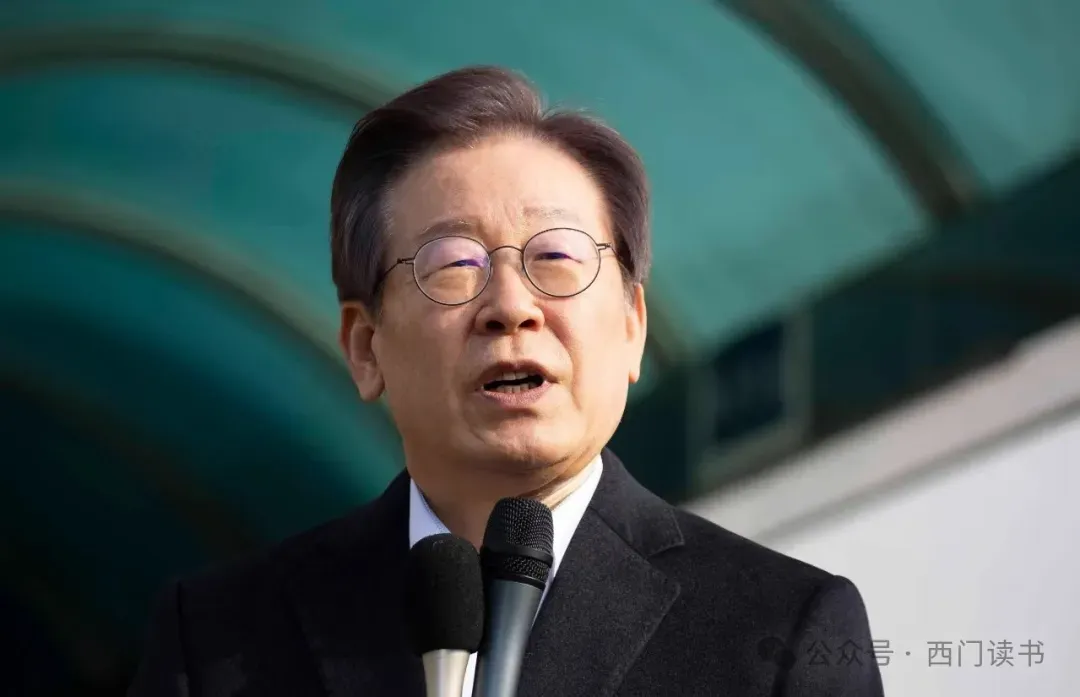
△ Lee Jae-myung, leader of the largest opposition party, the Democratic Party of South Korea
Lee Jae-myung, the leader of the largest opposition party, the Democratic Party of South Korea, arrived at the National Assembly building at around 11 p.m. on the 3rd and expressed his opposition to the martial law, saying, "Yoon Suk-yeol has betrayed the people. From this moment on, he is no longer the president of South Korea."
The South Korean National Assembly passed a resolution to lift the martial law order. Woo Won-shik, the Speaker of the South Korean National Assembly, said that the soldiers who had previously entered the National Assembly headquarters had all left. However, can the "fuse" that has been ignited be extinguished?
It is worth mentioning that Lee Jae-myung and the opposition party's members have a very strong consistency in their actions. Almost all members of the opposition party, led by Lee Jae-myung, arrived at the National Assembly within two hours under the condition of traffic interruption, with more than 180 people present. Lee Jae-myung himself walked 4.5 kilometers in the 0° blizzard and first snow of Seoul, and climbed over the 2.3m-high wall outside the National Assembly building to enter the National Assembly hall.
Yoon Suk-yeol's public support has been declining, and a survey released by the polling agency Gallup Korea on November 29 showed that his approval rating was only 19%, while the disapproval rating reached 72%. The reasons for the disapproval were "failure in economic, people's livelihood, and price control" (15%), "controversy related to First Lady Kim Keon-hee" (12%), and "diplomacy" (8%).
Some analysts said that the recent efforts of the South Korean opposition parties to promote legislation and impeach public officials such as prosecutors against the president's wife may be the fuse for Yoon Suk-yeol's announcement of "emergency martial law."
Regarding the phenomenon of the South Korean government's confrontation with the opposition parties spreading to the entire civil servant society, some experts pointed out that this situation has plunged the country into a state of uncertainty and chaos. The South Korean newspaper "JoongAng Ilbo" quoted Lee Jun-han, a professor of political diplomacy at Incheon University, as saying, "The number of bankrupt and closed enterprises is increasing, and the international environment is also changing rapidly. If the National Assembly and the government continue to shirk responsibility, the country will fall into a quagmire of uncertainty in economic, political, and international aspects."
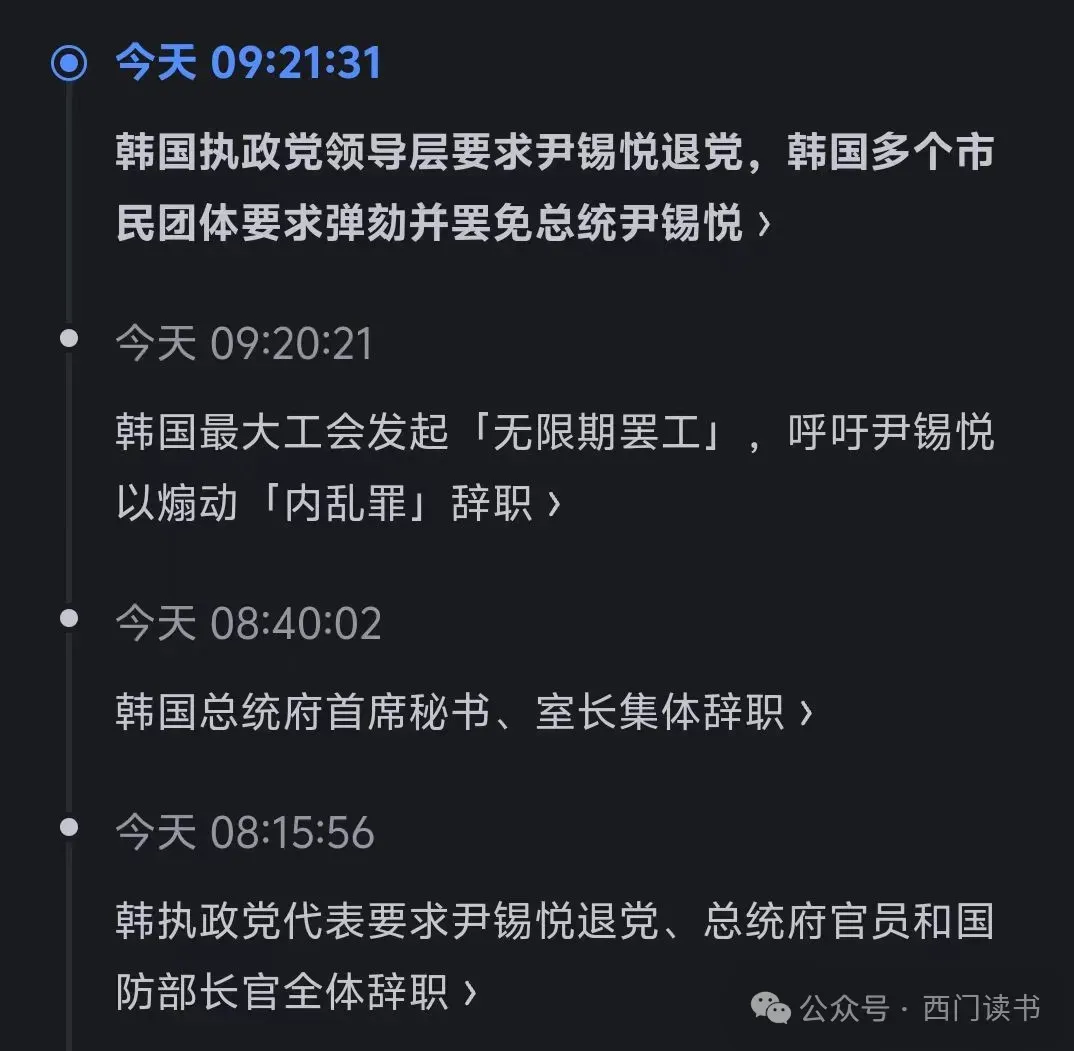
At present, the sudden situation in South Korea seems to have ended in a few hours, but there are reports that the main opposition parties in South Korea are calling for Yoon Suk-yeol to be held accountable for violating the constitution. What awaits this president is still unknown.
The complexity and uncertainty of South Korean politics are fully reflected in the event of Yoon Suk-yeol's announcement of martial law. The political struggle between Yoon Suk-yeol and Lee Jae-myung, as well as the domestic and international pressure faced by the Yoon Suk-yeol government, have jointly promoted the development of this event. Although the martial law was eventually lifted, its impact on South Korean politics, economy, and society is still continuing. The future direction of South Korean politics and Yoon Suk-yeol's political destination are full of uncertainty and variables.
Yoon Suk-yeol is the first South Korean president to move out of the Blue House, but his fate seems difficult to escape the fate of South Korean presidents, imprisonment, suicide, and being killed. Yoon Suk-yeol, who rashly launched martial law, may have to face a long prison term.
The issuance of martial law, failure is a coup, success is a revolution. Yoon Suk-yeol lacks the cunning of Park Chung-hee and the courage and decisiveness of Chun Doo-hwan, but only the recklessness of a common man. Who will he not lose?