


Recently, the term "ocean fishing" has frequently appeared in the media.
"Ocean fishing" refers to the act of judicial authorities arresting private enterprise owners in other locations and seizing the property of enterprises in other regions.
This phenomenon is called "ocean fishing" style case handling by the legal community.
"Ocean fishing" and "using criminal means to pay off debts" are collectively referred to as the "two evils" of robbing private enterprise property!
It was originally thought that both "using criminal means to pay off debts" and "ocean fishing" were merely isolated cases under special circumstances. However, the facts tell us that this is not an isolated case, but a phenomenon.
Recently, a "Guangdong Provincial Internal Reference" with a release date of April 15, 2024, was exposed to the public's view.
The "Internal Reference" states that Guangdong Province's "internet industry companies are suffering from profit-seeking law enforcement in other locations, making it difficult to survive". In recent years, Shenzhen, Guangzhou, Dongguan and other cities in the Pearl River Delta have become high-incidence areas for law enforcement in other locations. In Guangzhou alone, since 2023, nearly 10,000 enterprises, such as Pupu and Yi Health, have encountered law enforcement in other locations, mostly private enterprises, and most of them are obviously motivated by profit.
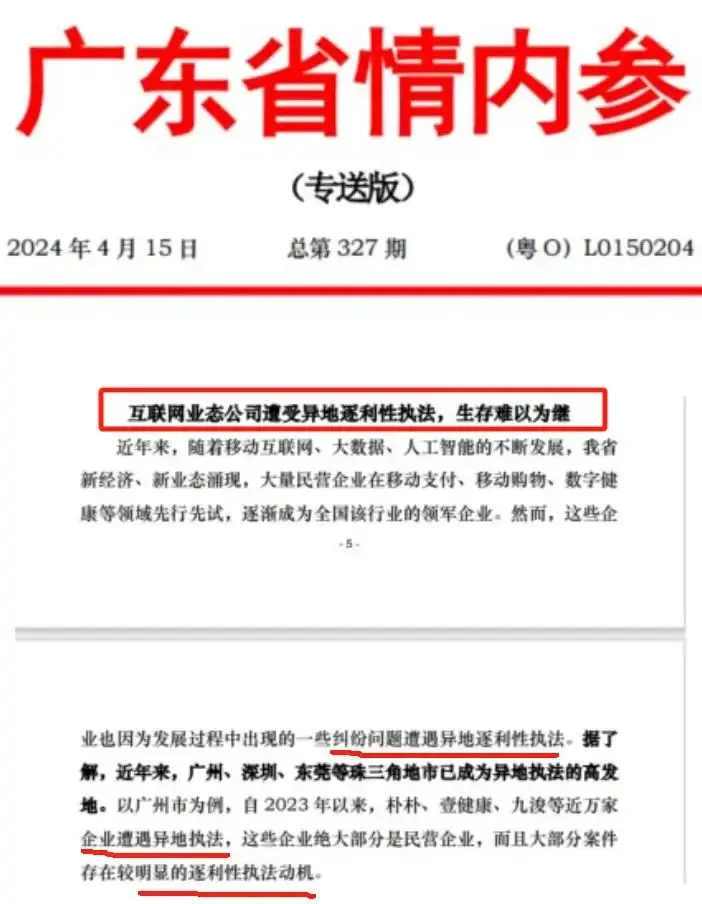
The Guangdong Provincial Internal Reference states that Henan Province dispatched more than 1,600 police officers to handle cases across provinces. The Public Security Bureaus of Jiaozuo and Shangqiu cities in Henan Province dispatched more than 1,600 police officers to Guangzhou City to "ocean fish" the subsidiaries of Yi Health Group. Originally, the total amount involved was only more than 600,000 yuan, but the case handlers in Henan successively froze 64 accounts of the group and froze 758 million yuan in funds. According to Yi Health, hundreds of employees have been questioned by the police, dozens have been criminally detained, dozens of accounts have been frozen with limits, and dozens of accounts have been completely frozen, involving hundreds of millions of yuan in funds, "the listing is in vain, and the enterprise is on the verge of bankruptcy".
The Guangdong Provincial Internal Reference states that Henan Province dispatched more than 1,600 police officers to handle cases across provinces. The Public Security Bureaus of Jiaozuo and Shangqiu cities in Henan Province dispatched more than 1,600 police officers to Guangzhou City to "ocean fish" the subsidiaries of Yi Health Group. Originally, the total amount involved was only more than 600,000 yuan, but the case handlers in Henan successively froze 64 accounts of the group and froze 758 million yuan in funds. According to Yi Health, hundreds of employees have been questioned by the police, dozens have been criminally detained, dozens of accounts have been frozen with limits, and dozens of accounts have been completely frozen, involving hundreds of millions of yuan in funds, "the listing is in vain, and the enterprise is on the verge of bankruptcy".
What kind of behavior is this?
This is a behavior that uses the guise of justice to carry out robbery.
Such behavior, one or two times, ten or twenty times, Guangdong may have held back and endured it for the sake of its brother provinces.
But with tens of thousands of incidents occurring one after another, any province would probably be "unbearable".
After all, such behavior, in a small way, seriously affects Guangdong's tax revenue and employment, and affects the sense of security of Guangdong's enterprise development. In a larger way, it seriously affects the harmony and stability of Guangdong Province and the whole country.
When malice is rampant, don't expect the innocent to remain silent.
This is true for individuals, and the same is true for a province.
Therefore, Guangdong has begun to fight back, introducing corresponding measures to protect the legitimate rights and interests of local enterprises as much as possible and reduce unnecessary interference.
The measures introduced by Guangdong Province have a fatal effect on those departments that are heavily engaged in "ocean fishing".
The measures stipulate that the Provincial Public Security Department and the Provincial Local Financial Supervision Bureau will form a linkage mechanism, stipulating that if cross-regional law enforcement needs to freeze the accounts of Guangdong's private enterprises, it must be approved by the Provincial Public Security Department, and cannot easily freeze the accounts of private enterprises across provinces based solely on a public letter from the public security organs of other provinces.
For operational property involved in cases that are not suitable for seizure, detention, or freezing, while ensuring the normal conduct of investigation activities, relevant parties are allowed to continue to use it reasonably, so as to minimize the impact on the legitimate production and operation of enterprises.

After the introduction of this measure in Guangdong Province, those departments that treat Guangdong's private enterprises as "Tang Monk's meat", drooling and rushing to Guangdong on the grounds of "suspected crimes" and carrying out "ocean fishing" will no longer dare to be presumptuous.
Prior to this, a police station in Hangzhou widely posted a notice of "anti-illegal enterprise case handling" for enterprises in its jurisdiction:
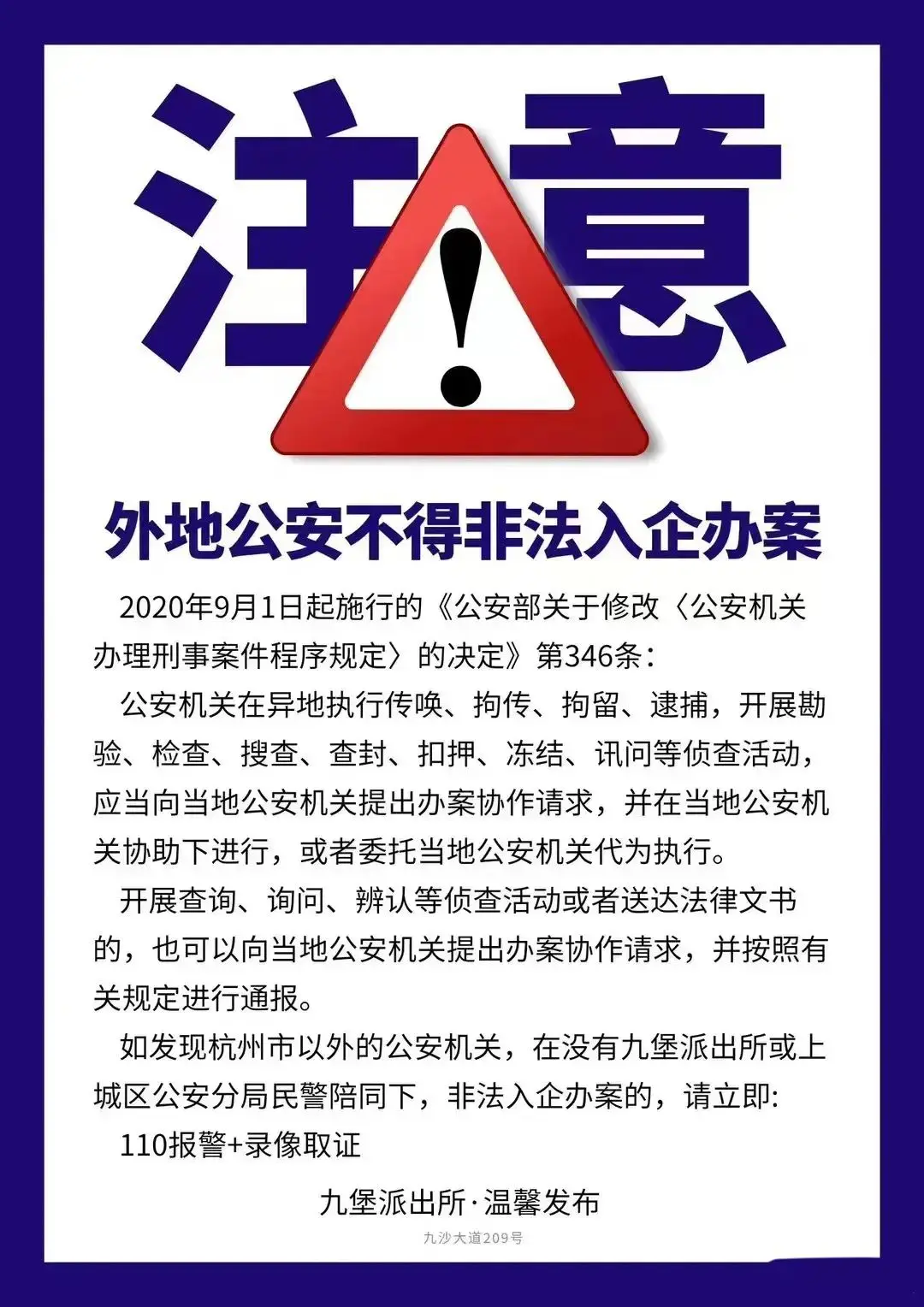
In addition, with the Zhejiang Xinhu Group being sentenced to billions of assets by a county-level court in Hubei some time ago, the official media officially fought back against "ocean fishing", and Zhejiang Province's efforts can be described as unyielding.
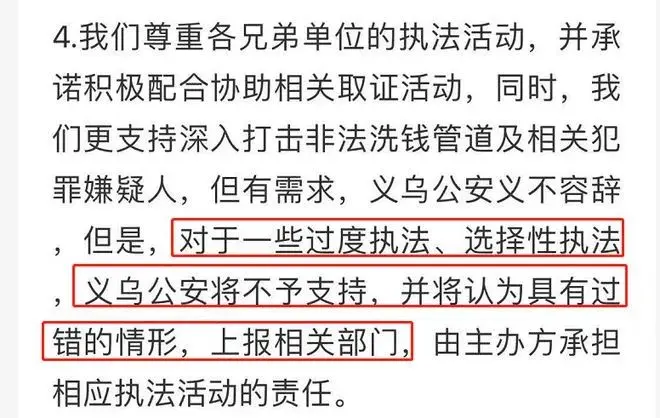
Earlier, in April 2020, Yiwu wrote a "Case Handling Reminder Letter" to its counterparts across the country for law enforcement in other locations. In addition to popularizing foreign trade common sense, it also warned that if excessive law enforcement and selective law enforcement are carried out, it will not be supported and will be reported to the higher authorities:
On October 14, a seminar on the prevention and governance of profit-seeking law enforcement was held in Beijing. The seminar brought together experts from the legal academic and practical circles to discuss the causes, harms, and governance suggestions of the phenomenon of profit-seeking law enforcement.
The profit-seeking law enforcement discussed at the meeting refers to the law enforcement behavior of law enforcement agencies that, in the process of law enforcement, pursue personal or departmental interests and adopt law enforcement behaviors that violate legal principles and principles of justice.
This behavior takes various forms, such as arresting enterprises or individuals in other locations to obtain benefits, and even freezing and transferring their property; some local governments and departments also pass down assessment indicators for fines and confiscation revenue, leading law enforcement officers to over-enforce the law in order to complete the indicators;
In addition, there are law enforcement officers who abuse their power in the process of law enforcement, arbitrarily impose fines, and seize property, and even threaten the survival of enterprises.
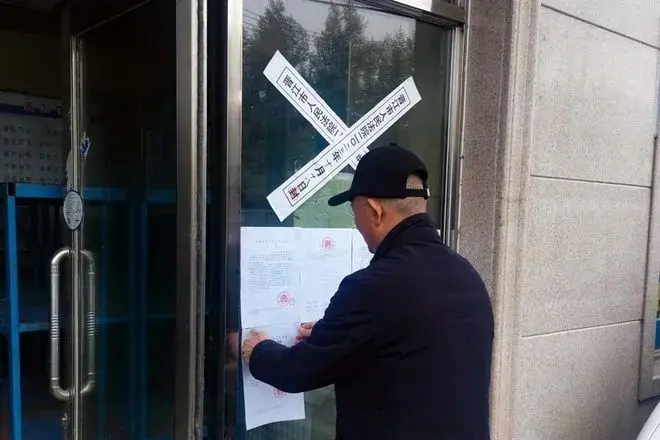
Legal experts attending the meeting suggested that cross-regional law enforcement case handling is not absolutely impossible, but it is necessary to set up a system of higher-level jurisdiction and joint superior approval, and to standardize the authority to take measures to restrict the personal freedom of senior executives of private enterprises. At the same time, it is recommended that the state level quickly carry out special rectification actions and establish a system of accountability for the main officials to curb the chaos of cross-regional profit-seeking law enforcement.
Profit-seeking law enforcement is not a new problem, but it has received more widespread attention in the context of current economic development.

At the end of September, the meeting of the Political Bureau of the Central Committee emphasized helping enterprises overcome difficulties and proposed to standardize law enforcement and supervision behaviors related to enterprises.
On October 8, Zheng Shanjie, Director of the National Development and Reform Commission, mentioned that it is necessary to standardize the administrative law enforcement behavior of administrative law enforcement units related to enterprises and resolutely prohibit illegal cross-regional law enforcement and profit-seeking law enforcement.
In addition, the "Law on Promoting the Private Economy (Draft)" also has relevant provisions on standardizing law enforcement and supervision behaviors related to enterprises.