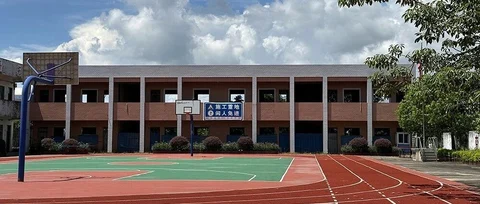



Shenzhen police reported that at around 8:00 a.m. today (18th), a case of a person with a knife injuring passersby occurred within the jurisdiction of the Zhaoshang Subdistrict, Nanshan District, resulting in the injury of a minor, Shen. "After receiving the report, our bureau quickly organized forces to the scene to handle the situation, apprehended the suspect Zhong (male, 44 years old) on the spot, and assisted 120 in sending the injured person to the hospital.""
This confirms the news from Nikkei Chinese Network that was trending on WeChat this morning: a boy attending the Japanese School in Shenzhen, Guangdong Province, China, was attacked and injured on his way to school. Hiroshi Moriya, Deputy Chief Cabinet Secretary of Japan, stated: "The suspect has been taken into custody by the authorities and is under investigation."
The Shenzhen police's actions were swift and timely, and the report was also quick, but there is still a point that is regrettable: The report did not mention that the injured minor was "a boy attending the Japanese School," and the term "Shen," seems to imply that he is a Chinese child.
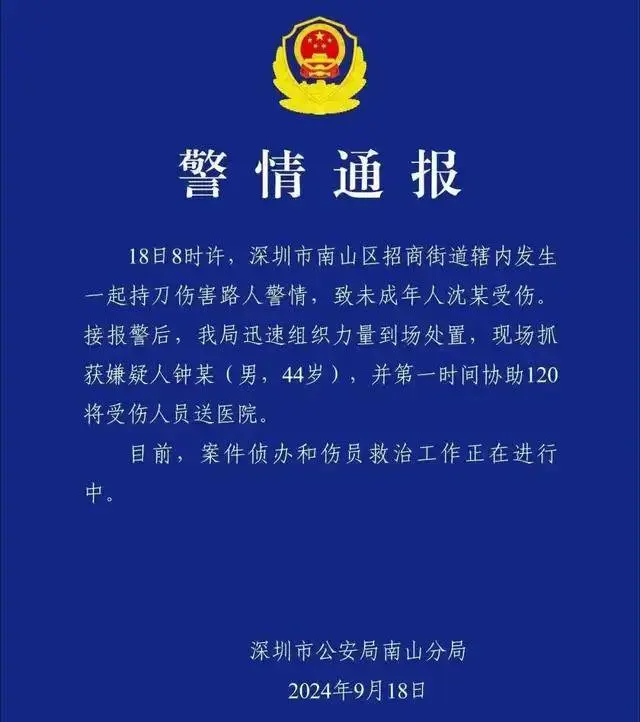
If the official Japanese news and the Shenzhen police report are the same incident, this "Shen" may be the Chinese name of a Japanese elementary school boy; it is also possible that he is a Chinese boy who has a relationship with Japan and happens to be attending the Japanese School.
Regardless, whether the injured elementary school student has any connection with Japan is the core issue of concern. A Chinese teenager being injured by a knife should also attract our attention; however, if it is "intentional harm to a Japanese elementary school student," then it is another matter. On the anniversary of "9/18," this issue is undoubtedly more likely to touch the nerves of the Chinese people.
"9/18" is a special day. At 9 a.m. this morning, the air raid sirens sounded in the city where I live. I believe that people who hear the sirens will feel a sense of solemnity, but "never forget national humiliation" and attacking a "Japanese child going to school alone" are two completely different things. I support the Chinese national football team defeating the Japanese national football team on the football field, but I cannot feel a hint of hatred towards the Japanese children of today.
Since the incident in Suzhou where a man attacked a Japanese school bus and Ms. Hu Youping was killed while protecting Japanese students, people have been paying extra attention to the safety of Japanese people in China, which is completely understandable. If "China is the safest country in the world," this sense of security should undoubtedly belong not only to Chinese citizens but also to foreigners working, visiting, and studying in China.
However, there has long been language attacks on "Japanese schools in China" on the Internet. This is a special category of videos, filming videos near Japanese schools, claiming to drive these schools out of China, and even threatening to use force... Such videos will of course be suppressed by relevant authorities, but they have never disappeared because they always have traffic on the Internet.
"Japanese schools" are the result of strengthening economic and trade relations between China and Japan, and are supporting policies of the initial introduction of foreign investment, allowing the children of related personnel of Japanese companies to attend school nearby, which can also make it easier for them to work. Whether it is Suzhou or Shenzhen, they both hold a positive attitude towards the development of Sino-Japanese economic and trade relations. For a long time, foreign investment and foreign enterprises have made great contributions to these two cities.
The occurrence of this kind of "public security incident" has a certain degree of contingency. I do not believe that the suspect in the Suzhou incident and the Shenzhen case are necessarily related to these videos. However, the relevant departments need to provide more information to the society, tell the suspect's motive for the crime, to reduce people's doubts.
People in various places are very grateful to Ms. Hu Youping, and she was eventually rated as an "outstanding" advanced individual; however, people know very little about the information about the murderer. What kind of person is he? Does he really hate the Japanese, or is he dissatisfied with life and randomly "retaliates against society"?
The relevant departments did not disclose the details, which can be understood as not wanting to link the public security incident with "narrow nationalism," but in terms of the effect of the spread, this may be counterproductive. "Nationalist sentiment" is the result of complex social interaction. The more mysterious and secretive, the more likely it is to form a "spiral of incitement," which excites some extremists.
The "spiral of incitement" is of no benefit to the current social and economic development, a friend believes that the frequent occurrence of attacks on Japanese children will accelerate the withdrawal of Japanese companies, which is a reasonable "logical inference."
In such incidents, "ambiguity" will only make things worse. This society needs to be clear and transparent, to punish those who commit crimes, and to make their motives public. We must boldly tell the world: ordinary Chinese people are not that extreme.