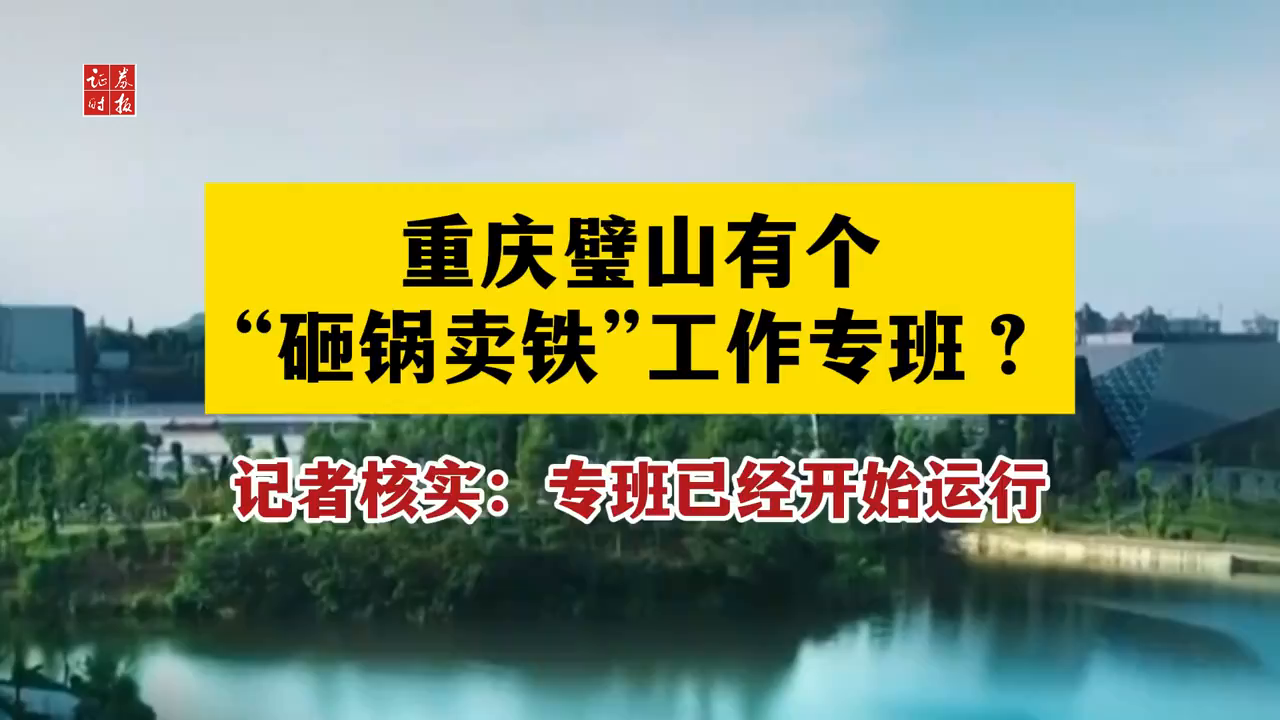
Recently, two terms have become very popular: one is housing pension, and the other is ‘smashing pots and selling iron’. Both terms have sparked widespread discussion in society.
One of the reasons for the discussion is that, as a form of policy language, both are very non-standardized. If, in the future, people search historical materials and find that there was a department called the ‘Smashing Pots and Selling Iron Task Force’, they will be laughed at.
In fact, I know that both measures are addressing problems that need to be solved, and they also indicate the intention to solve these problems. But using the above expressions, the effect may be counterproductive.
For example, the issue of housing pensions. Most of China’s current residential buildings were built in the past 20 years. Due to aging and, more importantly, due to the quality of construction, how to repair them in the future and how to ensure the safety of living are indeed very realistic problems.
And ‘smashing pots and selling iron’, according to relevant documents, is to solve the debt problem of local governments through asset disposal and realization. The heavy debt burden of local governments is known to everyone, and there is no need to elaborate here. I think that the so-called ‘smashing pots and selling iron’ also shows a determination to solve this problem.
Let’s put aside the content and right or wrong of these two things for now, and just talk about the way they are expressed.
Housing pension and smashing pots and selling iron, on the surface, are very colloquial, very vivid, very lively, and very down-to-earth language. But if you think about it carefully, this kind of language has a common characteristic, which is non-standardization. In life, this kind of language is easy to understand, but once it becomes policy language, it often becomes vague and even causes misunderstandings.
What is a housing pension? Who provides for the house? Does a person in their sixties or seventies have to provide for a house that is more than a decade old? Then, a series of questions arise: What is the legal basis for this policy? Who pays the money? Who uses it? How is it used? The saying ‘smashing pots and selling iron’ may cause more ambiguity. Some people joked, why smash the pots and sell them? Wouldn’t it be more valuable to sell the pots directly?
Let me digress a little here.
Recently, I chatted with an entrepreneur. In the chat, he used the word ‘fright’ several times. I know he was talking about the issue of uncertainty. In fact, I have been talking about this issue in the past few years. Uncertainty is a very realistic problem now, and an important reason for this uncertainty is the frequent changes and ambiguity of policies.
There is a recent joke: the two richest people take turns selling off their shares, neither of them wants to be the richest. After selling off their shares, they found that they were still the richest, but their net worth had shrunk a lot. This is the so-called involution. Everyone knows that this is talking about Pinduoduo and Nongfu Spring. On August 26, Pinduoduo’s stock price fell 28.51%, and its market value evaporated by 55.37 billion US dollars in a single day, equivalent to 394.6 billion yuan, the largest drop since its IPO. On August 28, news came that Nongfu Spring’s stock price plummeted by more than 11%.
The sharp decline of these two stocks is very worth pondering. Although the saying that the two richest people take turns selling off their shares is a joke, it is obvious that Pinduoduo’s stock price fell by nearly 30% in one day, which is directly related to the cold wind blown by the management. The decline in Nongfu Spring’s stock price is directly due to the first significant decline in revenue. But everyone knows that this decline in revenue is not unrelated to the large amount of public opinion attacks and malicious slanders against the company and its founder on the Internet some time ago.
It seems a bit off topic, what does it have to do with the issues discussed earlier? What I want to say is, don’t think that language is a small problem, what kind of language a society uses reflects to a large extent what kind of atmosphere the society is. In recent years, there have been more and more harsh words. Don’t think that using harsh words from life can show the determination to do things. Using such harsh words too much will cause social tension, discomfort, and uncertainty.
The current economic downturn, of course, has many reasons. But everyone agrees that social psychology is also an important factor among these many reasons. This is the issue of entrepreneurs’ confidence and the public’s expectations. The former involves investment, and the latter involves consumption. And to restore or rebuild social confidence, the most fundamental way is effective rule of law, which is trustworthy rules.
And one of the reasons for the failure of the rules is that the rules themselves are vague.
Modern politics is a standardized and institutionalized politics that must operate on the track of the rule of law. Those down-to-earth, colloquial ‘popular sayings’ are often unclear in meaning, unclear in what they refer to, and vague in boundaries. Such sayings, which seem to be down-to-earth and close to the masses, can only reduce the degree of institutionalization and rule of law in social life and leave room for arbitrary abuse of power.
Therefore, I especially look forward to this situation: the text of a policy begins with: According to the relevant laws of the People’s Republic of China, Article so-and-so, paragraph so-and-so, this regulation is formulated, and then what the content should be, it is expressed in standardized language. In this way, the meaning is clear, easy to implement, and people will not misunderstand.
Modern social life should not make the operation of the country approach the level of everyday language, but should make the operation of social life approach the level of the rule of law and institutionalized language.
Discover more from 自由档案馆
Subscribe to get the latest posts sent to your email.