Recently, the website of the National People’s Congress of China published the “Administrative Penalties for Public Security (Amendment Draft)” and solicited opinions from the public.
It is worth noting that some clauses of Article 34 of the draft have sparked widespread discussion.
Article 34: Anyone who commits any of the following acts shall be detained for not less than five days but not more than ten days, or fined not less than 1,000 yuan but not more than 3,000 yuan; if the circumstances are more serious, they shall be detained for not less than ten days but not more than fifteen days, and may be fined not more than 5,000 yuan:
(1) Engaging in activities that damage the environment and atmosphere of commemorating heroes and martyrs in public places;
(2) Wearing or displaying clothing or symbols that damage the spirit of the Chinese nation and harm the feelings of the Chinese nation in public places or forcing others to do so;
(3) Producing, disseminating, publicizing, or spreading articles or speeches that damage the spirit of the Chinese nation and harm the feelings of the Chinese nation;
(4) Desecrating or denying the deeds and spirit of heroes and martyrs, publicizing and glorifying aggressive wars and aggressive acts, provoking trouble, and disrupting public order;
(5) Infringing upon the names, portraits, reputation, and honor of heroes and martyrs through insult, defamation, or other means, and harming social public interests;
(6) Occupying, destroying, or defiling memorial facilities for heroes and martyrs.
Regarding the above-mentioned controversial clauses, Professor Lao Dongyan, a professor of criminal law at Tsinghua University, said that she was somewhat incredulous after seeing the content of Article 34 of the “Administrative Penalties for Public Security (Amendment Draft)” and only knew that it was true after checking on the website of the National People’s Congress of China.
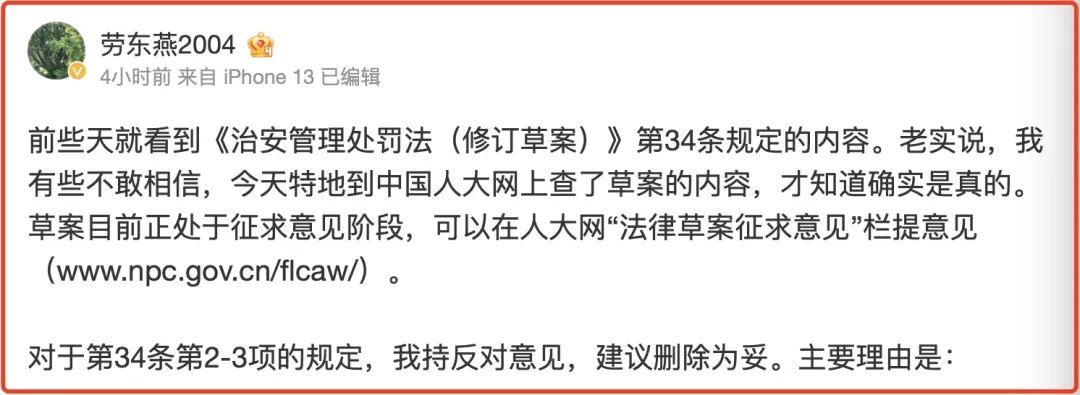
Lao Dongyan said that she opposes the provisions of the second and third paragraphs of Article 34 of the draft and suggests that they be deleted. The reasons are: First, “damaging the spirit of the Chinese nation and harming the feelings of the Chinese nation” is a concept with extremely vague connotations, and different people have different understandings and interpretations. If it is used as a legal standard for punishment, it will inevitably face the problem of vague punishment standards, which is likely to lead to an arbitrary expansion of the scope of administrative penalties.
Second, due to the vague punishment standards, it will inevitably lead to selective law enforcement by administrative power, which is likely to create new space for the breeding of corruption, and may also intensify conflicts between the police and the people, bringing new risks to social stability.
Third, the state’s power directly interferes in the field of citizens’ personal daily attire, which is obviously excessive intervention. The national spirit and national feelings belong to the cultural and spiritual level, and the state can advocate them, but should not promote them through legal compulsion.
Fourth, such legislative provisions may stimulate the rampant spread of populism or extreme nationalism, further worsen the public opinion environment, and unduly suppress the freedom of individuals in daily clothing and speech. At the same time, it may also exacerbate the confrontation with some countries, leading to diplomatic passivity.
Professor Zhao Hong of China University of Political Science and Law also wrote that whether offending national feelings should be criminalized and punished has always been a hot topic of public opinion. Modern criminal law generally uses legal interest infringement as the benchmark for weighing criminalization and punishment, the purpose of which is to provide a basis for the legitimacy of the state’s power of punishment through legal interests, and to screen out those behaviors that do not need or should not be punished by law. In other words, if the state prohibits a certain behavior by criminal punishment or administrative punishment, it is not based on the protection of legal interests, then the law’s interference with personal freedom is not legitimate.
Zhao Hong said that, in general, mere emotional offense, moral perversion, or even violation of taboos and self-harm are not among the legal interests protected by criminal law. This is because the generalized moralized legal punishment appeals to abstract concepts such as public emotions and social values as the basis for punishment, which will not only condone the abuse of public power, but also transform criminal punishment and administrative punishment into tools for promoting certain moral concepts, thereby harming the rights and freedoms guaranteed by the rule of law.
However, Zhao Hong also mentioned that it does not mean that offending national feelings should not be criminalized and punished, but when the legislator stipulates it, it must comprehensively examine and weigh multiple interests, including the seriousness of the offense, whether the audience has become unavoidable to the offense, and the degree of harm of the offensive behavior to personal rights and social values. If the seriousness of the offense is overestimated and the offensive behavior is over-interpreted, it is easy to cause excessive suppression of personal freedom. “Damaging the national spirit and harming national feelings” as a relatively abstract concept, in specific practice, is often replaced by the personal cognition of public officials, thereby evolving into a tool for others to launch moral trials and even launch state punishment. We must be vigilant about this.
Zhao Hong believes that expanding the scope of punishment also means the expansion of the authority of the public security organs. For this expansion of authority, the law must be equipped with corresponding restraint mechanisms, otherwise the crackdown and suppression of emerging illegal behaviors is likely to breed unrestrained and uncontrolled power.
Tong Zhiwei, a professor of constitutional law at East China University of Political Science and Law, also suggested that Article 34, paragraphs 2 and 3 of the “Administrative Penalties for Public Security (Amendment Draft)” should not be reviewed for the time being.
Tong Zhiwei is worried that if the Standing Committee of the National People’s Congress passes this article according to the current draft, it will inevitably lead to the actual consequences of arresting and convicting people according to the will of the chief, which will be harmful in the long run.
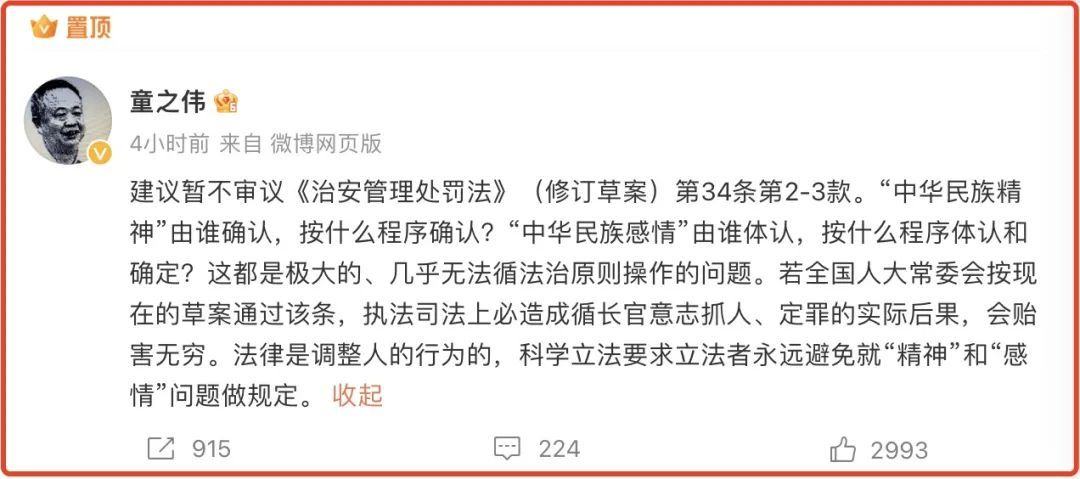
Tong Zhiwei said that the law is to regulate people’s behavior, and scientific legislation requires legislators to always avoid making provisions on “spirit” and “feelings”.
Compiled from media reports, Professor Lao Dongyan’s Weibo, Professor Zhao Hong’s article in the “Details of the Rule of Law” column of The Paper, and Professor Tong Zhiwei’s Weibo
Discover more from 自由档案馆
Subscribe to get the latest posts sent to your email.