Tokyo Electric Power Company (TEPCO) admits that 66% of the stored nuclear wastewater exceeds the standard for radioactive substances, what a terrifying headline! Does this still give supermarkets a chance to replenish the salt that has been snatched up?
In addition, IAEA live-streamed real-time data showing that the amount of radioactivity released by the Fukushima nuclear power plant is far below the designed upper limit, with tritium emissions of only over 200 Bq/L. The upper limit of the emission plan is 1500 Bq/L, while the WHO drinking water limit is 10,000 Bq/L. In other words, under the already very conservative emission limit, the actual emissions are now even more conservative. As a result, the Chinese internet was not happy, and they pointed out: These data all come from TEPCO, and the IAEA has never independently sampled or tested. TEPCO and the IAEA have only tested a few radioactive elements, and there are many that have not been tested, and so on.
Okay, let’s take advantage of the fact that the account is still active and continue this ridiculous journey of debunking the nuclear wastewater rumors.
The explosive news that 66% of the nuclear wastewater stored by TEPCO exceeds the standard for radioactivity. When I saw this 66% figure, I was amused. Does the reporter who reported this news think this is bad news? If this number is true, it’s very good news, it’s great!
Why? Because according to the data released in April 2021 when Japan announced its preliminary plan for the discharge of nuclear wastewater, in December 2020, 71% of the nuclear wastewater stored by TEPCO exceeded the standard for radioactivity—that is, it did not meet the level that could be discharged:
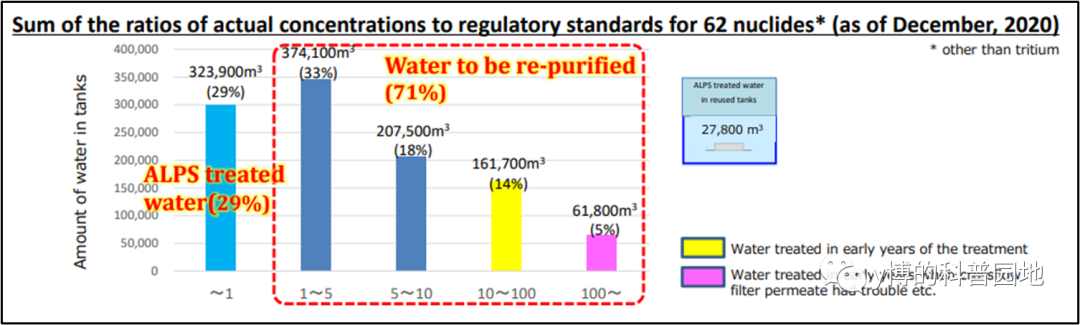
Less than two years have passed since the end of 2020, and the proportion of exceeding the standard has decreased from 71% to 66%, a decrease of 5%. Isn’t this good news?
Considering that today’s reporters seem to be more specialized in intimidation than in journalism, we still need to explain it in more detail.
There are two types of indicators for the discharge of Fukushima nuclear wastewater, one is tritium, and the other is other radioactive elements besides tritium.
Why are they divided into these two categories? Because the nuclear wastewater collected from Fukushima will be treated by a system called ALPS. This system can adsorb and remove 62 kinds of radioactive elements. There are two radioactive elements that cannot be removed in the nuclear wastewater, one is tritium, and the other is carbon-14. The content of carbon-14 itself is very low, so it is considered together with other radioactive substances besides tritium.
Tritium is different. The tritium in these nuclear wastewaters exceeds the standard, so how to make tritium meet the standard needs to be considered separately during discharge.
TEPCO’s approach is to use ALPS to make all radioactive substances other than tritium meet the emission standards, which is the 1 shown below the 29% ALPS treated water in the figure. Excluding tritium, the total radioactivity ratio of all radioactive substances is 1. Tritium is diluted by more than 100 times the seawater before discharge to reduce its concentration and meet the emission standards they set—1500 Bq/L, which is one-seventh of the WHO drinking water standard.
Many people online argue that the actual ALPS treated water rarely meets the standard, and most of it does not. This is not a new discovery by netizens. TEPCO, the Japanese nuclear energy regulatory agency, the Japanese government, and the IAEA have long known about it. Even if you look at the figure, 71% of the non-compliant at the end of 2020 are framed and written as being re-treated with ALPS.
And the results of the re-treatment have also been shown:
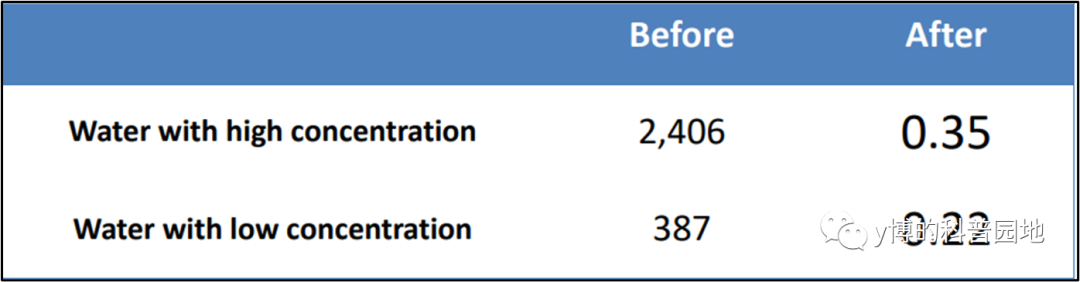
Excluding tritium, the total radioactivity after the first treatment was more than 2400, and after another ALPS treatment, it was only 0.35, which meets the emission standards.
At the end of 2020, 71% of the radioactivity other than tritium exceeded the standard and needed to be re-treated. Now it is only 66%, a decrease of 5%. Doesn’t this prove that the re-treatment is very successful? The radioactivity exceeding the standard in the nuclear wastewater stored in Fukushima is decreasing, and the total amount of radioactive substances to be treated is also decreasing. Isn’t this good news?
Besides, what does it matter if 66% of the wastewater stored exceeds the standard? Those that exceed the standard will remain there. Only those that meet the standard will enter the sequence waiting for discharge. As long as there is a mechanism to confirm that it meets the standard during the final discharge, you can ignore how much inventory does not meet the standard.
It’s like asking a junior high school student to do a mock exam for the college entrance examination. If they don’t reach the first-tier university line, should we blame the teacher’s teaching level? Or should we say that this child won’t be able to go to college in the future? It doesn’t matter at all. The child is still far from the college entrance examination and needs to continue studying.
Speaking of how much of the stored nuclear wastewater has not yet met the standard, let’s talk about the detection of Fukushima nuclear wastewater discharge. Yes, that is, many people are clamoring that the data is all from TEPCO, and the IAEA did not conduct its own tests, or that they were all sampled unilaterally by TEPCO, and many radioactive elements were missed.
These can all be disproved by reading the IAEA report.
First, let’s talk about the types of radioactive elements detected. Which radioactive elements should be detected (or are worth detecting), the IAEA explained very clearly in its comprehensive report released on July 4 this year:
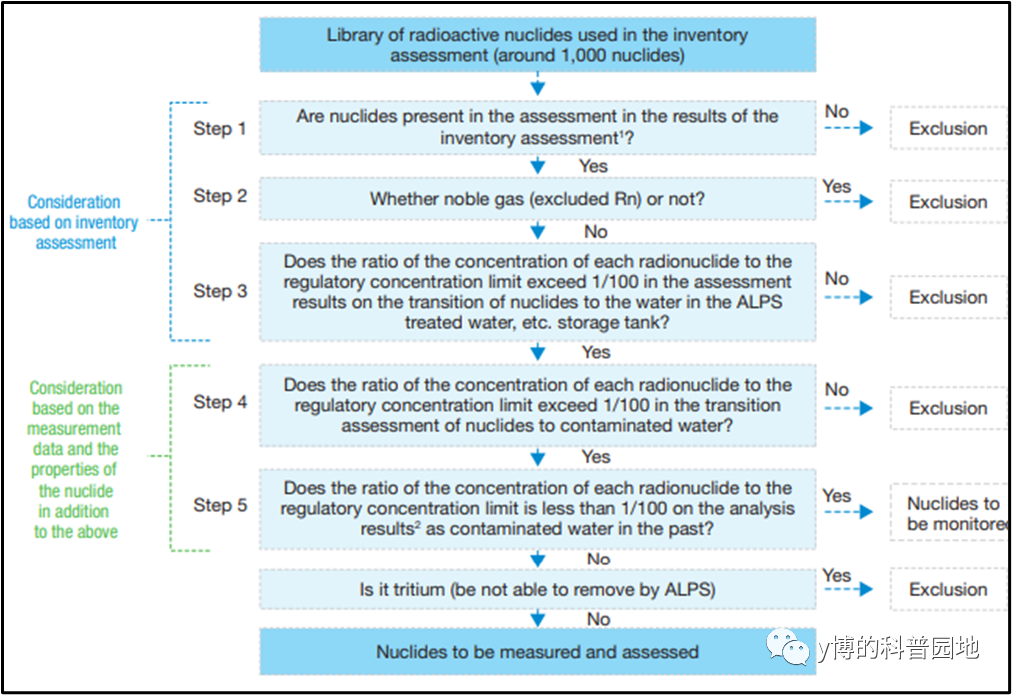
Nuclear wastewater is contaminated because it comes into contact with the nuclear reactor, so the first step is to analyze the radioactive elements that still exist after 12 years of cooling of the Fukushima nuclear power plant’s reactors 1-3—because these are the only potential sources of pollution. Then consider which radioactive elements have reached a level that may be worth paying attention to, such as some elements that do not need to be treated by ALPS and are already below one percent of the emission standard, which also needs to be detected (the initial amount is far less than the emission standard).
Based on the above deductions based on science and real data, the IAEA, the Japanese nuclear energy regulatory agency, and TEPCO have determined 37 radioactive elements that need to be detected: tritium (which exceeds the standard in ALPS treated water, and it also needs to be detected to determine the emission amount and the dilution ratio of seawater), 29 kinds of radioactive elements need to be tested for each batch of ALPS treated water and compared with their respective emission standards (only those that pass can enter the sequence to be discharged), and 6 kinds of radioactive elements that have never been detected will be spot-checked regularly (no need to check every batch of ALPS treated water).
This is also why ALPS can remove 62 kinds of radioactive elements, but there are not so many radioactive elements in the IAEA’s multi-laboratory test report. Because only a small part of them really exist in the nuclear wastewater and are worth testing.
Regarding the radioactive elements detected, the IAEA’s comprehensive report also has such a conclusion:

That is, except for tritium, carbon-14, and technetium-99, only 7 major radioactive elements (cesium-134 and 137, cobalt-60, iodine-129, strontium-90, Sb-125, Ru-106 and) can be frequently detected in ALPS treated water. The 37 radioactive elements currently detected include many elements that will not be detected at all, which is actually very conservative.
From the above assessment, it can also be seen that the so-called claims of multiple radioactive elements not being detected are obviously misleading.
In fact, in the multi-laboratory joint test report released in May 2023, the IAEA laboratories and independent laboratories from the United States, France, Switzerland, and South Korea were encouraged to test whether there were other radioactive substances in the ALPS treated water samples. The conclusion was that no other significant radioactive substances were found.
Let’s talk about TEPCO’s unilateral testing or the samples being all provided by TEPCO.
The multi-laboratory joint test report released in May clearly states that 7 laboratories participated and tested with TEPCO:
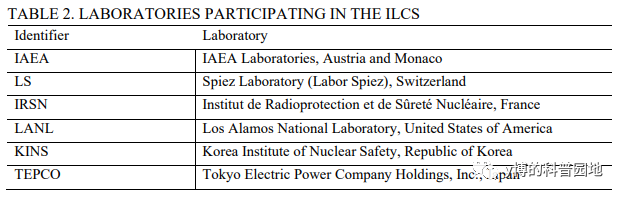
Three IAEA laboratories, one each from the United States, France, Switzerland, and South Korea. How can it be said that only TEPCO is testing? In terms of sampling, the joint test report also states that TEPCO completed the sampling under the supervision of the IAEA and immediately sealed it:
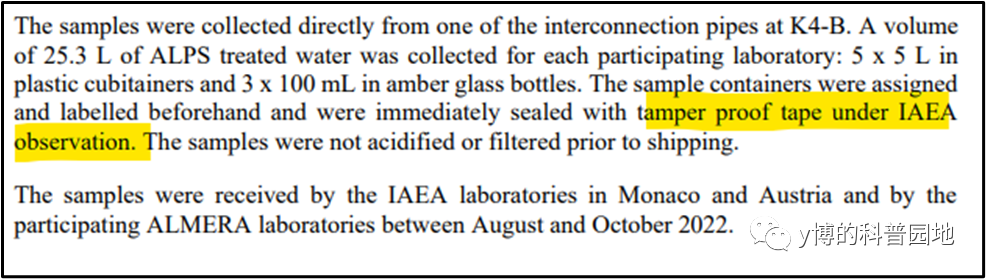
I’m not sure what some people online mean by independent sampling. Isn’t it independent enough to have IAEA supervision?
What is really worth paying attention to is why there are no Chinese laboratories participating in the joint tests that have been made public. Didn’t people online call for no independent testing? Then go and test. And the IAEA said that it welcomes the participation of third-party laboratories.
There are also some who say that not all nuclear wastewater has been tested. Yes, the joint tests only tested the samples from the K4-B water storage tank group, which are used in conjunction. But K4-B is the earliest to be discharged and is also the source of the nuclear wastewater currently being discharged. Similar to the 66% exceeding the standard, as long as it is confirmed to be problem-free before discharge.
In fact, the IAEA has completed the sampling for the second and third joint laboratory tests, which came from two other water storage tanks.

It’s just that the comprehensive report mentions that the independent laboratories participating in the second and third joint laboratory tests are the United States and South Korea laboratories, and the name of the Chinese laboratory is still not seen:
Now, even if China is not the most worried country in the world about the discharge of Fukushima nuclear wastewater, it is at least one of the most worried. Why haven’t we seen Chinese laboratories go to test, while we see reporters taking radiation meters to Fukushima (it is recommended that this reporter also take a radiation meter on the plane next time, and it is estimated that they will be frightened out of their wits)?
Finally, let’s talk about the issue of data originating from TEPCO. Many people say that the real-time data on the IAEA website is provided by TEPCO, proving that the IAEA and TEPCO are in cahoots. Here, it is necessary to clarify what is being tested.
As explained earlier, there are actually two standards for the discharge of Fukushima nuclear wastewater. One is that before discharge, in the water storage tank, it is necessary to confirm that all radioactive substances other than tritium meet the standard. The other is that during discharge, by mixing with more than 100 times the seawater, to ensure that the tritium concentration meets the standard when discharged.
The first batch of discharges all came from the K4-B water storage tank area, with a total volume of 10,000 cubic meters. The radioactivity other than tritium in this batch has been confirmed to meet the standard through the international joint tests organized by the IAEA. In fact, the amount of tritium was also tested in that test, about 150,000 Bq/L. Dilution by more than 100 times will also meet the standard as planned.
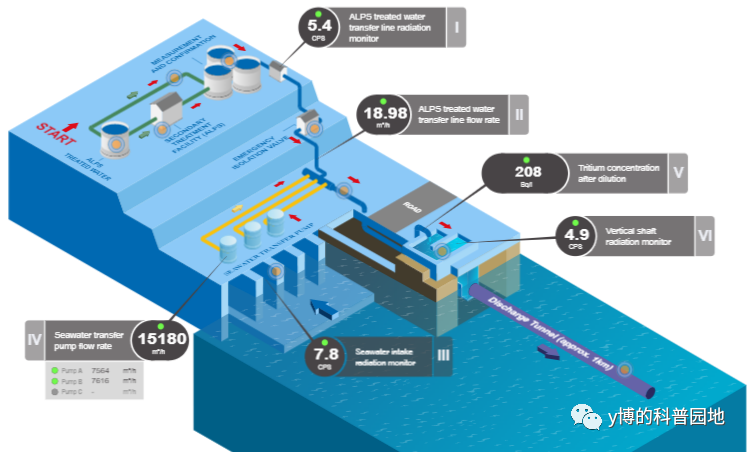
However, the dilution is done after leaving the water storage tank, so real-time monitoring of tritium emissions is required, which is to sample at the point of discharge and determine that it is below the upper limit of 1500 Bq/L, which is the position of 208 Bq/L in the figure below, and sample at the location of the 1-kilometer discharge pipe:
This real-time data is being done by TEPCO. What it tests is very simple, which is tritium, because it is used to determine whether the dilution ratio is appropriate. If it exceeds 1500 Bq/L, the discharge will be suspended. Why not test other things? Because the others have already been confirmed to be qualified in the water storage tank, and the concentration can’t rise after dilution?
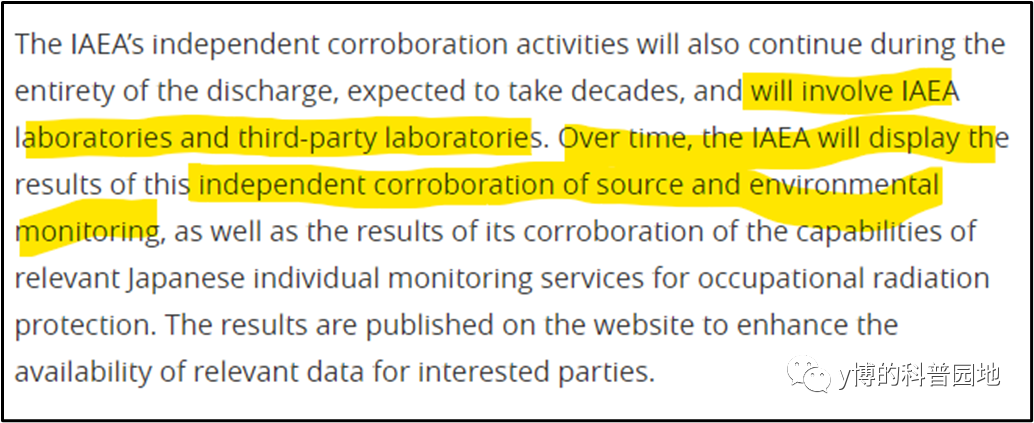
The detection of different radioactive substances is complex, and it is difficult to do a lot of real-time testing. You can take a look at the method section in the IAEA joint test report. The IAEA has said on its website that it will publish the results of its own and third-party laboratory tests in the future:
Therefore, there is no need to be alarmed by the real-time tritium data from TEPCO. It’s just that I don’t know when we will be able to see the data from Chinese laboratories.
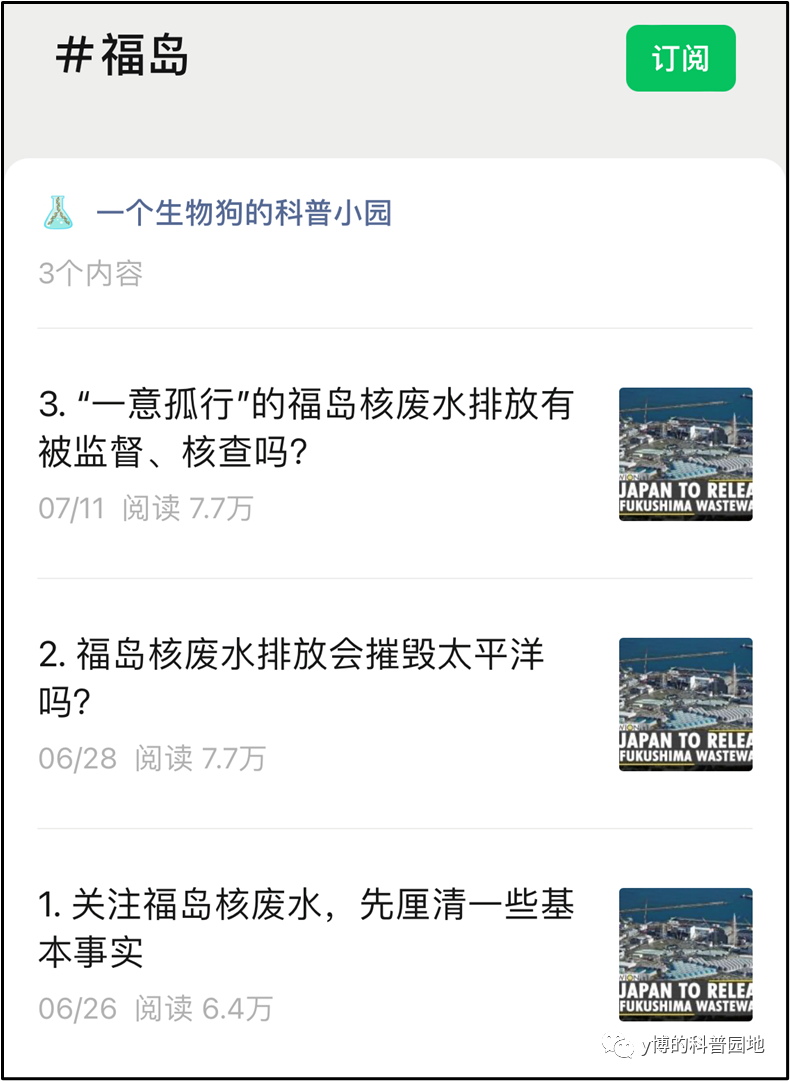
A month or two ago, I wrote several articles on my main account introducing the treatment, discharge, testing, and supervision of Fukushima nuclear wastewater.
Why Fukushima needs to discharge nuclear wastewater, what kind of treatment the nuclear wastewater has undergone, and what kind of supervision it has—including international supervision—are all explained in these articles. The reading volume of these articles has soared in the past few days, which can be regarded as providing some people with relatively accurate information, and perhaps also dispelling some people’s idea of rushing to supermarkets to grab salt. Those who are interested can take a look. Click on the keyword “Fukushima” on the homepage of the public account to cover most of the rumors online.
Discover more from 自由档案馆
Subscribe to get the latest posts sent to your email.