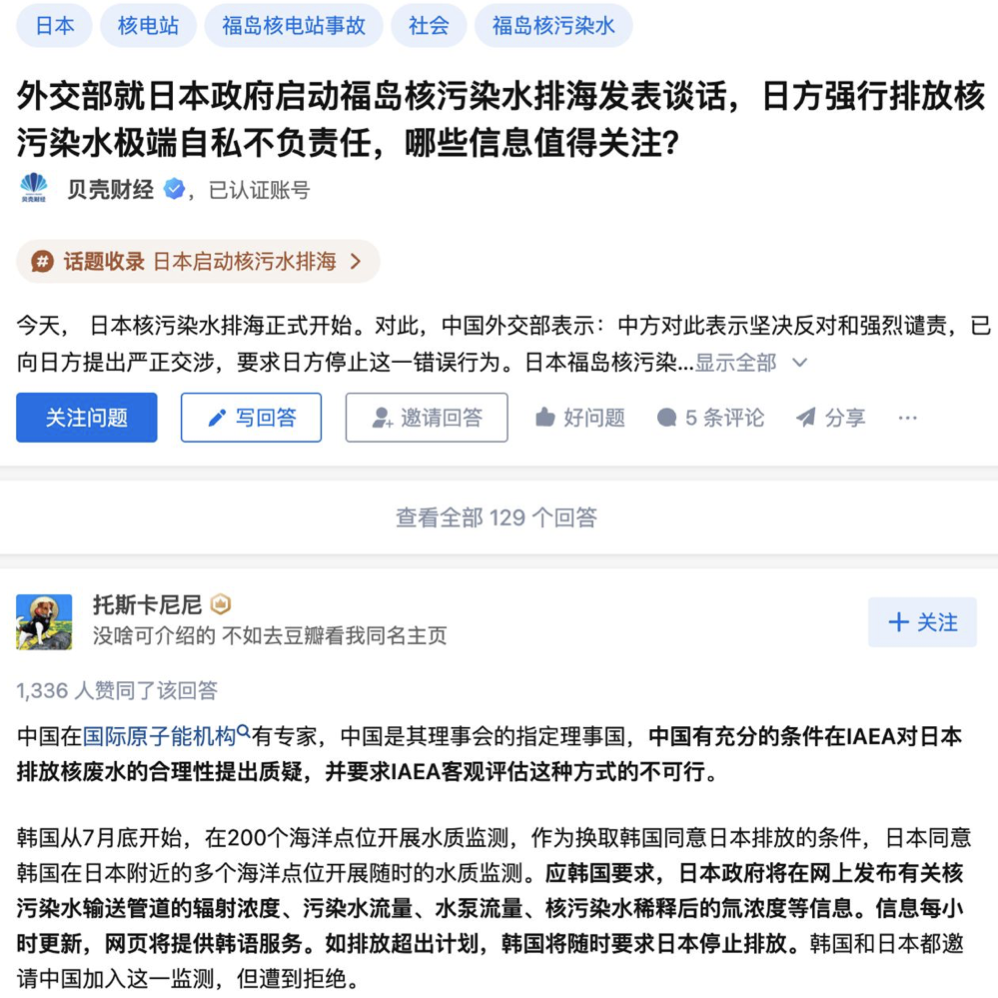
Screenshot of a netizen’s submission
Here is the full text of the Q&A:
@Toscanini: China has experts in the International Atomic Energy Agency, and China is a designated member of its board of governors. China has sufficient conditions to question the rationality of Japan’s discharge of nuclear wastewater in the IAEA and request the IAEA to objectively assess the infeasibility of this method.
South Korea started water quality monitoring at 200 marine locations at the end of July. As a condition for South Korea to agree to Japan’s discharge, Japan agreed to allow South Korea to conduct water quality monitoring at multiple marine locations near Japan at any time. At South Korea’s request, the Japanese government will release information online about the radiation concentration of the nuclear-contaminated water transport pipeline, the flow rate of the contaminated water, the flow rate of the water pump, and the concentration of tritium after the nuclear-contaminated water is diluted. The information is updated every hour, and the webpage will provide Korean language services. If the discharge exceeds the plan, South Korea will request Japan to stop the discharge at any time. Both South Korea and Japan have invited China to join this monitoring, but were rejected.
According to relevant international law, China has the right to sue Japan and request a temporary suspension of the discharge before Japan officially discharges. “According to the United Nations Convention on the Law of the Sea, countries can apply to the International Tribunal for the Law of the Sea for an injunction to stop the discharge plan of nuclear-contaminated water, but so far no country has filed a lawsuit.
“The Chinese and Russian navies have repeatedly sailed around the waters near Japan in 2023. China has the conditions to dispatch warships or scientific research vessels to conduct water quality monitoring in the high seas near Fukushima. For example: various indicators before discharge, changes in indicators after discharge, etc.
Fukushima nuclear wastewater will successively affect South Korea, Canada, the United States, Southeast Asian countries, and Pacific island countries. If the nuclear wastewater is really very harmful, China has the conditions and opportunities to at least unite with one relevant country (even if it is Pakistan, North Korea, Russia, Myanmar, Cambodia?) to formally protest to Japan, or to speak out in international organizations.
As a result, none of the above were done, but instead chose to use internal propaganda to incite domestic public opinion, promoting the theory of Japan as a lackey of the United States, the theory of Japan poisoning the world, the theory of Japan and the United States seriously infringing on China’s security, and the theory that the whole world is suppressed by the United States and Japan and dares not speak out, etc.
If a person claims that his legitimate rights have been violated, but he neither calls the police, nor sues, nor seeks the government, nor seeks organizations, nor seeks associations, nor seeks lawyers, and even does not seek the media, but instead takes a loudspeaker and denounces everywhere – what does this mean?
According to the internal propaganda: Fukushima nuclear wastewater will arrive in our country in 240 days, which will seriously affect our country’s marine safety and endanger aquatic product safety. Then, in August 2023, the import of Japanese aquatic products was banned. After 240 days, can all domestic aquatic products and seafood also not be eaten? If it can be eaten and the harm can be ignored, what did you object to?
If you are “strongly condemning Japan’s discharge of nuclear wastewater and endangering China’s security”, but on the other hand, you don’t care about eating “domestic seafood and aquatic products seriously affected by nuclear wastewater”, may I ask how you view the harm of nuclear wastewater?
The ultimate end of the “anti-nuclear wastewater movement” is the same as the “old witch’s visit to Taiwan”, putting oneself in a position that cannot be resolved.
In fact, after it is clear that the impact of nuclear wastewater can be ignored (as recognized by the IAEA and all countries in the world except China), the most beneficial way for China is to conditionally agree to Japan’s discharge.
And because China’s strength is far stronger than South Korea’s, and Japan’s demands for discharge cannot be changed. Therefore, as long as China does not propose conditions that break Japan’s bottom line, Japan will definitely agree. The imaginable conditions include:
● Establish an inspection station controlled by China in Japan, dispatch permanent inspectors to monitor Japan’s nuclear wastewater discharge.
● Require Japan to disclose internal information related to nuclear power plants and nuclear wastewater discharge to China.
● Pay compensation.
And the only advantage of internal propaganda hype is that it can strengthen the guidance of “the United States and Japan are strengthening their suppression of China, and national security is in jeopardy”. Whether it is to increase China’s actual influence on Japan, or to take the opportunity to strengthen the internal propaganda security guidance, which is more important, can be seen at a glance in front of the relevant departments’ choices.
Discover more from 自由档案馆
Subscribe to get the latest posts sent to your email.