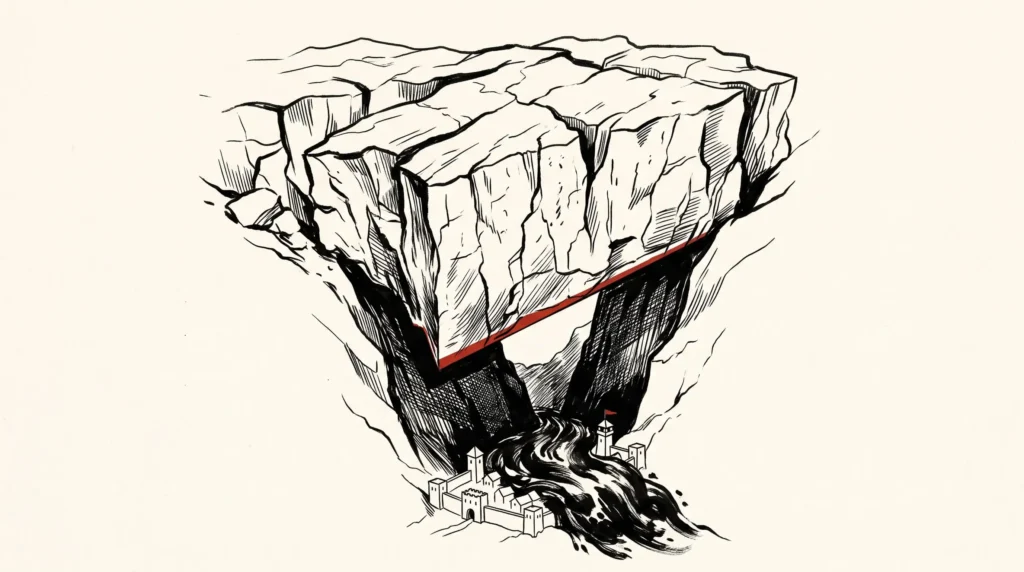
The discharge of Fukushima nuclear wastewater may begin on August 24th. Unsurprisingly, Japan is going its own way, and the voice of the Pacific in danger is once again filling the Chinese internet. If you feel anxious about this and wonder if seafood is still safe, then I suggest you remember this: more than a month ago, the International Atomic Energy Agency released a report confirming that the discharge of Fukushima nuclear wastewater complies with international safety standards. This article was first published when the IAEA report was released and is now republished for viewing.
On July 4, 2023, the International Atomic Energy Agency (IAEA) published a comprehensive safety review report on Japan’s plan to discharge ALPS-treated nuclear wastewater, concluding that the plan to discharge treated water from Fukushima into the sea complies with international safety standards, and the impact on humans and the environment can be ignored.
The Chinese version of the IAEA’s press release on the report is reprinted as follows:
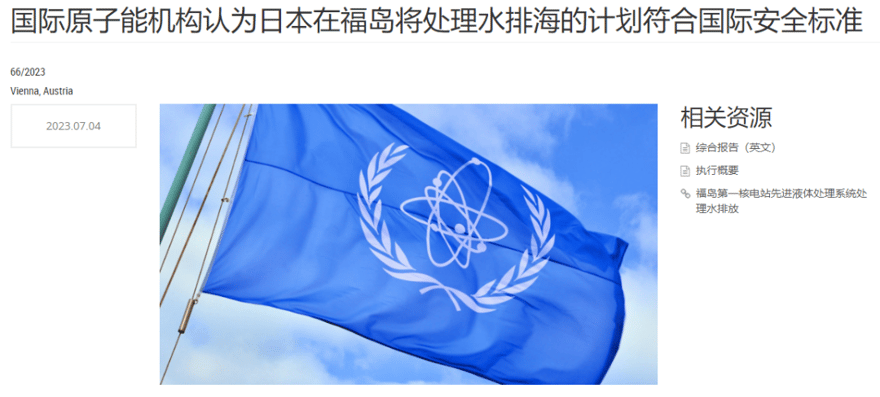
The International Atomic Energy Agency (IAEA)’s safety review concluded that Japan’s plan to discharge treated water stored at the Fukushima Daiichi Nuclear Power Station into the sea complies with the IAEA’s safety standards. In a report officially submitted to Japanese Prime Minister Fumio Kishida in Tokyo today by Director General Rafael Mariano Grossi, the IAEA also stated that the radioactive impact of the discharge of treated water on humans and the environment can be ignored. The report is the result of nearly two years of work by the IAEA’s special task force, composed of top experts within the IAEA, and international recognized nuclear safety experts from 11 countries provided consultation. Experts reviewed Japan’s plan against the IAEA safety standards, which constitute a global reference for protecting humans and the environment and promoting a unified high level of safety worldwide. IAEA Director General Rafael Mariano Grossi said in the preface to the report: “The IAEA concludes, on the basis of its comprehensive assessment, that the discharge of advanced liquid processing system-treated water by Japan and its activities comply with relevant international safety standards.” He also added: “In addition, the IAEA notes that, according to the current plans and assessments of TEPCO, the radioactive impact of the controlled and gradual discharge of treated water into the sea on humans and the environment can be ignored. After making the decision in April 2021 to discharge the water stored at the Fukushima Daiichi Nuclear Power Station into the sea, Japan requested the IAEA to conduct a detailed review of the safety-related aspects of the plan. IAEA Director General Grossi accepted Japan’s request and promised to be involved before, during, and after the discharge. The water stored at the Fukushima Daiichi Nuclear Power Station has been treated by the advanced liquid processing system to remove almost all radioactivity except tritium. Before discharge, Japan will dilute the discharge water to make the tritium content below regulatory standards. As with the rest of the world, the decision related to nuclear safety is the responsibility of the state, and the Nuclear Regulation Authority of Japan approved the plan in May. The IAEA’s review covers all key safety elements of the discharge plan, including three main parts: protection and safety assessment; regulatory activities and processes; and independent sampling, data verification, and analysis. Over the past two years, the special task force has made five working group visits to Japan, published six technical reports, and held meetings with the Japanese government and TEPCO, the operator of the Fukushima Daiichi Nuclear Power Station, and analyzed hundreds of pages of technical and regulatory documents. Members of the special task force also visited the site in eastern Japan several times to review the discharge preparations there. Director General Grossi said that the report released today “is an important milestone in the IAEA’s review work,” but “our task has just begun.” He said: “The IAEA will continue to provide transparency to the international community, enabling all stakeholders to rely on verified facts and science to understand this issue throughout the process.” The IAEA’s safety review will continue during the discharge phase. The IAEA will also maintain a continuous presence on site and provide real-time online monitoring of the discharge facility on its website. Director General Grossi said: “This will ensure that the relevant international safety standards continue to be applied in the decades-long process established by the Japanese government and TEPCO“.
The preface written by Director General Grossi in the IAEA’s comprehensive report helps us understand the entire process of the IAEA’s review of the Fukushima wastewater discharge, and is now translated as follows:
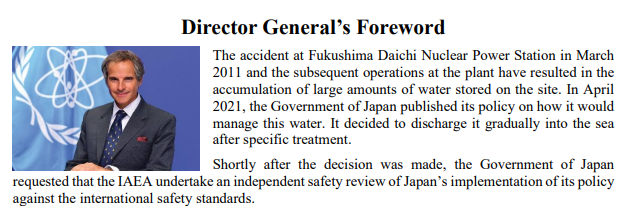
The Fukushima Daiichi Nuclear Power Station accident that occurred in March 2011 and its subsequent operation led to the accumulation of a large amount of water in the nuclear power station (Note: i.e., nuclear wastewater). In April 2021, the Japanese government announced its policy on how to manage these waters, deciding to gradually discharge them into the sea after special treatment (Note: i.e., ALPS treatment).
Shortly after the decision was made, the Japanese government requested the International Atomic Energy Agency (IAEA) to conduct an independent safety review of Japan’s implementation of its policy in accordance with international safety standards.
I agreed with Japan’s view that the IAEA would comprehensively review the implementation of the government’s plan before, during, and after the discharge of ALPS-treated water.
That year, I established an IAEA task force. It is composed of top experts from within the IAEA Secretariat, and is also advised by internationally recognized external experts from around the world (including the areas surrounding the wastewater discharge).
Due to its statutory mission and global influence, the IAEA is able to use internationally agreed nuclear safety standards as an objective blueprint for assessing the safety of the planned discharge. These international standards will also be constantly updated with reference to advances in science and technology and what is learned from research and practical experience. They are an indispensable global reference for protecting humans and the environment, thereby greatly contributing to the achievement of coordinated and high levels of nuclear safety worldwide.
This comprehensive report clarifies the scientific nature of the Fukushima treated water discharge to the international community, and I believe it has answered the technical questions related to safety that have been raised.
The IAEA concludes, on the basis of its comprehensive assessment, that the discharge of advanced liquid processing system-treated water by Japan and its activities comply with relevant international safety standards. In addition, the IAEA notes that, according to the current plans and assessments of TEPCO, the radioactive impact of the controlled and gradual discharge of treated water into the sea on humans and the environment can be ignored
These findings and this comprehensive report are an important milestone in the IAEA’s review. Even so, our task has just begun.
The IAEA will continue its impartial, independent, and objective safety review during the discharge phase of the wastewater, including continuous on-site monitoring, and providing real-time online monitoring of the discharge facility on our website. This will ensure that the relevant international safety standards continue to be applied in the decades-long discharge process established by the Japanese government and TEPCO. In these ways, the IAEA will continue to provide transparency to the international community, enabling all stakeholders to rely on verified facts and science to gain an understanding of this issue throughout the process.
Finally, I would like to emphasize that the discharge of treated water stored at the Fukushima Daiichi Nuclear Power Station is a national decision of the Japanese government, and this report is neither a recommendation nor an endorsement of that policy. However, I hope that all those interested in this decision will welcome the IAEA’s independent and transparent review, as I said at the beginning of this process, I promise that the IAEA will be there before, during, and after the discharge of ALPS-treated water.
In addition to the publication of the above-mentioned IAEA report, on July 5, IAEA Director General Grossi also personally went to Fukushima to inspect the key equipment for discharging the treated nuclear wastewater.
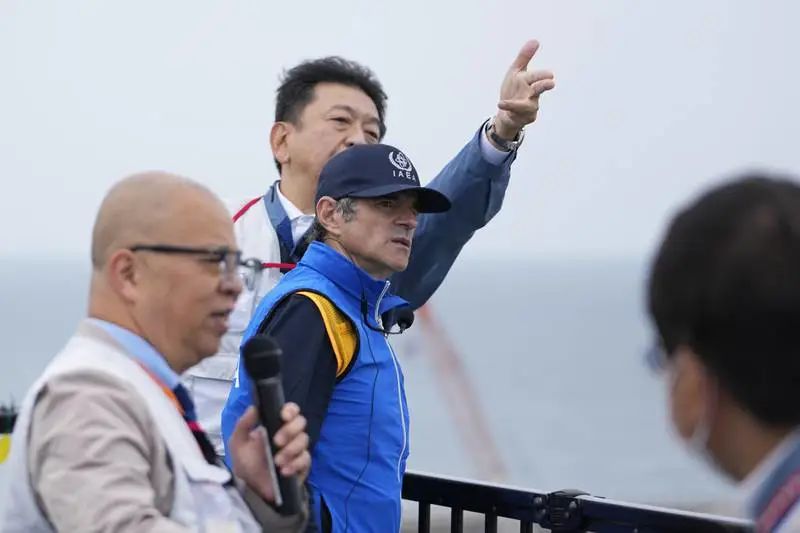 (IAEA Director General Grossi visits the Fukushima treated water discharge facility)
After visiting the discharge facility, Grossi said: “I am satisfied with what I saw, and I did not see any unresolved issues.”
In the exchanges with local governments and fisheries organizations, Grossi further explained the concerns about the discharge of ALPS-treated water into the sea: “What is happening today is not something special, or some strange scheme designed only for use here and promoted to you. This is a common practice certified by the International Atomic Energy Agency, agreed upon and followed in many places around the world.“
Regarding the future of the Fukushima nuclear wastewater discharge, Grossi reiterated that the IAEA will always fulfill its supervisory responsibilities: “We will be with you in the coming decades until the last drop of water (referring to nuclear wastewater) accumulated in the reactor is safely discharged.”
A healthy society needs to learn to respect science and needs to allow rational voices to drown out the clamor of conspiracy theories. It is hoped that in the matter of the discharge of ALPS-treated nuclear wastewater in Fukushima, we can, as the IAEA says: be able to rely on verified facts and science to gain an understanding of this issue.
Discover more from 自由档案馆
Subscribe to get the latest posts sent to your email.