A person in charge of public welfare at Southern Weekend angrily scolded some cadres in Zhuozhou in their WeChat Moments: If you had any guts, if you were human, you wouldn’t do these things… You are… worse than beasts… The common people who died would still set off fireworks.
Screenshots are here. A person working at the newspaper was so angry that they cursed, you can imagine how they were trembling.
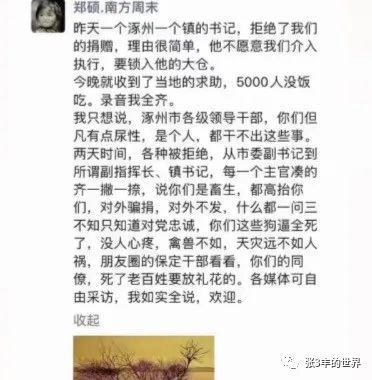
He actually made a serious accusation here, which is equivalent to reporting: The town government rejected public welfare workers, but the local people could not get supplies, and 5,000 people were starving.
Such things may not be isolated cases. Thinking of the chat content circulating in WeChat Moments the day before yesterday, some people involved in the disaster relief complained that they waited there for a whole day and did not wait for the local leaders to “allocate” the location. There were many chaotic phenomena in that chat record.
Going further back, the media reported two details: rescue teams from Shanxi and Shandong were stranded there because they did not have a “letter of introduction”; when people in a certain county town drove away, they were blocked at the highway toll station because the toll collectors still insisted on one card per vehicle, and they passed slowly.
These details may reflect a worrying reality: what is more terrible than heavy rain is the unscientific nature of water conservancy and planning, and what is more terrible than planning is the collapse of society and people’s hearts.
I don’t want to discuss who should be responsible for these specific things, I only want to discuss the question raised by the Southern Weekend reporter. He was a little incoherent, and what he said was actually plain language: Some officials in Zhuozhou are “not human”.
Yes, it’s the three words “not human”. When I was a child in rural Henan, when adults had disputes, they wouldn’t all go to court. They often swore: “Not human” is almost as serious as “die out your whole family”, which shows that even among the rural people, there are universal standards about “what is a human being”, which is the humanity and emotions of Chinese people.
If the heavy rain in Zhengzhou showed us the “systemic loopholes” (subway and emergency management plans, water conservancy planning, etc.), then the events in Zhuozhou and other places this time show us the “loss of humanity” of many grassroots officials. They are numb and indifferent, and are actually adhering to their posts without compromise.
The rescue team has arrived and needs to go to the most severely affected areas. But where each rescue team goes needs to be decided by relevant departments in a meeting; social donations and materials, but if they do not follow the local process, they can only wait outside first. Local workers may also feel wronged, they are just following the steps, and that’s how it’s usually required.
A daily routine of an official is like this: holding meetings, studying, implementing, and executing… Every link is perfect.
The more smoothly this system runs, the more it deprives individuals of their sense of responsibility: you don’t need to make decisions, you just need to execute the above; the following continue to execute the above. In fact, what the system emphasizes is not execution, but “communication”, each link sees the document, writes a sentence on it, and finally the person at the bottom executes it – they may have run out of battery on their phones in the flood, and they can’t write materials.
Of course, the loss of “execution” is only superficial, and what is more important is the ability to make decisions and be responsible. A town mayor may be more important than a county magistrate at this time, because he knows where the flood is most severe; the village head knows whose house is the most dilapidated, and who lives with the elderly who have difficulty moving.
At this time, the ideal state is that each link “acts like a human being” to make decisions and take responsibility, and the whole system can operate. But the current situation in Zhuozhou is that the entire county’s system is “petrified”.
“Being responsible” is not just relying on conscience, it is a kind of ability, and it also requires daily practice. For example, when a media commentator writes an editorial, the subject of each sentence is “we”, he cannot have a sense of responsibility. Because in his view, the main body of responsibility is the abstract “we”, which is “everyone”, but not any “one person”.
However, when a person writes self-media, cautiously writes an “I”, he knows there will be risks, he will be deleted, and he may be sued. He will treat every word carefully. Just like me now.
“Being responsible” requires true subjectivity, requires returning to the person himself, and requires “self” to be a living thing. The friend from Southern Weekend did not find it on the land of Zhuozhou.
Discover more from 自由档案馆
Subscribe to get the latest posts sent to your email.