Imagine a question:
If you were born in the countryside, your parents worked and farmed, and they sold everything to support your education. You were also very competitive and, carrying the hopes of your entire family, you were admitted to university.
Seeing that you are about to graduate, everyone around you envies your parents, saying that they have finally come to the end of their hardships and are about to see the light of day. They will go to the city with their children to enjoy their lives.
May I ask, what kind of job will you do after graduation?
I don’t know what you will do, I only know that People’s Daily will definitely suggest that you return to the countryside to use your strengths.
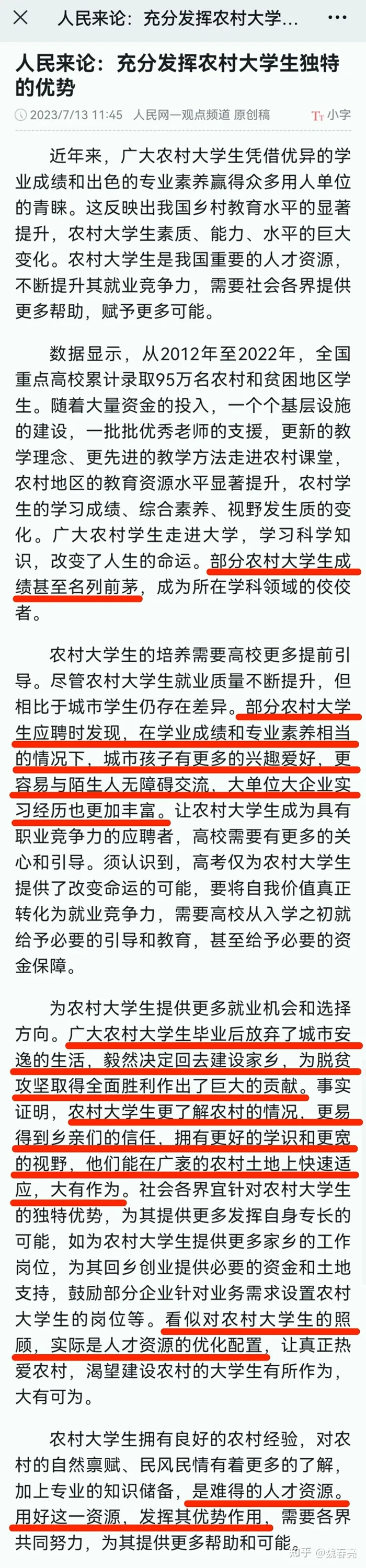
This is an extremely schizophrenic article. It would take years of mental illness to write such disgusting words. Even the 24 Billys would have to admire the professionalism.
When taking the college entrance examination, rural and urban candidates have the same admission scores, and there is no reduction in admission scores because of the poor economic and teaching conditions in rural areas.
However, after completing the same studies and obtaining the same academic qualifications, when it comes to employment, rural college students are singled out, which is also flattering.
The article starts by praising rural college students:
“They win the favor of many employers with their excellent academic performance and outstanding professional qualities”
“The learning achievements, comprehensive qualities, and horizons of rural students have undergone qualitative changes”
“Some rural college students even rank among the best”
Every sentence is a good word, but it’s like my former boss praised me, “I didn’t expect you to have some skills”, but it always feels strange.
Especially that “even”, it is almost equivalent to directly saying “rural college students are inherently inferior to urban college students”, you can feel the arrogance and prejudice behind this assumption.
Since rural college students have so many advantages, it seems somewhat stiff to say that they still have differences from urban students, and it makes the previous praise insincere.
It is perhaps true that urban children have more hobbies and more experience in internships in large companies. But it is also a result, an unequal result under the urban-rural dual system. A large amount of resources are supplied to the city, and of course, children in the city have many natural “advantages”.
If we have to argue, the more natural advantages urban children have, the more it highlights the country’s debt to rural areas and farmers.
People’s Daily dares not face the real problem, does not reflect on the reasons behind it, but blatantly regards it as the advantage of urban college students, and uses it to compare with rural college students. It’s really shameless.
And the sentence “easier to communicate with strangers without barriers” is undoubtedly naked PUA. Do rural college students have barriers to communicating with strangers? I think this is not a fact, but just a self-righteous delusion and belittling. If there are barriers to communicating with strangers, the reasons for personality may be more important.
However, after saying so many “disadvantages” of rural college students, it is nothing more than implying “the city is not a place you can adapt to, get out of here”. But they don’t say it directly, they also put a high hat on you:
“After graduating, the vast number of rural college students gave up their comfortable life in the city and resolutely decided to go back to build their hometown, making a huge contribution to the comprehensive victory of poverty alleviation.”
Rural college students give up the “comfortable” life in the city, and choose the “hard” life in the countryside, otherwise why would they say “resolutely”?
Then the question arises, since rural children have gone back to the countryside to suffer, who is left with the comfortable life in the city?
The words are grand and righteous, translated, it is nothing more than: The hard work of revitalizing the countryside, urban college students are not willing to do it, so, the rural college students who have suffered should do it, who told them they can endure hardship? If you can endure hardship, you will have endless hardship.
Let you suffer, and also give you a high hat of “contributing to poverty alleviation”, putting you on a moral high ground, making it difficult for you to step down. Then, with a lot of persuasion, you say that you don’t know how great your advantages are:
“They know the situation in the countryside better, are more likely to gain the trust of their fellow villagers, have better knowledge and a wider vision, and they can quickly adapt on the vast rural land”.
But it was clearly said before that rural college students don’t have as many hobbies as urban college students, and they don’t have as much experience in internships in large companies as urban college students. How come they suddenly have “better knowledge and a wider vision”? It’s also magical.
Are they telling the truth? Maybe, rural college students do know the situation in the countryside better and are more likely to gain the trust of their fellow villagers.
But the problem is, urban college students are also more familiar with roads and construction sites, and People’s Daily has not called on urban college students to sweep the floor and move bricks. The children of the tobacco, electricity, and petroleum families don’t have to worry about money, and People’s Daily has not called on them to resign and make way for the bottom.
They only make demands on rural college students, and they only pick on the soft persimmons.
And they only make demands, as for what rural college students can do when they go back, what kind of difficulties they face, and how they survive, they don’t care.
An article says it well:
What rural college students need is equal opportunities and fair treatment, not simple differentiation and opposition. The efforts and contributions of rural college students should be affirmed and praised, rather than being limited by imposed expectations and responsibilities.
Just because they were born in the countryside, should they stay in the countryside for generations? Is this the “kings, marquises, generals, and ministers, would rather have a kind” of the new era?
If there are problems in our countryside, then someone owes the countryside. To build the countryside, we should also make demands on those who owe debts, rather than encouraging those who are owed to work hard.
Since the articles of People’s Daily all say that rural college students have so many shortcomings, I don’t see any advantages they have. I only see their disadvantages:
That is, they are shy, thin-skinned, and still maintain the most basic sense of shame as a person. These disadvantages greatly hinder them from abandoning the bottom line and pursuing so-called success at all costs.
And some people are just making fun of vulnerable groups, fooling them to dedicate themselves, and they have long since lost their face, which is the biggest advantage.
Discover more from 自由档案馆
Subscribe to get the latest posts sent to your email.