
In the context of a poor job market, a large number of the labor force will choose to wait and see, or temporarily withdraw from the labor market, and they are usually ignored by the unemployment rate statistics, leading to misjudgment of the overall labor force situation.
Regarding the issue of a significant increase in the unemployment rate among Chinese youth, it is necessary to distinguish between the long term and the short term, and to analyze it from the perspectives of labor supply and demand.
In the long run, the high unemployment rate among young people should first be attributed to the three-year-long COVID-19 pandemic since 2020. The COVID-19 pandemic has a sustained impact on consumption, the business environment of enterprises, and even the overall vitality of the economy, causing the economic growth to shift gears rapidly. Specifically, the year-on-year GDP growth rate has decreased by 2.4 percentage points compared to before the pandemic.
My team and I recently conducted research based on data from a labor platform in the manufacturing center of the Yangtze River Delta. We found that the pandemic at the end of 2022 severely impacted manufacturing employment in Suzhou, Kunshan, and other places. Until March 2023, after the pandemic, employment only recovered to 2/3 of the level before this round of the pandemic. Young people are the main employment group in manufacturing, so they were also hit harder.
Secondly, since 2021, there have been a series of regulatory policies for specific industries such as education and training, real estate, and internet platforms. While regulating the industries, these policies have also impacted employment, especially the employment of highly educated labor. As new entrants to the labor market, young people naturally bear the brunt, leading to a year-on-year increase in their unemployment rate.
Finally, the rapid development of artificial intelligence (AI) technology may also exacerbate youth unemployment. The recent report “Potential Impact of AI Large Models on China’s Labor Market” jointly released by the National Development Institute of Peking University and Zhaopin.com points out that China has initially shown a trend of artificial intelligence technology replacing human labor. The development of AI in the past five years and the development of generative AI such as Chatgpt in the past six months have led to a decline in the demand for jobs with high AI exposure. Jobs with high AI exposure are mainly concentrated in white-collar jobs such as finance, banking, translation, and sales, which have a greater impact on highly educated people.
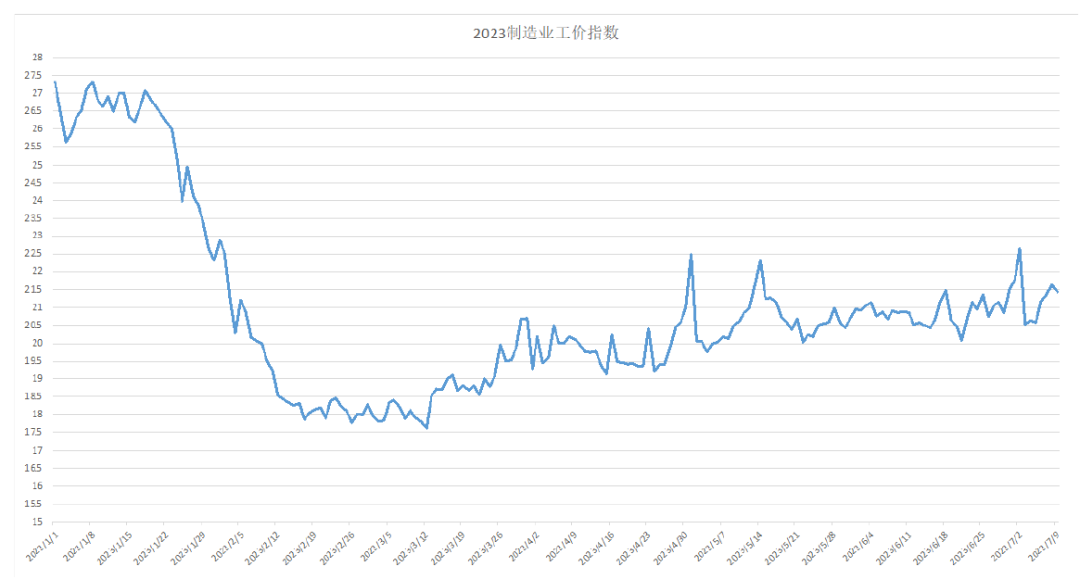
From the above analysis, it can be seen that different influencing factors will have different effects on young people with high and low skill levels. In fact, according to education level or skill level, young people can be divided into two relatively separate labor markets: skilled workers and ordinary college graduates. The main employment group of skilled workers is in manufacturing, and China’s manufacturing industry accommodates an industrial workforce of 100 million people. The manufacturing wage index in the figure below reflects the supply and demand of manufacturing labor. The increase in wages indicates that supply falls short of demand, and the decrease in wages indicates that supply exceeds demand. From the beginning of this year to now, the manufacturing wage in China reached its lowest point in recent years in February, indicating that manufacturing orders have been greatly reduced under the impact of the pandemic, and the demand for labor has continued to decline. Afterwards, the wages slowly recovered from March to July, indicating that the skilled worker labor market is also warming up while the economy is recovering.
Figure 1: Manufacturing Wage Index in 2023
Data source: New Citizens Research Institute.
Since the employment situation in the skilled worker market has improved since March this year, we can boldly guess that the high unemployment rate among young people after March should mainly be reflected in the employment market for ordinary college graduates. The real data confirms our guess. According to data provided by the China Institute of Employment Research, the number of job applications from college graduates has recently surged, far exceeding the increase in the number of recruitment demands, and the job-applicant ratio (the number of positions corresponding to each job seeker) has dropped significantly, and the employment market for college graduates has shown a serious situation of supply exceeding demand.
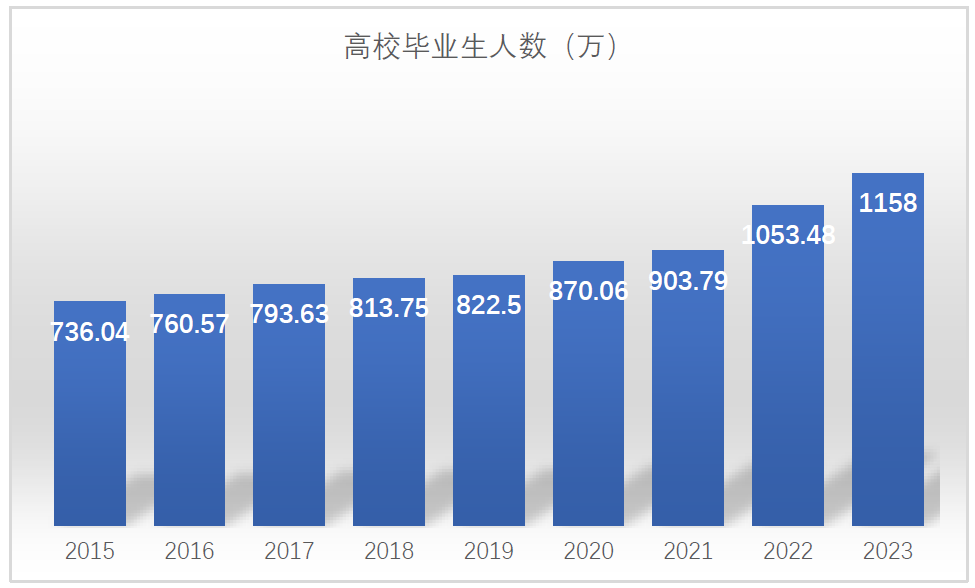
From the perspective of labor supply (see the figure below), the number of college graduates in China has increased year by year. Compared with the annual average of 200,000-300,000 new graduates, the number of graduates in 2022 increased by 1.5 million compared to 2021, an increase of 16.6%, of which the number of graduates from ordinary higher education undergraduate and junior colleges increased by 17%, and the number of postgraduate graduates increased by 12%. It is estimated that the total number of college graduates in 2023 will reach 11.58 million, an increase of nearly 1.05 million graduates compared to 2022. However, according to reports, the scale of postgraduate enrollment in 2023 is expected to be 1.2 million, which is not an increase from the 1.24 million last year, and the proportion of graduates who can continue their studies in China has decreased. In addition, the significant increase in graduates is also the inevitable result of the increase in students who have delayed graduation and continued to study in the past two years since the 2020 pandemic in order to avoid employment. The youth employment problem in the pandemic year has been accumulating for three years and has recently broken out. Therefore, the significant increase in ordinary college graduates, coupled with the impact of the pandemic and other factors, has led to the surge in the youth unemployment rate in recent months.
Figure 2: Number of College Graduates 2015-2023
Data source: “Statistical Bulletin of National Education Undertakings Development”.
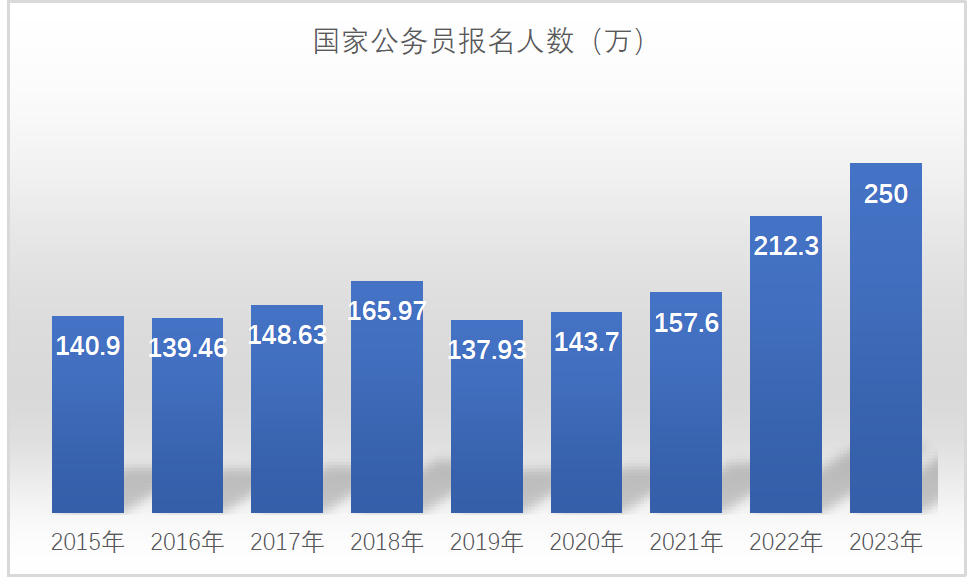
As a major choice for college graduates, the number of college graduates taking the civil service examination (i.e., “taking the civil service exam”) has increased significantly in recent years. As shown in the figure below, the number of applicants for the national civil service examination has increased significantly in the two years of 2022 and 2023. The number of applicants for the national civil service examination from 2019 to 2021 remained stable at less than 1.5 million. In 2022, it soared to 2.2 million, and in 2023, it further increased to more than 2.5 million, with an 80% increase in the number of applicants. The significant increase in the proportion of “taking the civil service exam” reflects the employment pressure of young people and the employment preferences of college graduates. However, the number of people recruited by the “taking the civil service exam” is only 37,000, and the recruitment ratio is only 70:1, which cannot solve the employment problem of most college graduates.
Figure 3: Number of Applicants for the National Civil Service Examination 2015-2023
Data source: Civil Servant Examination Network.
In addition to continuing their studies and “taking the civil service exam”, a considerable number of young labor force choose to withdraw from the labor market, and this group should not be ignored. In the context of a poor job market, a large number of the labor force will choose to wait and see, or temporarily withdraw from the labor market. This part of the people are also called “frustrated labor force” or “hidden unemployed group”, and they are usually ignored by the unemployment rate statistics, leading to misjudgment of the overall labor force situation. Therefore, the change in the unemployment rate needs to be analyzed by analyzing the change in the labor force participation rate.
The National Bureau of Statistics has not publicly released statistics on youth labor force participation, and it is impossible to track its changes over time. According to the data on the labor force participation of the urban population aged 16-24 in March 2023 obtained by us, there are about 96 million people aged 16-24 in urban areas nationwide, of which non-labor force accounts for 2/3, which is 64 million, and labor force accounts for 1/3, which is 32 million (including 25.7 million employed and 6.3 million unemployed).
Among the 64 million non-labor force, there are a total of 48 million students, and the remaining 16 million are non-students. Most of them choose to “lie flat”, not work, and “rely on their parents”, which is the so-called “full-time children”. If we consider all 16 million non-students in the non-labor force as “unemployed”, we can calculate the maximum value of the youth unemployment rate in March 2023, which is (1600+630)/(1600+630+2570) = 46.5%, which is much higher than the officially announced youth unemployment rate, which is 19.7% (=630/(630+2570)).
Based on the 2021 household financial survey data from Southwestern University of Finance and Economics, college graduates account for about 3/4 of the 17-24 year old youth group who do not work after graduation, of which junior college and higher vocational colleges account for 18%, and undergraduates and above account for 56%, and compared with the survey data in 2017 and 2019, the proportion of college students “lying flat” and not working has been increasing in recent years.
Regarding the employment performance of college students, the “2023 College Student Employment Survey Report” of Zhaopin.com summarizes that the graduates of 2023 have a continuous increase in their desire for stability, the proportion of choosing to work in units has increased (reaching 58%), and the proportion of slow employment has increased significantly and accounts for nearly 1/5 of the total.
In summary, the phenomenon of high unemployment rate among urban youth that emerged at the beginning of 2023 is both caused by structural contradictions such as insufficient long-term demand and the result of a significant increase in the supply of college graduates in the short term. Currently, there are about 6 million unemployed young people in China, accounting for only 6% of the total unemployed population, which does not affect the overall employment outlook of the labor market. According to analysis, the shortage of youth employment in the short term is mainly concentrated in the employment market for ordinary college graduates, and undergraduates and above account for the majority of the unemployed youth group. College graduates show a preference for employment tendencies such as “taking the civil service exam” and “seeking stability”. According to the seasonal fluctuation trend, the unemployment rate will continue to rise in July and August this year. Properly guiding college students, reducing employment and salary expectations, seeking employment first and then choosing a career, and accelerating economic recovery may be the way to solve the current unemployment of young people.
Source of this article: Caixin.com

Zhang Dandan, Associate Professor (Tenured) of Economics, National Development Institute, Peking University, Boya Young Scholar of Peking University, and Yangtze River Young Scholar of the Ministry of Education. Her research areas are labor economics, applied econometrics, and experimental economics. Her research interests include the socio-economic impact of urban-rural migration in China, the crime problem of the floating population, social change and gender differences, and the health benefits and costs of COVID-19 prevention and control.
Discover more from 自由档案馆
Subscribe to get the latest posts sent to your email.