Recently, the Chengdu Railway Public Security Bureau’s determination of “mutual fighting” in a case has sparked online attention.

On May 2nd, a woman posted a video stating that on that day, while she was on train C6276, she was slapped by the other party’s parent for stopping a “naughty child” from hitting the back of her seat, and she fought back. Ultimately, the police determined that both parties constituted “mutual fighting”.
The woman’s “Administrative Penalty Decision” stated “…a quarrel occurred, and then they used their hands to hit each other”, and imposed an administrative penalty of a 200 yuan fine; the “naughty child’s” parent was fined 500 yuan.
On May 7th, the woman posted again, saying that she is currently filing for administrative review and insists on not settling.
The core point of contention in this incident lies in the police’s determination of “mutual fighting” and the fairness and reasonableness of the administrative penalties.
Woman on high-speed rail fights back after being slapped by parent for stopping “naughty child”
On May 2nd, a woman posted a video stating that on that day, she was traveling alone on the high-speed rail, and there were 5 people sitting behind her, including two adults and three children.

During the train’s journey, the children were constantly playing games, during which they repeatedly hit the back of her seat. The woman said that she turned around to stop them because she couldn’t bear the children repeatedly hitting the back of her seat. Her action of stopping the children caused dissatisfaction from the children’s parents, and a dispute arose between the two parties. During the dispute, the children’s parent slapped the woman, and the woman also fought back.
According to media reports, the woman was on train C6276 that day, with the starting station being Emeishan and the terminal station being Guangyuan.
On May 3rd, the children’s parents reported the incident to the police, and the above-mentioned woman was summoned. The woman believed that the children’s parents were at fault first, had verbally abused her and then hit her, and should be the primary responsible party, so she refused to settle.
Ultimately, the police determined that both parties constituted “mutual fighting”, and imposed an administrative penalty of a 200 yuan fine on the above-mentioned woman who fought back after being hit, and a 500 yuan fine on the children’s parents.
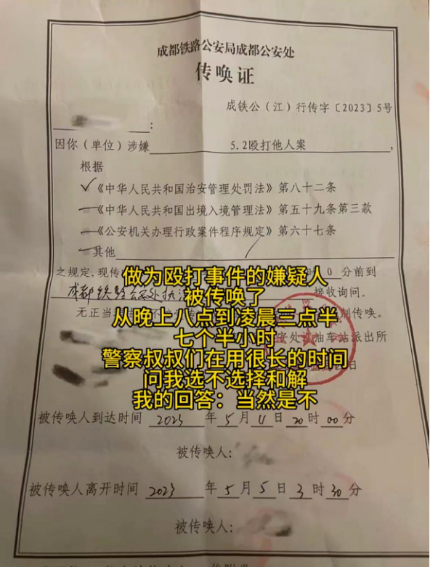
On the morning of the 7th, the woman involved posted another video online, stating that she had already applied for an administrative review.
Three questions need to be clarified
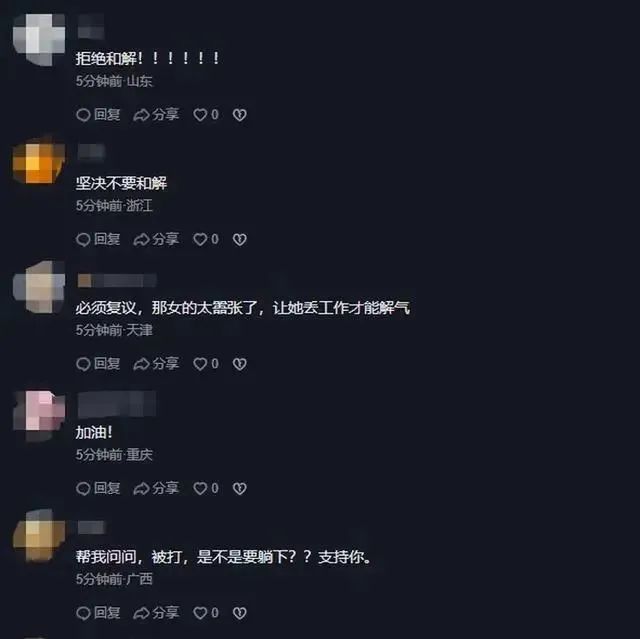
After the penalty result was announced, it immediately caused heated discussions, and public opinion was almost “unanimously” in support of the woman not settling and seeking a review.
In the course of sorting things out, we found that there are still some questions that need to be clarified to make fairness and justice visible and understandable to everyone.
I. What is mutual fighting?
In fact, the reason why this case has caused widespread discussion is mainly due to the police’s determination of the nature of the case – mutual fighting.
It is generally believed that “mutual fighting” means mutual fighting, which refers to the behavior of participants actively implementing mutual infringement under the dominance of the intention to fight and the intention to cause harm. Some scholars divide mutual fighting into true mutual fighting and non-true mutual fighting. The former refers to the mutually attacking behavior agreed upon in advance by both parties, while the latter is not based on the prior agreement of both parties, which is also the difficulty in distinguishing it from justifiable defense in judicial practice.
In addition, linking the relevant provisions of the crime of gathering to fight is conducive to a better understanding of the concept of “mutual fighting”. According to the “Opinions on Several Issues in the Application of Law in Handling Cases of Gathering to Fight”, the crime of gathering to fight refers to the behavior of forming gangs, generally involving three or more people, with the intention of gathering to fight and engaging in mutual fighting; it is usually manifested as retaliating against others, vying for dominance, or fighting in gangs for other improper motives, often resulting in serious consequences. Having the intention of “mutual fighting” is the basis for constituting the crime of gathering to fight, and serious mutual fighting may escalate into gathering to fight, constituting a crime.
II. How to distinguish between justifiable defense and “mutual fighting”?
According to the provisions of China’s Criminal Law, justifiable defense refers to the act of stopping unlawful infringement in order to protect the state, public interests, the person, property, and other rights of oneself or others from unlawful infringement that is currently taking place. Those who cause damage to the unlawful infringer are not liable for criminal responsibility. It is generally believed that to constitute justifiable defense, five conditions must be met, including the cause condition, time condition, subjective condition, object condition, and limit condition. China’s Civil Code also clearly stipulates that “no civil liability shall be borne for damage caused by justifiable defense”.
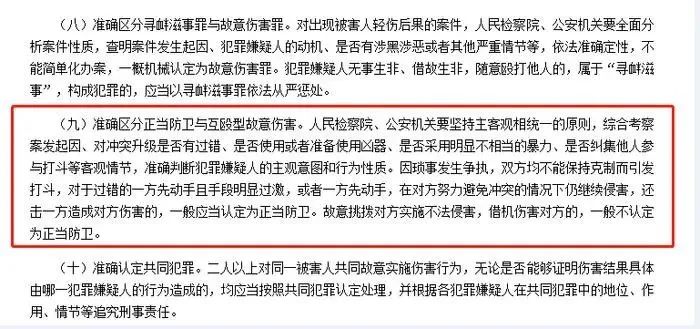
In fact, the problem of “mutual fighting generalization” has existed for a long time. Despite the efforts of theoretical and practical circles to make many changes, the practice of judicial practice is still to determine the case as mutual fighting and deny justifiable defense. In this regard, in March of this year, the Supreme People’s Procuratorate and the Ministry of Public Security jointly issued the “Guiding Opinions on Properly Handling Cases of Minor Injury in Accordance with the Law”, which made further provisions.
The “Opinions” clearly put forward “accurately distinguishing between justifiable defense and mutual fighting-type intentional injury”, and pointed out that “due to trivial matters, disputes arise, and both parties cannot maintain restraint and trigger a fight, for the party at fault who takes the first action and the means are obviously excessive, or one party takes the first action, and the other party still continues to infringe when trying to avoid the conflict, the party who fights back and causes injury to the other party should generally be determined as justifiable defense“. “It is necessary to adhere to the principle of the unity of subjective and objective, comprehensively examine the cause of the case, whether there is fault in the escalation of the conflict, whether weapons are used or prepared to be used, whether obviously disproportionate violence is used, whether others are gathered to participate in the fight, and other objective circumstances, to accurately judge the subjective intention and nature of the behavior of the suspect.”
III. Can this incident be determined as mutual fighting?
Specifically to this incident, Professor Jin Zegang of the Law School of Tongji University believes that: on the one hand, from the perspective of the determination of mutual fighting, there is a lack of basis for determination.
First, the cause of the case is the “naughty child’s” noisy behavior on the high-speed rail, kicking the back of the seat, and other bad behaviors. For children under the age of 8 who do not have the capacity for civil conduct, their guardians should bear the responsibility of preventing and stopping bad behavior and conducting reasonable discipline.
Second, the parents have fault in the escalation of the conflict, from the lack of supervision of the children’s bad behavior in public places, to being accused of verbally abusing others first, and then directly hitting people, every point of conflict escalation lies in the parents.
Third, the parents, as the party at fault, “took the first action”, and bullied the few with the many, using the excessive means of slapping in public.
Fourth, the woman was calm in her words, and sat down after the staff came, reflecting her efforts to avoid conflict.
On the other hand, from the perspective of the determination of justifiable defense, the answer should be affirmative.
The woman fought back after the “naughty child’s” parents took action and continued to raise a water bottle to attack, and the act of fighting back had the subjectivity and objectivity of avoiding further infringement, which meets the requirements of justifiable defense. The woman’s behavior is passive and defensive, which is different from the initiative and unlawful infringement of mutual fighting.
Experts: “Each side gets fifty blows” is legal but unreasonable
In fact, for such non-malicious, minor harm incidents, the police will generally suggest that both parties settle, and administrative penalties may not be imposed after settlement. However, once an administrative penalty is issued, the relevant information will be registered in the public security organ’s system, and this violation record will accompany the person for life.
In this case, the child’s behavior of making noise and hitting the back of the front passenger’s seat in a public place is actually the parents’ lack of supervision and education, which can be considered as being at fault first. When the disturbed passenger (that is, the woman involved in the incident) expressed dissatisfaction and stopped them, the children’s parents not only did not guide and educate them correctly, but instead verbally abused and hit them, which is also difficult to agree with. This is also an important reason why public opinion is dissatisfied with the determination and penalty results of the case.
Jin Zegang believes that the case has already caused widespread discussion, and the relevant authorities should strictly distinguish according to the law, make an accurate determination of the relevant behavior, and impose fair penalties. “Each side gets fifty blows” and the case-handling thinking that focuses too much on settlement may be legal, but it is definitely unreasonable, which is not conducive to encouraging people to bravely defend their legitimate rights and interests, and is contrary to the requirements of building a society ruled by law.
Jin Zegang said that tolerance for those who fight back is the due meaning of fairness and justice. In judicial practice, it should be clarified that moderate retaliation does not belong to mutual fighting, and the retaliator should not be punished. The handling result of this incident may become a weathervane for punishing “high-speed rail troubles” and “aircraft troubles” incidents, giving more people the courage to stand up and stop bad behavior and unlawful infringement, as well as the determination to protect their own and others’ legitimate rights and interests.
In short, how to convince the public that “the woman was slapped and fought back” was determined as mutual fighting may require clarifying some questions.
Discover more from 自由档案馆
Subscribe to get the latest posts sent to your email.