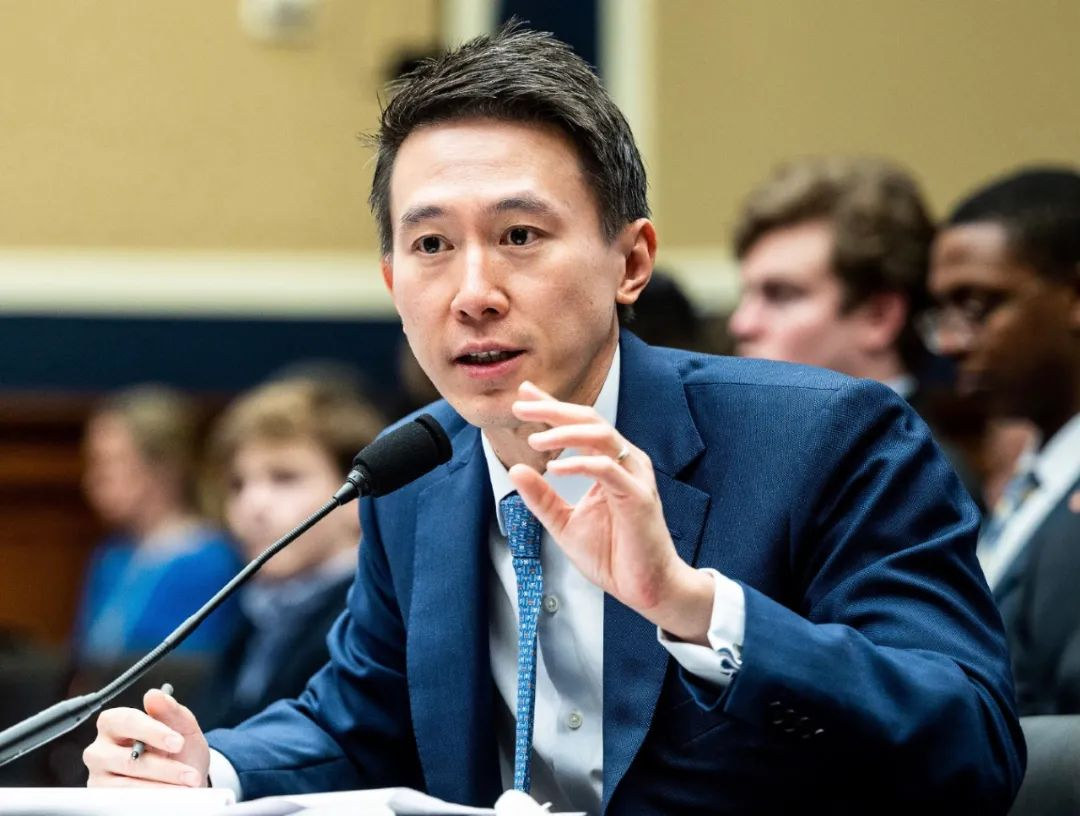
Many people have watched the more than five-hour-long hearing on TikTok, I believe.
U.S. congressmen took turns attacking, and they all went on the offensive. The questions were very sharp, which was the American version of a criticism meeting. The last internet giant to enjoy this treatment was Zuckerberg, who almost lost a layer of skin because of the abuse of user information in the 2016 election and had to pay a fine of 5 billion U.S. dollars to settle the matter.
First of all, TikTok’s CEO, Shou Zi Chew, for the first time represented Chinese capital and came to the front line. He dared to attend the hearing face-to-face, demonstrating the spirit of showing his sword. He has both good looks and talent, and his IQ and EQ are not low. He has the style of Zhuge Liang debating with the scholars.
From the five-hour-long debate, it can be seen that he is well-versed in British and American culture and values, has bilingual thinking, and is fluent in English to the point of barrier-free communication. He is fighting with his back to the river, aiming to clarify the facts, ease conflicts, and save the country. His overall performance is reasonable and measured.
When I looked at his resume, this guy was indeed not Chinese. He is of Chinese descent, a Singaporean citizen, studied in the UK for university, and then studied at Harvard Business School for his MBA. After graduation, he worked at Goldman Sachs on Wall Street; his previous employer was Xiaomi, where he was CFO and helped Xiaomi go public; then he switched to ByteDance, from Group CFO to the top CEO of TikTok.
He can be called the emperor of workers, and his resume and performance are worthy of his income. Shou Zi Chew’s annual salary is 100 million U.S. dollars, nearly 700 million RMB.
Chinese descent, Singaporean citizenship, and a degree from a prestigious British and American university. This group of elites can be said to be the biggest beneficiaries of globalization and internet dividends.
So why do I repeatedly emphasize that children must learn English well, have bilingual thinking, and have an international perspective? This is the reason. Young people are keen on taking the civil service examination and the public examination, but in the eyes of these trendsetters, it’s nothing. The income you earn in the system for a lifetime is not as much as their salary for a month.
But even if Shou Zi Chew performs as well as he can, it’s still useless. This time, TikTok may not be so lucky. It’s not something that money can solve. Its fate may be to be removed or to be stripped and find a new buyer. ByteDance’s senior management is also well aware of this, and they issued an internal letter after the meeting.
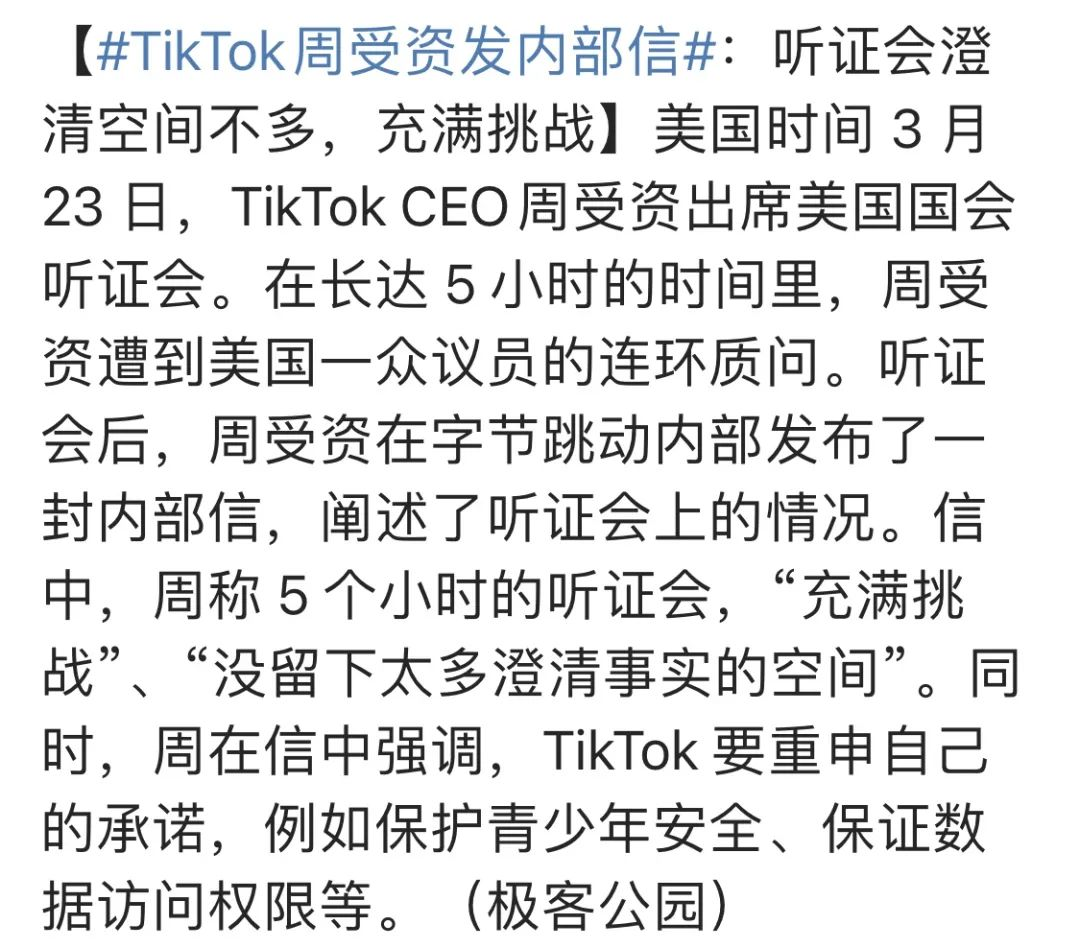
The TikTok ban is a continuation of the policies of the previous president, Trump. This time, the Democratic Party is doing a more decisive job than Trump, with almost no chance of turning things around.
Trump’s time was a presidential executive order, based on the U.S. International Emergency Economic Powers Act (IEEPA). This act authorizes the U.S. president to declare a national emergency, and without congressional approval, can implement a series of economic sanctions against foreign countries, including but not limited to restricting foreign currency transactions, bank blockades, freezing, and even confiscating assets. Trump banned TikTok by using this power.
But the president’s executive order can be appealed, and the person involved can file a lawsuit and apply for judicial relief. In fact, many of Trump’s measures did not come to fruition. For example, his first presidential order, the “Muslim ban”, was sued in a local court, suspected of discrimination against ethnic minorities, and was judicially frozen; the policy of building a wall on the U.S.-Mexico border was not completed until he left office.
At that time, Zhang Yiming also chose to take up the weapon of litigation and sued the Trump administration’s presidential order in the United States. According to the U.S. system of separation of powers, the judiciary is independent, and the litigation is protracted. Regardless of whether he can win in the end, there will be a turning point if it is delayed until Trump loses the election.
The “delay” strategy is an effective response strategy. Using the internal friction of the separation of powers, it has been delayed until now. The old Trump, who has stepped down, is about to be arrested, but TikTok is still thriving in the United States, with 150 million active users, basically encompassing half of Americans.
The reason why it is doomed this time is that the Biden administration is not using the president’s executive power to ban it, but is legislating through Congress to ban TikTok, and the two parties in Congress are now unprecedentedly consistent on the China issue.
And once the bill in Congress is passed, it is a legislative act. Zhang Yiming wants to overturn a law, which is theoretically possible, but the probability is extremely low. He must take the case to the Federal Supreme Court and file a constitutional lawsuit, which will be reviewed by nine justices. Only by relying on constitutional protection can he negate the legislation of Congress.
The probability of winning the lawsuit is as difficult as climbing to the sky. Including the previous ban faced by Huawei, they did not put the focus of their work on the expectation of “winning in the United States”. Byte’s executives should know that this road has definitely been evaluated by lawyers long ago. Because the U.S. Constitution mainly protects the basic rights of U.S. citizens, the judiciary is difficult to make judgments on issues involving national security, and usually respects the legislative power of Congress.
Therefore, TikTok’s U.S. business is already in a precarious situation, and the situation it faces this year is more difficult than the options given by Trump back then.
Once the hearing procedure is followed by a vote in Congress, TIkTok has only two options:
The first is to be removed, disappear, and withdraw from the U.S. market, which is definitely not the best choice for ByteDance.
In this world, nothing is irreplaceable. Although many American users, especially young people, will wail, new products will appear soon. TikTok is dismembered, and there is no loss to American society. Technology, employees, management, business models, and user traffic will all flow back to the market, be acquired and reorganized by other companies, and new products from American companies will fill the void soon. And Zhang Yiming’s TikTok company not only has no compensation, but also has to pay a huge liquidation fee and employee severance pay.
In fact, in many countries like India and Russia, including China, an APP can disappear just like that. What can investors do? Relatively speaking, the United States, as a beacon of civilization and a country ruled by law, at least goes through the procedures on the surface and does enough formalities, from judicial relief to congressional hearings. They let you fully express your voice, and you have survived for a few more years in the controversy.
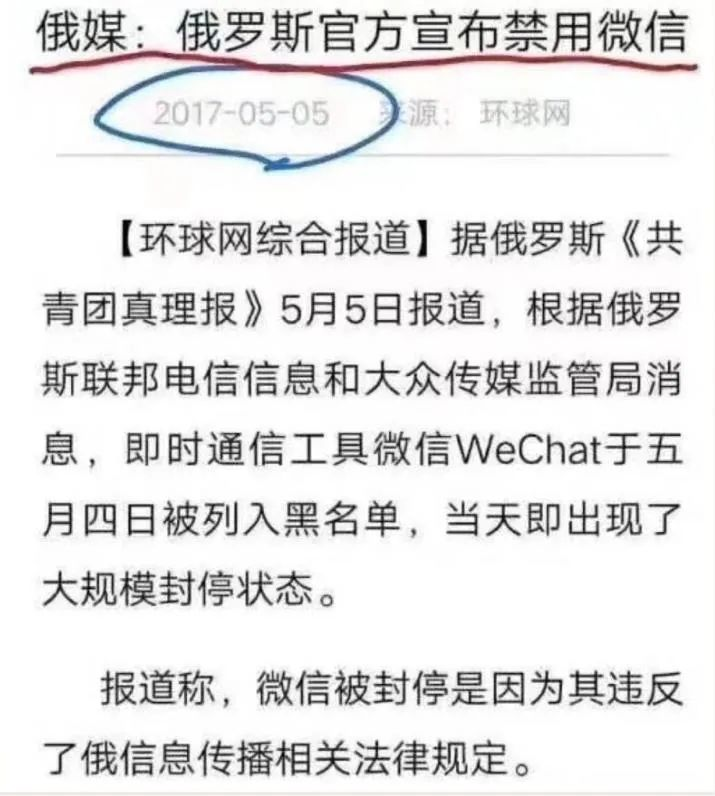
Think about it, Zhang Yiming’s Neihan Duanzi APP was removed from the mainland overnight. Did he dare to disobey? TikTok was banned in India. Why didn’t he sue? WeChat was banned in Russia a few years ago. Can Tencent get any compensation?
The second is to spin off, sell, and find a taker, to be acquired by U.S. capital.
This is a sub-optimal choice for the company. At least it can recover some money as compensation, which is equivalent to asset realization.
During the previous Trump administration, the rumored buyer was Microsoft. At first, the valuation of TikTok’s business was 50 billion U.S. dollars, which was a fair price, and the realization was not a loss; later, it became more complicated. It is said that Microsoft wanted to acquire all of TikTok’s businesses in the U.S., Canada, Australia, and New Zealand, and was only willing to offer 10 billion U.S. dollars, only one-fifth of the original price, which was indeed a case of taking advantage of the situation. Bill Gates said that this acquisition might be a “golden goblet of poison”, which might not be in line with Microsoft’s long-term strategy and interests.
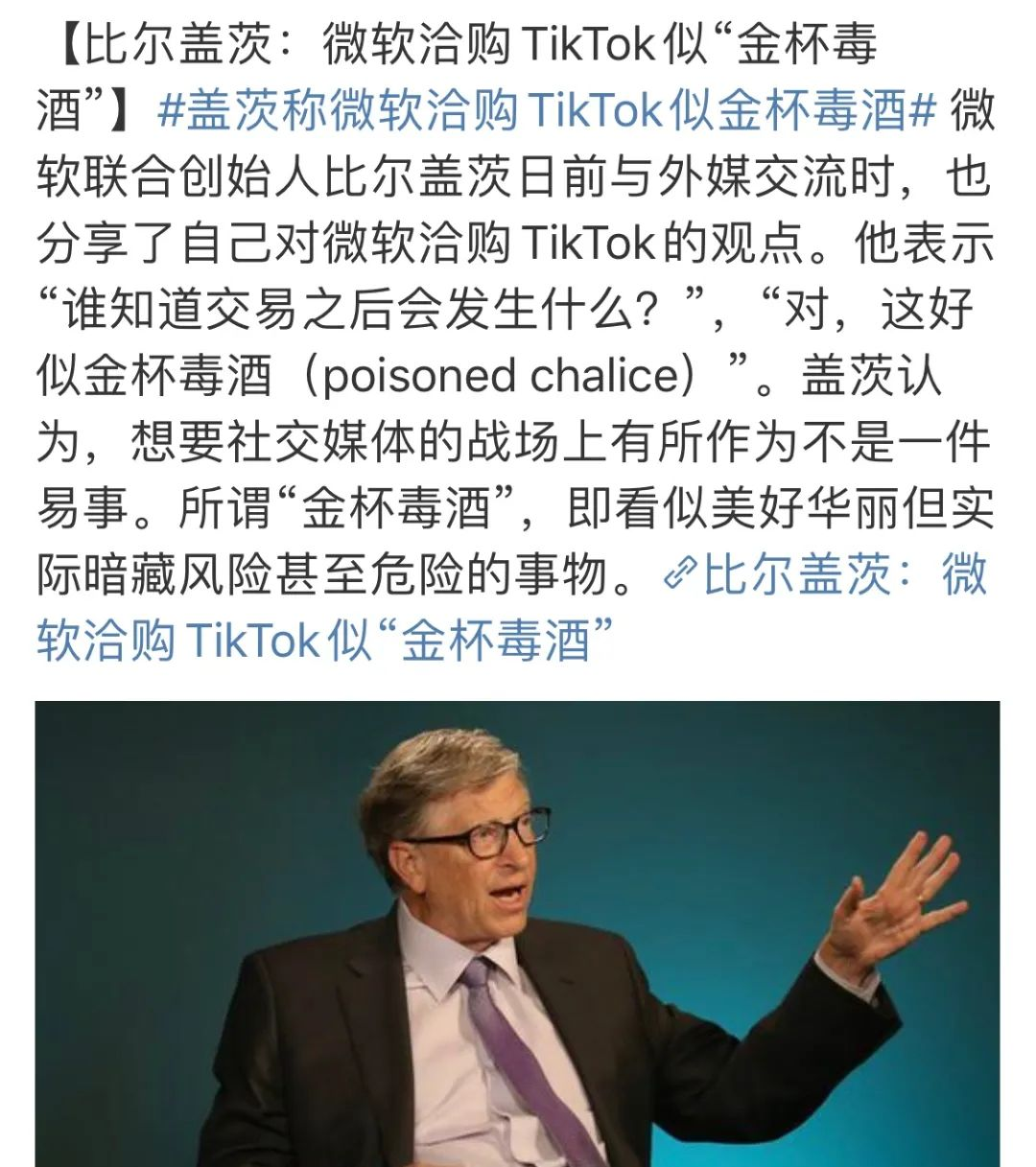
Now it seems that Microsoft has indeed bet on the next generation of technology, the AI revolution. ChatGPT is undoubtedly the focus of future development. Social media makes money through traffic, although it is easy, but the compliance risk is extremely high, and it often crosses the red line. Bill Gates’ concerns are not unreasonable, and the current Microsoft may not be willing to pay a high price to acquire TikTok again.
Of course, good goods are not afraid of being unsold. After all, TikTok has 150 million active users and strong user stickiness. To find the best buyer, the one who is willing to pay the price must be the one who understands it best. Besides Microsoft, I estimate that many big companies will be interested, such as Meta or Apple. Meta is definitely the company with the most synergy. Although Zuckerberg launched the short video competitor Reels, the competition with TikTok was very unsuccessful. Apple will enter the software market in the future and do streaming media. It already has long videos. TikTok is short videos, which enhances Apple’s voice in software and hardware integration.
For spin-off sales, the problem is that it needs the approval of the Chinese government, because it involves algorithm and other technology export controls. If China vetoes it, it cannot be realized. At present, the soaring nationalism in China makes it difficult to understand Zhang Yiming’s predicament of selling the business. This is regarded as a kneeling clan, submission, spinelessness, and national humiliation.
Two-pronged, in a dilemma.
The company is innocent, the entrepreneur is innocent, but the common man is innocent, and he is guilty because he possesses a treasure. An excellent internet company, caught between two major countries, becomes a victim of international political games.
Imagine, if TikTok were from Japan, South Korea, India, or any European country, it would not have encountered such a fierce thunderous attack, but who told you that you are from China?
Why am I so sure? I listened to the video of the hearing, and many details, I knew there was no suspense. CEO Shou Zi Chew’s performance was very good. He tried to prove to the U.S. congressmen that TikTok is a commercial institution, registered in the United States, with its business location in the United States, and its management and main employees in the United States, and promised that all user data of U.S. citizens is stored within the United States and is strictly protected. Although its major shareholder is a Chinese company and its founder is Chinese, ByteDance is a purely private company and is not controlled by any government.
Until a congressman asked: Can engineers in Beijing access U.S. data?
Shou Zi Chew replied: Yes.
This question doomed TikTok’s fate, and there are huge loopholes in compliance. No one dares to lie at the hearing, because it constitutes perjury, and not only will the company be investigated, but the individual will also bear criminal responsibility. In the past, President Clinton was almost impeached because his answer to the question of whether he had had sexual relations with Lewinsky during the congressional inquiry. Because this sentence was almost impeached, the extramarital affair was only a moral issue, and perjury was a criminal offense. (Clinton’s lawyer later argued that in Clinton’s mind, oral sex was not considered sexual intercourse, so it did not constitute intentional lying)
Why? Later, Congressman Crenshaw pursued this question, and Shou Zi Chew could only be clever and avoid the question, saying that I am a Singaporean. But it is not difficult for all the congressmen to understand, then how do you guarantee that other Chinese employees in ByteDance will not abuse information?
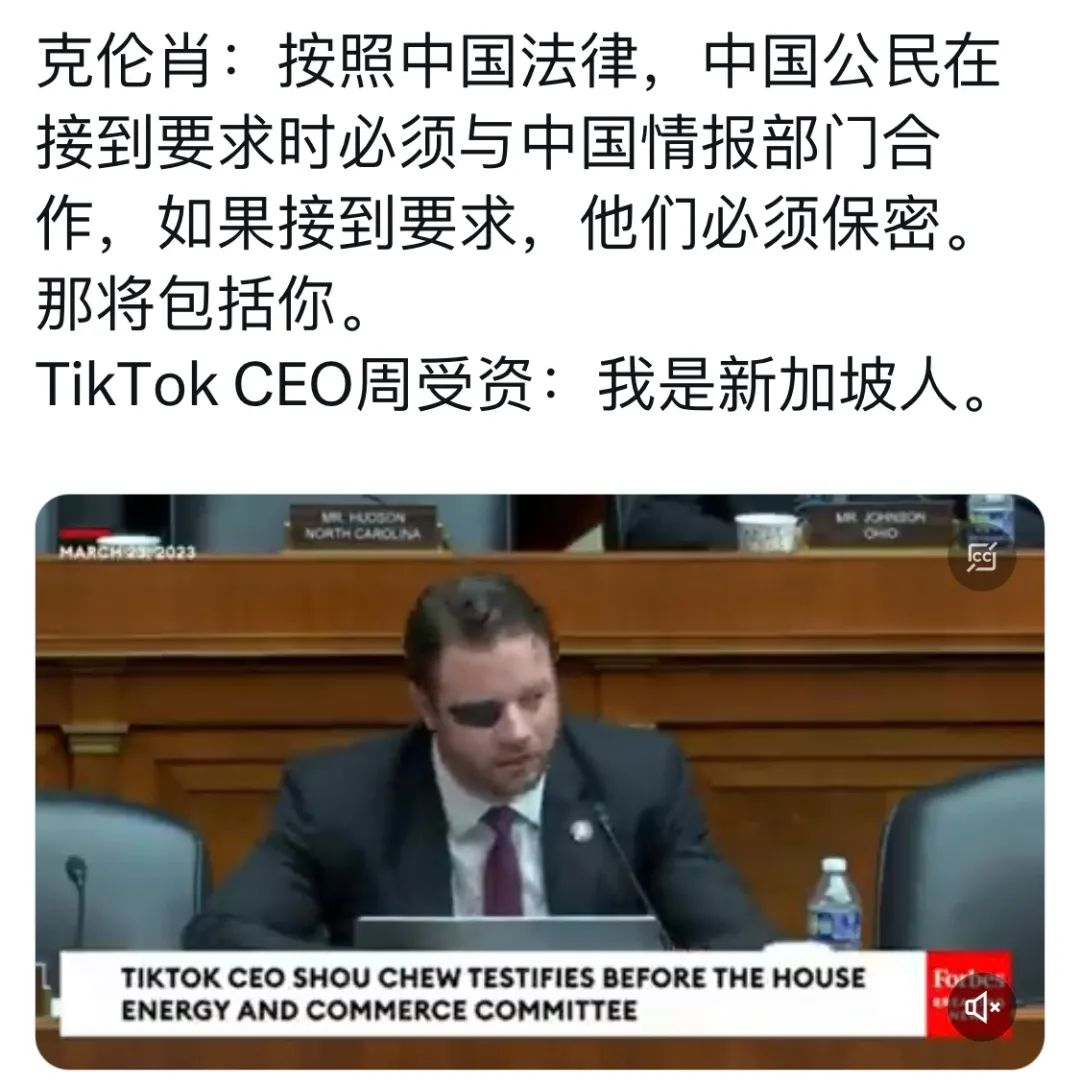
Because in Chinese law, it is illegal not to provide intelligence. It used to be a hidden rule, and they didn’t say it. Later, we openly promulgated the “National Security Law” and the “National Intelligence Law” and many other laws, which clearly stipulate that any enterprise and citizen have the obligation to assist the government in providing intelligence. This clause is not very favorable for Chinese enterprises to “go out”. The risks faced by Huawei’s 5G equipment are also the same dilemma. It is difficult to prove their innocence, because the law clearly stipulates the obligation to assist, and it is difficult to guarantee the security of its products and services at critical moments.
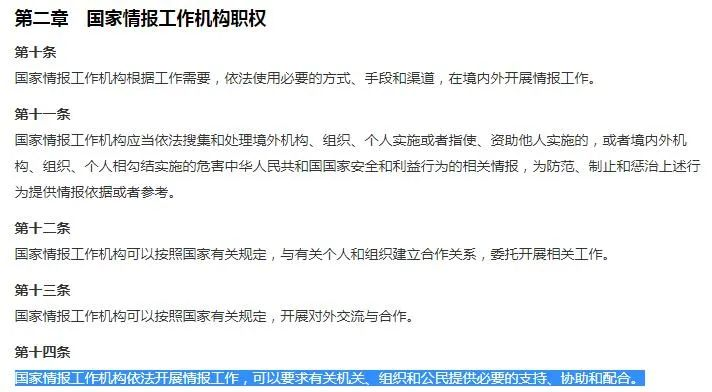
This of course involves national security issues, especially from a country with different ideologies and potential hostility. An APP from China can influence half of the national population through algorithms and the promotion of public preferences, which is enough to manipulate the U.S. election and the formulation of public policy. This is a new problem in the internet age.
Similarly, China cannot allow a U.S. company, such as Google or Facebook, to form a subtle influence on half of the population within its territory, which is as many as 700 million, through social platforms.
You know, the “Russiagate” in 2016 was only said to have found a few Russian hackers who hacked into Hillary’s email system, intending to manipulate the U.S. election. TikTok obviously faces much more serious accusations. Your own young people are brainwashed every day by an APP from an unfriendly country. It concerns national security, and I am afraid that no country can tolerate this kind of danger.
Therefore, India banned it long ago without saying a word, and after the United States took action, it is not ruled out that Japan, South Korea, Australia, and Europe will follow the footsteps of the United States on TikTok. This danger cannot be ruled out, especially against the background of increasingly confrontational geopolitics.
I remember in 2016, in the CCTV program “Dialogue”, several invited new internet tycoons chatted with each other. Huang Zheng of Pinduoduo suggested to Zhang Yiming three words: internationalization.
Zhang Yiming did not fail to work hard. In recent years, ByteDance has been desperately accelerating internationalization, diluting the Chinese color, and striving to “de-sinicize”. TikTok is a completely internationalized product, and the team is basically foreigners. Zhang Yiming even planned to move Byte’s headquarters out of China and move it to Singapore to completely change its blood and become a pure globalized international enterprise that can be compared to FAANG.
Unfortunately, it was still a step too late, and it failed.
The world is becoming more and more divided. On the one hand, there are the Russia-Ukraine war, the Saudi-Iranian reconciliation, and high-level visits to Russia, and the Belt and Road Initiative alliance; on the other hand, there are the Japanese-Korean century-old reconciliation, the U.S.-Australia cooperation to build submarines, Kishida’s visit to Ukraine, and AUKUS forming a team in the Indo-Pacific… The two major camps are increasingly taking shape, and the globalization process marked by the WTO is basically coming to an end.
The death knell of globalization has sounded!
Under the nest, how can there be intact eggs. Under the big background, the “going out” strategy of Chinese enterprises will inevitably encounter obstacles. Not only TikTok, but basically, all of them are at risk. If one goes out, one will stand out, and one will stand out, they will be pinched, harvested, and wiped out.
The globalized system is built on the basis of mutual trust. Once trust is destroyed, it is very difficult to rebuild. If both parties do not trust each other and have a bottom-line mentality, and consider everything in the worst-case scenario, they can only slowly slide towards a new Cold War. The Cold War is also a war, a chronic war, a war of attrition, a war without bloodshed. If you still have illusions about this, think about TikTok.
Discover more from 自由档案馆
Subscribe to get the latest posts sent to your email.