Text: Wei Chunliang
Interesting, interesting. Just last night, as soon as the official announcement regarding the Nanjing Museum was released, the museum’s apology letter followed.
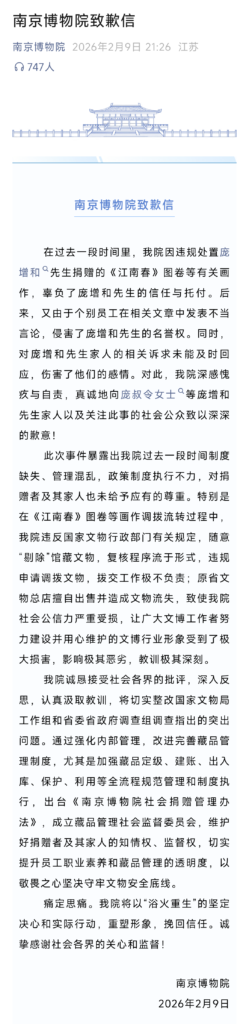
It can be seen that the Nanjing Museum apologized to the Pang family for three things:
1. Improper handling of paintings such as ‘Spring in Jiangnan’, failing to live up to trust and entrustment.
2. Individual employees made inappropriate remarks, infringing on the right to reputation.
3. Failure to respond to the Pang family’s requests in a timely manner, hurting their feelings.
Although the Nanjing Museum’s apology letter seems to be full of remorse, admitting to arbitrarily ‘removing’ museum artifacts, with the review process being a mere formality, and also reflecting on the improper application for the allocation of artifacts, with the allocation work being extremely irresponsible, you can still see their arrogance from between the lines.
For example, it says that it was because the former Provincial Cultural Relics General Storehouse sold and caused the loss of cultural relics that the Nanjing Museum’s social credibility was seriously damaged, shifting the blame to the Jiangsu Provincial Cultural Relics General Storehouse.
Not to mention that when ‘allocating’ paintings such as ‘Spring in Jiangnan’, Xu Huping, who was already performing the duties of the director of the Nanjing Museum, was the manager of the Jiangsu Provincial Cultural Relics General Storehouse. Just say that if Xu Huping had not signed and approved the ‘allocation’ of paintings such as ‘Spring in Jiangnan’, how could there have been Zhang and Wang’s embezzlement?
The disaster started from the Nanjing Museum itself, but it blames others for causing its own serious damage to credibility. Doesn’t the Nanjing Museum’s improper allocation of cultural relics lead to a loss of credibility if the Jiangsu Provincial Cultural Relics General Storehouse does not sell paintings such as ‘Spring in Jiangnan’?
That’s right, if the Jiangsu Provincial Cultural Relics General Storehouse did not sell paintings such as ‘Spring in Jiangnan’, their improper allocation of cultural relics would not have been known to the public, and naturally, their credibility would not have been damaged.
Nanjing Museum, is that what you mean?
And in the second half of the apology letter, the Nanjing Museum is going to strengthen the standardized management and system execution of the entire process, including the grading, accounting, warehousing, protection, and utilization of collections, and is also going to establish a social supervision committee for collection management to safeguard the right to know and the right to supervise of donors and their families, which really makes me laugh.
Does that mean the Nanjing Museum didn’t have processes and systems for collection grading, accounting, warehousing, protection, and utilization before? Or is it just a formality? If the previous processes and systems were not ‘strengthened’, does that mean that, in addition to the ‘Spring in Jiangnan’ paintings exposed this time, there may be more cultural relics that were ‘allocated’ and lost? Is it necessary to do another round of sorting and investigation?
Since your attitude is so sincere, don’t just say it!
Moreover, after the superior gave a heavy slap, you only then knew to safeguard the right to know and the right to supervise of donors and their families. What were you doing earlier? Didn’t the Pang family write you letters asking for an explanation before? Didn’t the Pang family sue you?
Why didn’t you think of ‘safeguarding the right to know and the right to supervise of donors and their families’ at that time?
In my opinion, the current apology letter is insincere just from the words. The Nanjing Museum doesn’t have the courage to cut off the wrist, but only the helplessness and unwillingness forced by authority.
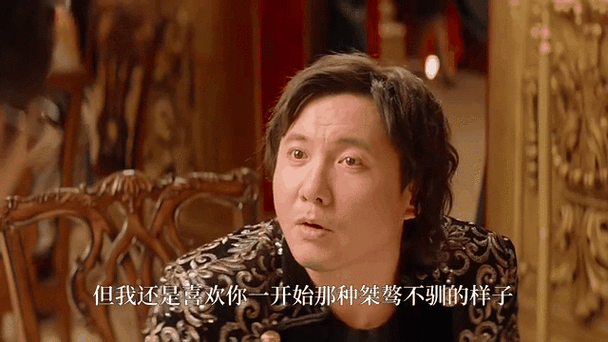
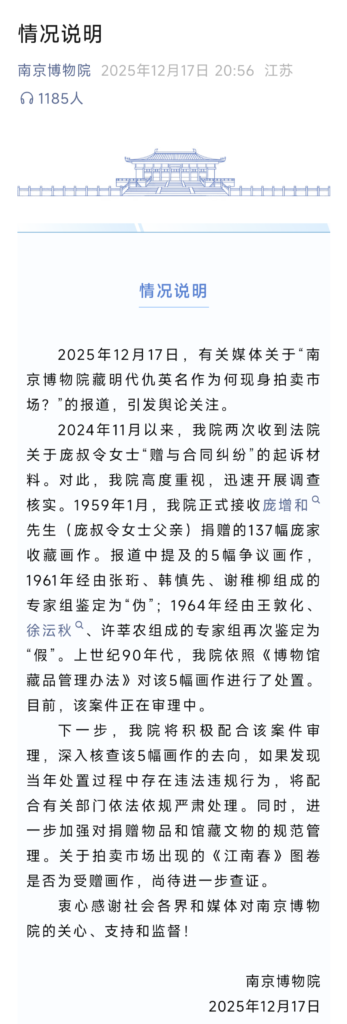
Therefore, in comparison, I still prefer the Nanjing Museum’s arrogant look when it firmly asserted that the five paintings, including ‘Spring in Jiangnan’, were forgeries.
Although the attitude at that time was arrogant, it was sincere and tough enough.
It’s much more individualistic than now.
Discover more from 自由档案馆
Subscribe to get the latest posts sent to your email.