

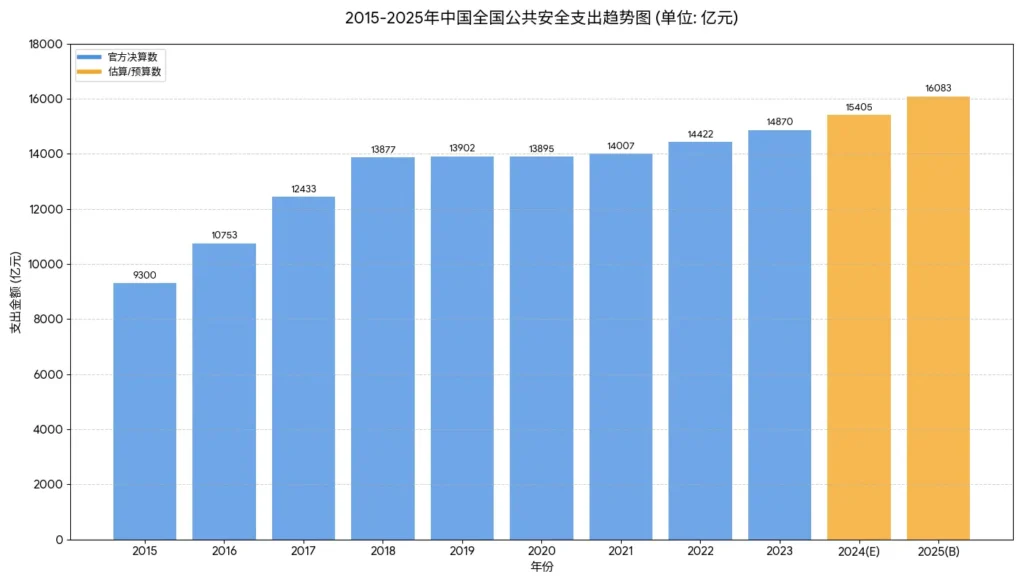
With the release of the 2025 fiscal budget draft, a long-standing figure has resurfaced: China's "public security expenditure" is expected to exceed 1.6 trillion yuan.
Since China's public security expenditure officially entered the "trillion-yuan era" in 2016, this huge expenditure, known as "stability maintenance expenses," and its growth rate and composition have become a barometer for observing China's social governance model. However, investigations have found that the figures presented on the books may only be the tip of the iceberg, with a large amount of governance costs being concealed in the financial statements of people's livelihood, infrastructure, and even enterprise operations through "creative naming."
1. Beyond the Books: Where did the Missing Stability Maintenance Expenses Go?
In the official fiscal categories, there is no such item as "stability maintenance." It is usually classified under **"public security expenditure,"** covering public security, armed police, courts, procuratorates, and judicial administration. However, many fiscal observers have pointed out that the funds actually used to maintain social stability have long exceeded this scope.
1. The Civilian Shell of "Grid Management" In the budget tables of many cities, a large amount of stability maintenance labor costs are bundled into "urban and rural community affairs" or "general public service expenditure."
- Name: "Comprehensive Governance Personnel," "Grid Information Personnel," "Peaceful Construction Subsidy."
- Actual Situation: The "red armbands" and community workers who are everywhere on the streets, one of their core responsibilities is to collect grassroots conflicts and monitor key personnel. This part of the expenses is reflected on the books as "community services," but in fact, it performs stability maintenance functions.
2. The Infrastructure Background of the "Bright Snow Project"
- Name: "Smart City Construction," "Urban Informatization Upgrade," "Informatization Infrastructure."
- Actual Situation: The "Bright Snow Project" (mass monitoring and alarm system) covering rural and urban areas across the country, its hundreds of millions of cameras and facial recognition back-end systems, its construction and maintenance costs are often allocated through local government bonds or special infrastructure funds.
3. "Hidden Apportionment" of Social Governance In recent years, stability maintenance costs have shown a trend of "socialization." Large internet companies need to pay for their own content review teams of tens of thousands of people, and security checks at public transportation hubs are undertaken by commercial security companies. These costs, which should have been borne by the government or incurred by supervision, are ultimately passed on to enterprises and consumers.
2. The Paradox of Input and Output: Why Does Stability Maintenance Lead to More Instability?
Despite the continuous increase in financial investment, the pressure of social governance has not been reduced. Since 2023, from discussions on mental health crises on social media to extreme individual cases that frequently occur at the grassroots level, it shows a gap between huge expenditures and the sense of security among the people.
Investigative news points out that the continuous rise in stability maintenance expenses reflects three core problems faced by current social governance:
- The Focus of Contradictions Shifts Downward: With fluctuations in real estate and the slowdown of economic growth, economic problems such as labor disputes, property delivery, and financial explosions have quickly turned into social contradictions. Traditional "strong control" can only suppress the superficial, but cannot solve the underlying logic of unequal distribution of interests.
- The "Tacitus Trap" of Digital Monitoring: High-tech means have achieved all-weather monitoring, but it has also led to the severance of communication paths. When the legitimate demands of the people are simplified into "risk points" by big data systems for control, social pressure is not only not released, but instead accumulates continuously due to the lack of channels for negotiation.
- The Rigidity of Governance Costs: Once a huge stability maintenance system is established, it will generate the power of self-expansion. From technology upgrades to a huge team of extra-budgetary employees (auxiliary police, co-management), the expenditure of each year has become a "rigid expenditure" that is difficult to reduce.
3. Expert Views: From "Rigid Stability Maintenance" to "Resilient Governance"
Sociology experts believe that the "naming dilemma" of stability maintenance expenses reflects the rigidity of governance thinking.
"The current model is a typical 'buying peace with money'," said a scholar who wished to remain anonymous. "When the growth of fiscal revenue slows down and the cost of stability maintenance continues to rise, the sustainability of this model faces huge challenges. True stability does not lie in the density of cameras, but in the protection of individual rights by the rule of law, and the transparency of interest negotiation mechanisms."
4. The Pandemic Legacy: From "Epidemic Prevention and Quarantine" to "Normalized Control"
Investigations have found that the period of epidemic prevention and control from 2020 to 2023 was a key node for the qualitative change in China's stability maintenance model. The expenditures originally used for public health were highly integrated with social control expenses in actual operation.
- The Identity Transformation of "Big Whites" and Quarantine Personnel: During the epidemic, millions of epidemic prevention volunteers and outsourced quarantine personnel were mobilized across the country. Investigations show that in the post-epidemic era, this huge grassroots force has not completely disappeared, but has been absorbed into the community comprehensive governance system through "transferring jobs."
- Name: "Public Health Emergency Reserve," "Community Grassroots Governance Optimization."
- Actual Situation: The personnel who were once responsible for nucleic acid testing and lockdown duty have been transformed into the current "security patrol officers" or "community civilization guides," continuing to maintain strong penetration into the grassroots level.
- The Institutionalization of Grid Members and "Digital Fences": Although the "health code" and "venue code" developed during the epidemic have withdrawn from the stage, the underlying data behind them has been incorporated into the public security and civil affairs systems.
- Name: "Digital Twin City," "Community Refinement Management Project."
- Actual Situation: The function of grid members has been upgraded from "checking body temperature" to "checking movements." Through real-time trajectory tracking of the floating population and key populations, local governments have built an invisible, costly digital fence.
5. The Huge "Shadow Army": Auxiliary Police, Security Guards, and Labor Dispatch
Outside the official police establishment, China's actual stability maintenance forces rely on a larger "shadow army." This part of the expenditure is the most concentrated area of "creative naming."
- Auxiliary Police (PA): The Buffer Pad of Public Security Budget
- The estimated number of auxiliary police nationwide is several times that of official police. Their salaries, equipment, and social security are usually not included in the national civil servant expenses, but are listed under the third-level category of "public security business expenses" of local governments in the form of **"government purchase of services"** or **"labor dispatch fees."** This makes the public security budget appear relatively stable on the books, but in fact, it bears a heavy burden.
- Security Outsourcing: Hidden Security Tax
- Whether it is subway security checks, government building security, or on-site maintenance of major festivals, it is now almost entirely undertaken by third-party security companies.
- Name: "Office Area Property Management Fees," "Special Security Service Outsourcing."
- Actual Situation: This model commercializes political tasks, and the government, by paying high service fees to security companies, indirectly expands the quasi-military stability maintenance force and avoids the restrictions of administrative establishment.
6. The Focus of Social Contradictions: Why Are There Still "Cracks" Under High Pressure?
Investigations point out that this "continuous blood loss" expansion of stability maintenance expenses precisely reflects the structural challenges currently faced by Chinese society:
- The Positive Correlation Between Economic Downturn and Stability Maintenance Pressure: With the decline of real estate and fluctuations in youth unemployment rates, "rights protection" behaviors caused by economic disputes have surged. The government has to invest more funds in grassroots interception, psychological counseling (in fact, monitoring), and on-site clearing.
- The Diminishing Marginal Returns of Governance Effectiveness: A monitoring network built with 10 billion yuan may fail due to public anger caused by an unfair grassroots law enforcement. This path of "suppressing problems with money" rather than "solving problems with law" leads to a vicious cycle of stability maintenance expenses, **"the higher the investment - the deeper the contradictions are suppressed - the greater the potential risks - the more expenses need to be invested."**
Summary: Unsustainable "Governance Premium"
The data trend from 2015 to 2025 clearly shows that stability maintenance costs have become a major rigid burden on China's local finances. The monitoring system, which was formed during the epidemic and is refined to each building, has become an astronomical figure for its annual maintenance costs (electricity, bandwidth, personnel subsidies).
If the root causes of social problems - such as employment security, judicial justice, and interest expression mechanisms - are not fundamentally improved, then no matter how the names are changed, this "trillion-yuan bill" will eventually face the dual test of fiscal support and social tolerance.
1.6 trillion yuan is not just a set of numbers, but a heavy footnote to the operating costs of Chinese society. If the core demands of distribution, employment, and the rule of law cannot be solved from the source, relying solely on budget additions and category transfers, it may be difficult to escape the vicious circle of "the more you invest, the greater the pressure."