


Object|Text
Bin Yue Yu Yun (ID: Lzkj328)|Published by
Today at 15:57, this account published "Why is the request for disciplinary action against Judge Hu being strictly defended?".
Just now, at 17:32, the Intermediate People's Court of Handan City released a "Situation Report". The full text of the report is as follows:
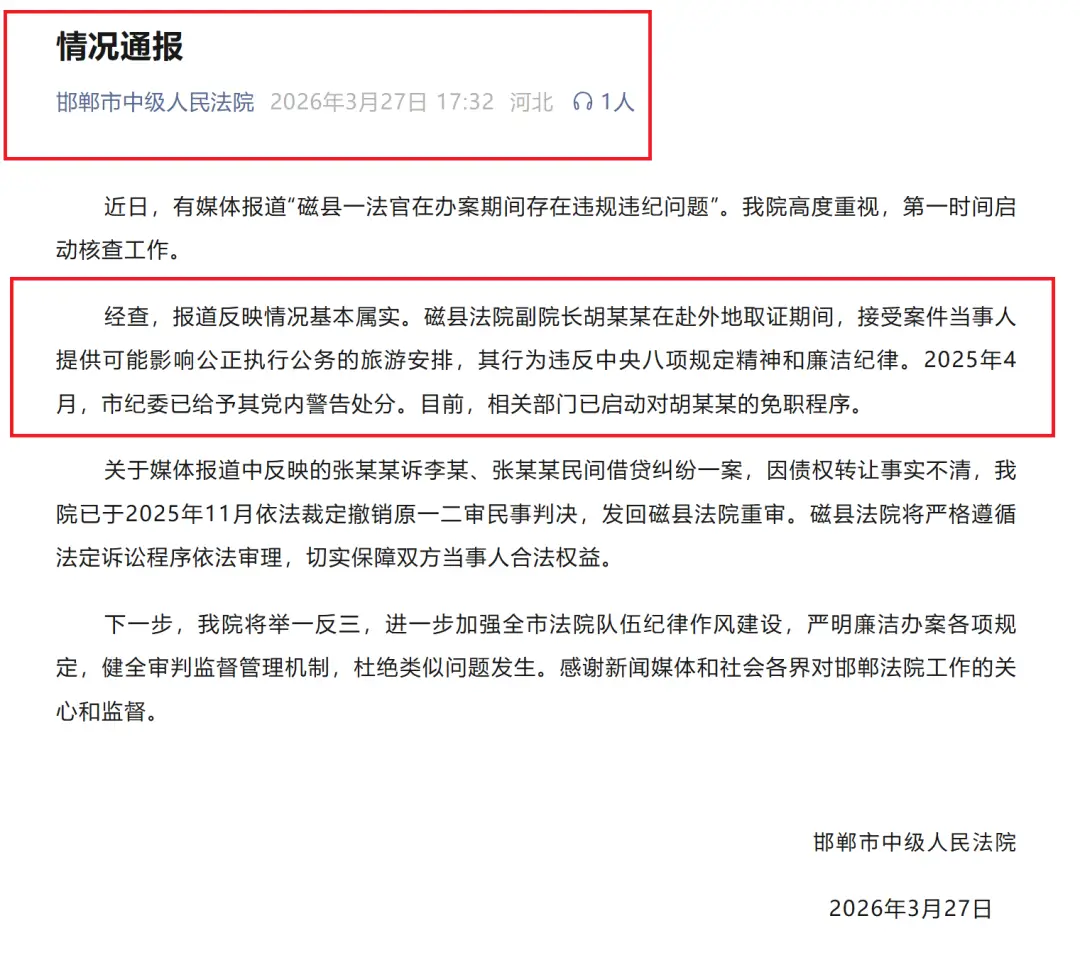
The Cixian County Court and Vice President Hu, who were complained about by the media, had their faces slapped hard!
The judge and the plaintiff walked together, ate together, and burned incense and worshipped Buddha... When such an absurd scene actually happened to the vice president of the court, what the public expects is naturally a serious accountability and a clear explanation.
Today (March 27), the official media Da Feng News publicly reported this absurd incident. (Click to view: "The vice president of the county court went with the plaintiff, ate together, and burned incense and worshipped Buddha during the case handling? Defendant: Initiate disciplinary action but no result; Judge involved: You ask the unit to understand")
However, after the self-media account "Lü Mei Record" published "The judge burns incense and worships Buddha and accepts banquets, judicial questioning behind the request" article, it encountered double complaints:
Cixian County Court, on the grounds of "content not authorized", claimed that the documents involved were "internal documents and are trade secrets"; while the judge involved, on the grounds of "infringement of reputation/privacy", claimed that the personal information in the documents was "not allowed by the person" to be posted online, and that "there are unclear basic facts" in the statement "constitutes smearing of the identity".
Two complaints, one from the court and one from the judge involved, seem to be talking about their own things, but in fact, they have the same goal, both trying to re-seal this "Request for initiating disciplinary procedures against Judge Hu" back into the "internal" black box.
The platform did not indulge them, and the answer was: "After review, the complaint does not meet the legal processing conditions and will not be supported."
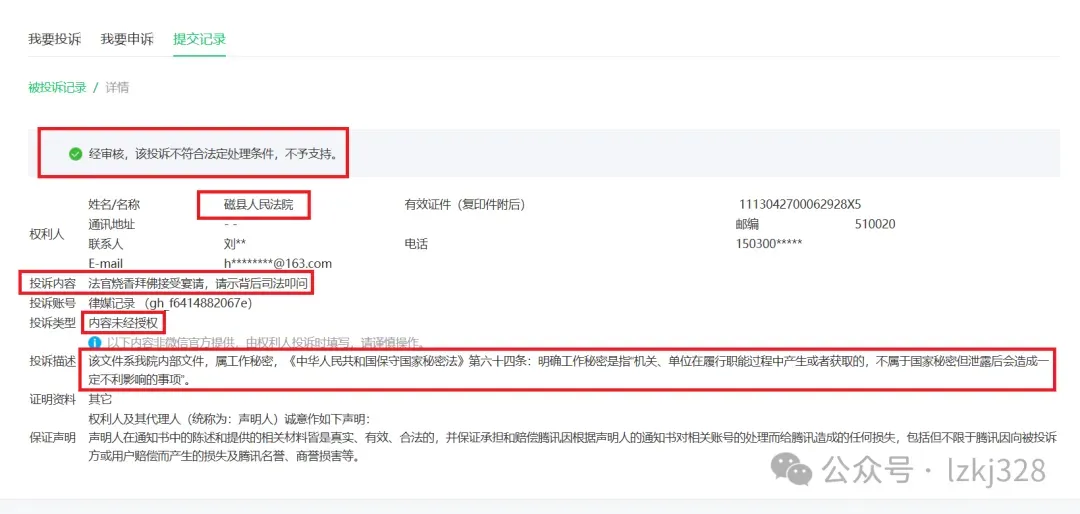
The complaint was rejected, indicating that the platform also understood: a request for disciplinary action involving a judge's violation of discipline and concerning judicial credibility is not a "trade secret" that cannot be seen; a violation of discipline that has been verified is not something that can be covered up by a complaint of "infringement of privacy".
It is necessary to clarify a basic common sense: trade secrets are not a "basket" that can be filled with anything.
Article 64 of the "Law on the Preservation of State Secrets" clearly states that trade secrets refer to "matters generated or obtained by organs and units in the process of performing their functions, which do not belong to state secrets but will cause certain adverse effects if leaked".
The key here is "certain adverse effects". If this document is made public, what "adverse effects" will it cause? Will it affect national security or social stability? Obviously not.
The truly "unfavorable" thing is probably the court's "face", the judge's "inside", and the public questioning that may be triggered once this incident is made public.
Covering up the judge's disciplinary action as a "trade secret" is essentially the same as the Chongqing cover-up of the "female prosecutor who committed adultery and gave birth to a child with others", which is essentially the same as turning internal supervision into internal protection. (Please click to view "Breaking news! Well-known netizens apply to the Chongqing Municipal Procuratorate to disclose the decision on the punishment of the female prosecutor and the wealthy businessman for improper sexual relations" "Breaking news! Well-known netizens apply to the Chongqing Municipal Procuratorate to disclose the decision on the punishment of the female prosecutor and the wealthy businessman for improper sexual relations")
What's even more ridiculous is that this "request", which the court calls an "internal document", itself reveals all sorts of irregularities and carelessness. The document misspelled the word "banquet" as "晏", and the heading "Handan Intermediate People's Court" should have been written at the top, but two spaces were left blank.
More importantly, as a formal document, it does not even have a serial number, which is a basic component of a document. How can one believe that an "internal document" that does not even conform to the basic format is a formal request generated through strict procedures?
Or, this just shows that this so-called "disciplinary request" has a certain "informal" color from the very beginning. Perhaps it has never really entered the reporting procedure, but is just a "paper article" that remains within the Cixian County Court?
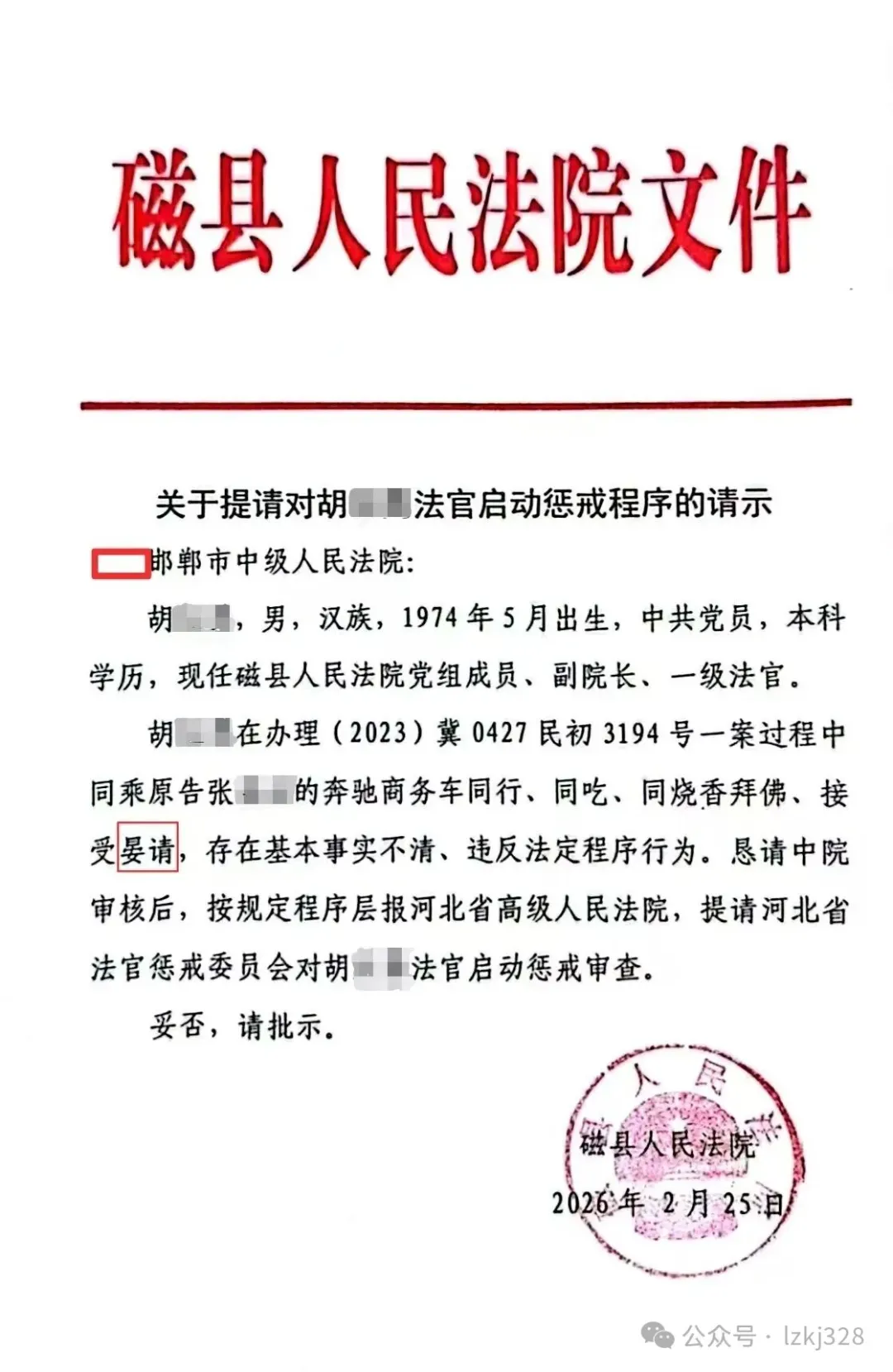
The previous statement of Li, the poster, may have confirmed this speculation. He said that this document was not submitted to the Handan Intermediate Court after it was issued.
If this is true, it means that a judge who has been found to have violated discipline may not have even walked out of the door of the Cixian County Court for his disciplinary procedures, and was "internally coordinated" away. And the shield of "trade secrets" just provides a legitimate reason for this kind of "internal digestion".
The judge's complaint on the grounds of "infringement of reputation/privacy" is also untenable. The personal information in the document is the official information that the court generated in accordance with the law when performing the disciplinary procedures. The purpose of disclosing this information is to accept supervision and respond to social concerns, not for illegal purposes.
As for the statement of "unclear basic facts", it is precisely the determination written by the Cixian County Court itself in the document, but now it is to be complained as "written based on the defendant's subjective description, without factual basis".
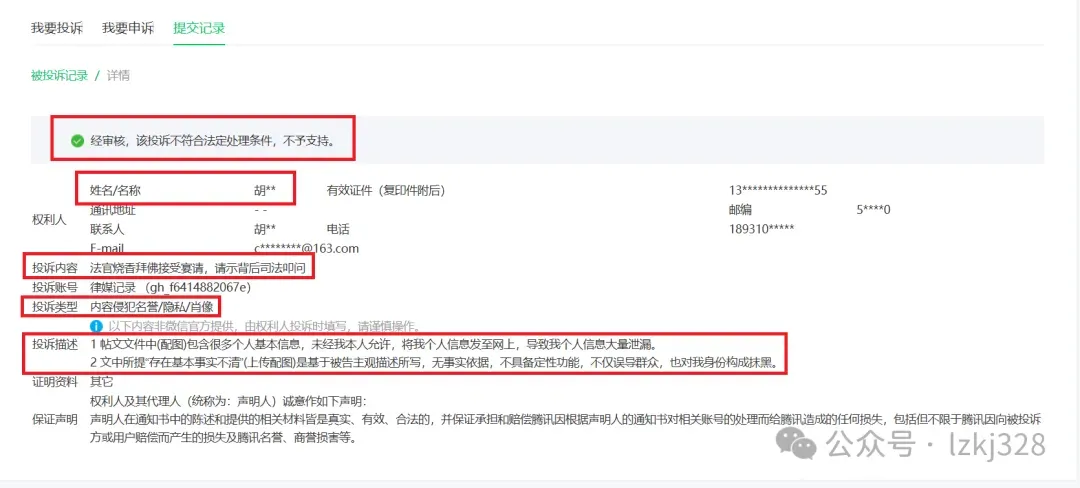
Is this self-contradictory, or is it an attempt to deny the document issued by the court? If this document is really "without factual basis", why did the Cixian County Court issue it in the first place? If there is a basis, then where does the "smearing" come from?
Defining the disciplinary request as a "trade secret" and packaging the punishment process as "personal privacy", this double-covering operation is in itself a cover-up.
Imagine, if this document is really just an ordinary internal working document, why would the court be so nervous that it has to specifically complain to the self-media? If the disciplinary procedures are being promoted in accordance with the law, why not openly inform the public of the progress? What really needs to be "confidential" is probably not the document itself, but the "thunder is loud, rain is small" disciplinary reality behind the document. A formal disciplinary request may never have been truly initiated.
The harm of this kind of "paper punishment" is far more than whether a certain Hu has received the punishment he deserves. It damages the seriousness of the entire judicial disciplinary system and erodes the public's trust in the judicial system.
The "Provisions on the Procedures for the Work of Disciplinary Judges (Trial)" issued by the Supreme People's Court in 2021 designed a set of procedures for reporting layer by layer and professional review, the purpose of which is precisely to ensure the fairness and transparency of the disciplinary action. However, if this set of procedures becomes opaque under the packaging of "internal documents" and "trade secrets", if the public does not know whether the disciplinary action has been truly initiated and whether it has been truly implemented, then no matter how perfect the system design is, it is just a "paper article".
Admittedly, not all internal documents are suitable for public disclosure, but disciplining judges is by no means a trivial matter that can be "internally digested". When a judge is found to have walked with the plaintiff, eaten together, and burned incense and worshipped Buddha, when his behavior has led to the retrial and revocation of the original judgment in the relevant case, this incident has long gone beyond the scope of "internal management" and entered the field of public interest.
The public has the right to know: Has the judge involved been transferred from the trial post? Has he withdrawn from the judicial staff? Has the party discipline warning and administrative warning been recorded in the files? Has this "Request for initiating disciplinary procedures against Judge Hu" been reported to the higher authorities?
——The answers to these questions are related to the seriousness of the judicial disciplinary system and also to the public's confidence in judicial justice. If the disciplinary procedures become unknowable and unaskable under the packaging of "trade secrets", then the public can only draw a conclusion: this is just a "paper punishment".
In a sense, covering up the disciplinary request as a "trade secret" is more worthy of vigilance than the violation of discipline itself. The violation of discipline is a problem of individual judges, while covering up the violation of discipline with "secrecy" and blocking supervision with "internal documents" may evolve into a systemic problem.
When a formal disciplinary document can be arbitrarily defined as a "trade secret", when the advancement of disciplinary procedures can be stagnant due to "internal coordination", when the formal documents of disciplinary actions can not be issued to the parties, the self-purification ability of the judicial system will be fundamentally questioned.
And using Article 64 of the "Law on the Preservation of State Secrets" to endorse this kind of unspeakable behavior is even undermining the seriousness of the law. It is not using the law in accordance with the law, but in panic, taking a fig leaf to cover up the shame, and at the same time, also wanting to silence public opinion. The law is used to protect state secrets, not to provide excuses for illegal acts.
The platform's decision to reject the complaint may be regarded as a kind of external correction: when the court tries to cover up the lid with "trade secrets", when the judge tries to block supervision with "infringement of privacy", the platform uses the review conclusion of "not meeting the legal processing conditions" to give the public a basic judgment. Some things can't be covered up if you want to.
Back to the core of this incident: disciplining the judge, should it stop at an "internal document", or should it be truly implemented? The answer is self-evident.
Judicial credibility is not achieved by "covering up the lid", nor is it achieved by "trade secrets", nor is it blocked by complaints of "infringement of privacy", but by cases that are judged impartially and by self-correction that is unambiguous.
Locking the disciplinary request in the file cabinet and hiding the decision of the punishment under the veil of "trade secrets" may temporarily preserve the "face" for a while, but what is lost is the public's trust in judicial justice.
The "shoe" of the disciplinary system cannot always be suspended in the air, and it cannot be left unfinished under the packaging of "internal documents". The "Request for initiating disciplinary procedures against Judge Hu" should not be the waste paper of "internal digestion", but should be the first horn of initiating accountability.
What the public expects is that this horn can truly sound, rather than being covered up by the four words "trade secrets" and becoming a dud of "paper punishment". (Author: Bin Yu) (Bin Yue Yu Yun WeChat public account: lzkj328)
Source | Bin Yue Yu Yun ID: lzkj328
Editor | Xia He
Reviewer | Bin Yu
Published by | Bin Yue Yu Yun ID: lzkj328
**Thank you for sharing!**