GDP growth continues to maintain above 5%, and the growth rate of residents’ income has also exceeded 5%; emerging industries such as biomedicine, integrated circuits, artificial intelligence, robots, and new energy are booming, and cultural tourism industries across the country are also unprecedentedly prosperous; the trade surplus exceeds 1 trillion US dollars, creating a historical record in human trade. The stock market also rose sharply for a year, a solid bull market, with the Shanghai Composite Index up 17% and the ChiNext up 50%. However, everyone generally feels bad, it’s difficult to do business, and it’s difficult to find a job. 80% of retail investors in the stock market bull market actually lost money, and it is said that the average loss per person was 20,000 yuan……
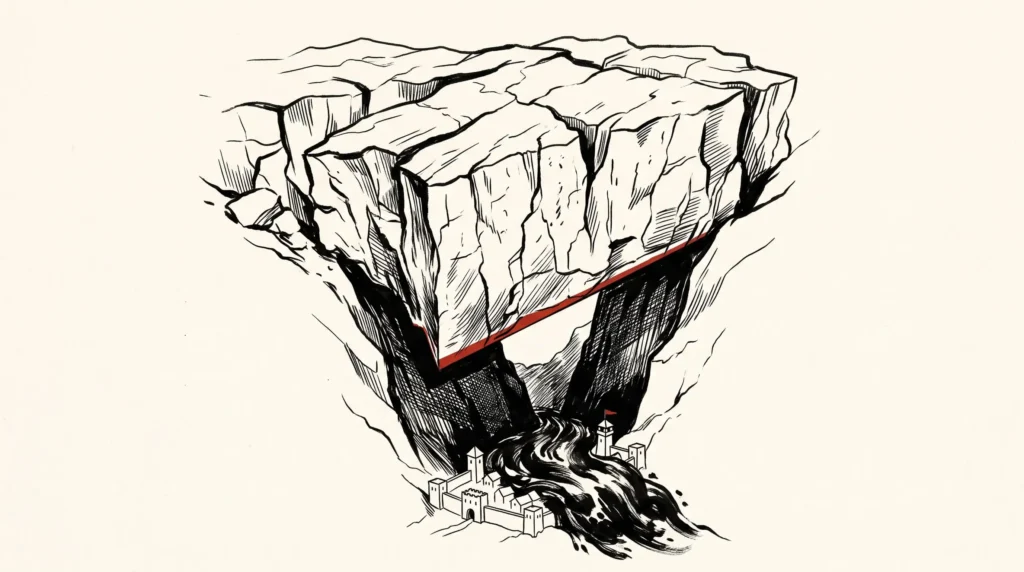
The macro and micro performances show extreme contrasts, like fire and ice, with a huge temperature difference in perception, what is the main reason? The main reason is not that the data is problematic, but that: the statistics bureau’s data only includes the indicators of the gross national output (GDP) in growth, but not the indicators of the gross national wealth (GDW) in decline. Today, one of the main contradictions of the Chinese economy is the contradiction between the decline of more than 20 trillion yuan in national wealth and the growth of 20 trillion GDP in the past three years. Because micro individuals are more affected by the shrinking of wealth, the macro GDP growth is difficult to compensate for the loss of wealth and translate into the sense of gain of micro individuals in the short term. GDP accounts for the flow, which can be regarded as the country’s “profit and loss statement without asset impairment”; while the current micro-individual’s perception is mainly determined by the balance sheet, that is, wealth shrinkage, and the cash flow statement, that is, how much money is in hand.
That is to say, the 5% GDP growth rate for three consecutive years, with a total increase of 20 trillion yuan in national output, cannot compensate for the total wealth shrinkage of 200 trillion yuan+ brought about by the adjustment of housing prices for three consecutive years. China is now a moderately prosperous society, and wealth sensitivity is greater than GDP growth rate, but currently lacks a GDW (Gross Domestic Wealth) to measure national wealth. What affects people’s perception is currently mainly the problem of wealth shrinkage, which is the main reason for the large temperature difference between macro and micro perceptions. More seriously, while assets are shrinking, liabilities are still increasing, further increasing the shrinkage of net wealth and the reduction of disposable income.
It is necessary to recognize that today’s Chinese economy is not the simple and primary shortage economy of a few decades ago, where the people lack wealth. The shortage economy needs to vigorously develop GDP to solve the contradiction of backward productivity and complete the accumulation of capital and wealth. Today’s Chinese economy has achieved a moderately prosperous society, and the main symbol of a moderately prosperous society is the formation of national wealth, the preservation and appreciation of wealth, and the stable growth of GDP are equally important. If you don’t understand the importance of the fair value of national wealth, you don’t understand the moderately prosperous society, you don’t understand the modern economy, and you are still stuck in the thinking of the past shortage economy.
Think about it, how much does a person’s income need to increase in the past three years to compensate for the loss of wealth brought about by the decline in housing prices (the average household wealth shrinkage of 500,000 yuan). And our macro indicators, from GDP to personal income, only measure the flow of this year, and there is no indicator to measure the loss of national wealth brought about by wealth shrinkage. GDP is the total national output, which measures the output. But there is no indicator GDW to measure the total national wealth. This is what I have repeatedly stated. Moreover, the income in recent years has not increased accordingly due to the pain of transformation. Employment and people’s livelihood are under great pressure.
A simple accounting common sense is that even if the “profit and loss statement without asset impairment” performs well, but because the balance sheet is “scarred”, and the cash flow statement is “stretched”, everyone’s actual perception will not be too good. A company’s long-term expectations are determined by the balance sheet. Even if it is not profitable in the short term, the prospects for asset returns are good, and the liabilities are appropriate, everyone’s confidence will still be strong. For example, in the early days of reform and opening up, GDP was not high, but everyone had good expectations and was full of enthusiasm, because everyone was full of confidence in the future growth of China’s assets. And life and death are determined by the cash flow statement. Even if the balance sheet and profit and loss statement are good, if there is no cash flow in the account, bankruptcy and liquidation may be just a matter of overnight. The statistical data of the statistical department mainly reflects the “profit and loss statement without asset impairment”, so it cannot truly reflect the actual perception of society.
Even GDP growth also has a large degree of differentiation. The increase in output value accumulates on the production side, large projects, large enterprises, and the supply side, and the benefits are realized in a few scientific and technological elites and financial elites, while most ordinary people feel the chill brought about by the shrinking of real estate. Behind the growth of the total GDP, there is an imbalance between actual variables and nominal variables, domestic demand and foreign demand, upstream and downstream, supply and demand. The transformation of real estate and local government debt has pain and new life. Ordinary people first feel the pain, such as employment problems, debt repayment problems, wealth shrinkage problems, etc., which are all related to the fate of micro individuals, especially the urban middle class. If you can’t see all this, it’s easy to misjudge the situation.
And doesn’t anyone enjoy the “cost dividend” brought about by the decline in housing prices? The paradoxical thing is that when housing prices fall to ten years ago, the down payment and interest rates fall to the lowest level in history, young people instead lack the willingness and impulse to buy a house. For them, the new forms of employment, new concepts of marriage and love, and concepts of identity have long been vastly different from the first generation of urbanized residents who bought property to obtain “urban identity”. To be precise, they no longer need to buy a house to prove their identity. Because identity is for others to see, why does a young group who advocate the culture of staying at home and personal experience live in the eyes of others?
Therefore, we need to face a problem: how will a generation of young people who have been liberated from being “house slaves” and embrace new consumption and new technology change China’s economic and industrial structure. At the same time, how will the retired personnel who are accelerating their exit from the labor market and are full of leisure change China’s economic and industrial structure. The logic of the past has changed. The link of the elderly selling houses to young people has been broken, and this may change more than just the supply and demand structure. On the one hand, there are young people who are having difficulty finding jobs and whose incomes are declining, especially the more than 10 million college graduates each year. Their problem is not whether to buy a house or not, but the problem of where to place their youth; on the other hand, there are retired elderly people who are leaving the workplace and whose pensions are increasing, and there are also about 10 million each year. Their problem is how to spend their leisure time. However, the ultimate problem is that the jobs vacated by 10 million retirees are not suitable for young people or are not of interest to them.
And the “low-cost dividend” brought about by the decline in housing prices on the production side and the supply side cannot improve production efficiency? Of course, it can, and the specific manifestation is the momentum of the export, sweeping everything, and creating a human record of a one trillion US dollar trade surplus. I used to say that the export chain is mainly private enterprises, with a high employment density and a large multiplier effect. But today, looking at China’s export structure, it is no longer dominated by labor-intensive industries such as clothing, toys, and furniture, and most of these industries are small and medium-sized enterprises. Instead, it is dominated by the capital-intensive “new three”, such as integrated circuits, photovoltaic, lithium batteries, and new energy vehicles, and these enterprises are all large private enterprises, with low participation from small and medium-sized enterprises. Therefore, the enthusiastic exports are transmitted to the micro-individual perception of the people, which is also very different from before.
In the first half of the year, the GDP growth rate reached 5.3%, and in the first three quarters it also reached 5.2%, which is a “miracle” in the world. You must know that today’s 5% growth rate is not ordinary. First, China’s total GDP has changed a lot, and a 5% growth can reach 1 trillion US dollars, contributing one-third of the world’s economic growth. Second, today’s 5% is against the background of the deep transformation of real estate and the local government’s debt reduction. If real estate and local infrastructure do not constitute a drag effect, the actual GDP growth rate may exceed 7%. Third, the main driving force of economic growth has shifted from over-reliance on real estate and infrastructure to net exports and investment in high-tech industries. Net exports are mainly capital-intensive products, behind which are high-end manufacturing enterprises. Chinese manufacturing has now truly upgraded to Chinese intelligent manufacturing, which is also the result of Chinese enterprises deeply participating in the global industrial chain. Therefore, today’s exports, even if they are in full swing, but due to the substitution of automation, the contribution to the employment of ordinary people is not as much as before.
Therefore, we cannot simply evaluate today’s Chinese economy with good and bad, prosperity and recession. Today is a time of extreme differentiation in economic structure, a time of the final competition between old and new forces, and a time of switching tracks between land capital represented by real estate and technology capital represented by artificial intelligence. If you still have nostalgia for the past, and still miss it and are still entangled, it has been four years. For four years, land capital has been depreciating significantly, and technology capital has been appreciating significantly, and a new era has arrived long ago. How do you feel, the key is where you are in the world today. Those on the real estate chain and infrastructure chain will inevitably feel the cold wind and broken walls; while those on the export chain and technology chain will feel the spring and the competition of thousands of sails, and they are in an era that cannot be let down. It’s just that this distribution is not uniform, but extremely skewed. Most ordinary people are still struggling in the old world, and a few technology and financial elites are enjoying the dividend premium of the new era. And the “left hand gold, right hand technology” that I proposed more than a year ago is still the best investment expression to capture the dividends of this era.
Discover more from 自由档案馆
Subscribe to get the latest posts sent to your email.