


By | Da He
To put it bluntly, the difficulty in determining this year's social security base is probably because it's also in a dilemma.
Many people should have had this experience: every year in late August or early September, when they receive their pay stubs, they have to pause for a moment—is the salary wrong? Because the monthly salary they receive will be a few dozen yuan less.
This is actually because the social security contribution base has been adjusted.
But this year is a bit unusual.
In previous years, this data was generally announced in July, and at the latest, it would be announced in August, but as of September 8, 2025, no reliable source has seen any province announce this data.
If it's delayed further, the National Day holiday notice may come first.
The Shanghai Human Resources and Social Security Department's response is that the data is still being calculated and needs to wait, and will temporarily follow last year's standard.

Could it be that this year's data is too complex and difficult to calculate?
I don't think this is a reasonable explanation in today's world where big data is so developed.
The delay in announcement is not because there is no data; on the contrary, it is because there is data that makes it a dilemma.
As of September 3, among the 31 provinces, 24 provinces have already announced the average wages of non-private and private units in 2024.
Taking Beijing as an example, the Beijing Municipal Bureau of Statistics announced the annual average wages of employed persons in Beijing in 2024.
Among them, the annual average wage of employed persons in non-private units in Beijing is 224,608 yuan (a 2.9% increase), and the annual average wage of employed persons in private units is 106,905 yuan (a 0.9% increase).
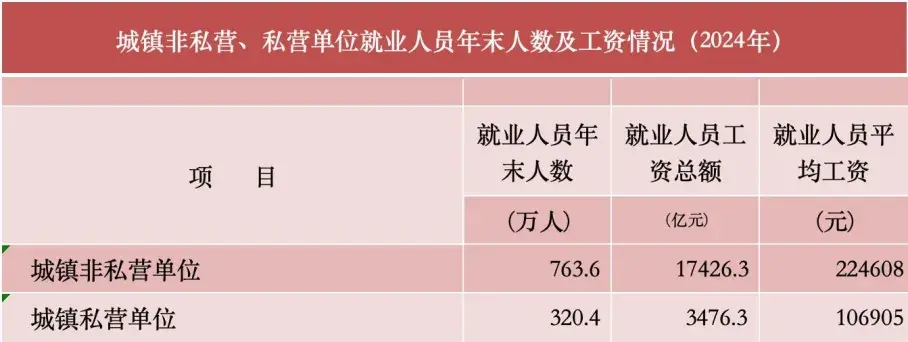
The number of people in non-private units is more than double that of private units.
If we refer to the calculation experience of previous years, Beijing's contribution base this year should still increase slightly by about 2%.
Good news, it's going up again.
Bad news, it's not the salary.
However, the social security contribution base is not necessarily the higher the better; it has a critical value.
It's like a math problem we did when we were kids: For a product, if the unit price is raised too high, fewer people will buy it, and the total sales may not increase but decrease.
Social security is now facing such a dilemma.
Because the social security base is determined according to the average social wage, the lower limit is 60%, and the upper limit is 300%. That is, if the average social wage is 8000, the minimum contribution base is 4800 yuan.
Even if your monthly income is 3000 yuan, it is still calculated based on a base of 4800 yuan.
Want to raise it, there's no way to raise it.
If you raise the contribution base again, the first to be unable to bear it and the first to "discontinue insurance" are those flexible employment armies who pay their own full social security (workers in the unit actually have no choice).
They see it's so expensive, so they'd better take care of the present first, and simply don't pay.
In the end, the money collected may not increase but decrease.
If you want to lower it, there's no way to lower it.
Lowering it in many places is not enough to cover the expenses, and this thing is linked to the average social wage. Wouldn't it be telling everyone that the economy is developing rapidly, and GDP is growing by 5% every year, but everyone's wages are actually decreasing? This is not presentable.
So you see, it's stuck here, in a dilemma, and it doesn't even know what to do.
It may be waiting for some signal before deciding what to do, or it may just follow the original plan.
And the data fluctuations in Beijing and Shanghai, these two first-tier cities, may be an important bellwether.
Mainly because of these two cities, their average wages are too high.
Beijing's average social wage (social security caliber) last year was 11,761 yuan per month, and Shanghai's was 12,307 yuan per month.
In the past few years, the lower limits of social security contribution bases across the country have all experienced a round of high growth.
From 2020 to 2024, the lower limit of Beijing's social security contribution base increased from 3,613 yuan to 6,821 yuan, a staggering increase of 88.8%.
Assuming a flexible employee has been paying the basic pension insurance according to the lower limit of the contribution base, according to a 20% contribution ratio, it was 722.6 yuan per month in 2019, and it became 1364.2 yuan in 2024, an increase of 641.6 yuan.
I have to say, judging from the increase in the social security base, the people of Beijing are truly "happy".

So why in the past few years, we always feel that money is getting harder and harder to earn, but the average wages and social security base announced by the official are soaring like rockets?
Many people suspect that the data may be "fabricated", but in fact, there is no need.
You only need to screen out more and more low-income people during the statistics, and then calculate the average with the remaining "top" group, and it will naturally rise against the trend.
This process of "purifying" the statistical population is much more clever than directly changing the numbers.
This thing about the social security contribution base, from a paper perspective, its original intention sounds quite fair.
It says, let's set a 100% contribution standard based on the average social wage.
But considering the gap between the rich and the poor (that is, the "Matthew effect"), the rich will pull the average up very high, and most people's income actually does not reach the average line, so it is also very "considerate" to set a 60% minimum.
Looking at it this way, does it feel like the logic is quite considerate of most people?
But the devil is hidden in the six words "average social wage".
Do you think it's the average wage of the "whole society"?
Wrong.
This statistic only counts the wages of people in formal units (enterprises, institutions, and government agencies) in urban areas, while perfectly excluding the two or three hundred million flexible employment armies—such as delivery guys, ride-hailing drivers, and freelancers.
Not only that, the statistical caliber also only counts before tax, counts your own five insurances and one housing fund as your wages, and even the welfare benefits such as rice, noodles, and oil issued by the company must be converted.
In a word: try every means to make this number look as high as possible.
This leads to a more absurd scene, which I call "Wudang Ti Yun Zong" (stepping on the right foot to go to heaven).
Think about it, what will happen to those whose income is just struggling near the minimum contribution line?
Their nominal wages may not have increased much, or even decreased, but because the "average social wage" that has been "picked and raised" has been rising, so their social security fees also rise with the tide.
The result is that, although the wages on the books are rising, the money they receive may remain the same or even decrease.
Where did the money go?
It has become the ever-increasing social security fees.
Especially those flexible employees who bear all the social security, this feeling of being under pressure will only become more and more real, and the complaints on the Internet will naturally increase.
So why do we need to constantly raise the base?
Because social security is essentially a "pay-as-you-go" fund pool, using the money paid by young people now to support the elderly now.
When we get old, we will be supported by the next generation.
It is not a savings account, not how much you pay, and then you get the same amount back, but an "intergenerational transfer payment" system.
But what about reality?
In the statistical annual report of the year before last, there were nearly 300 million elderly people over 60 years old in China, while in the same year, there were only just over 9 million newborns.
And according to the forecast data of the National Health Commission:
Around 2035, the elderly population aged 60 and over will exceed 400 million, and their proportion in the total population will exceed 30%;
That is to say, the elderly are increasing rapidly, and the newborns are falling off a cliff. Who will fill the social security pool in the future?
You may say, can't we rely on economic growth?
But the reality is that in 2023, more than half of the provinces in the country have had a shortfall in pension payments and have to rely on the central government's "blood transfusion" to issue wages.
The fact is that over the years, the intensity of financial subsidies has been increasing, and the annual subsidy scale has already exceeded 2 trillion yuan since 2020.
With the aging population intensifying, more and more people are receiving money, but fewer and fewer people (future young people) are paying money, and the gap in this pool will naturally become larger and larger.
To fill this hole, in addition to the national financial blood transfusion, the most direct way is to let everyone pay more money.
But the problem is that the total number of young people who can pay has been decreasing for more than a dozen years, what should we do?
The simplest and most brutal path dependence has come:
Since the number of people is not enough, then find a way to make everyone pay more—raising the contribution base and studying extending the contribution years have become the optimal solutions on the table.
However, the most ironic thing about this set of play is that it is sawing off the branch it is sitting on with its own hands.
The social security base that has been "picked and raised" is fundamentally excluding and abandoning those low-income groups and flexible employees who really need protection.
The worse the economic environment, the more people will be "screened" out, the more inflated this base will be, and in turn, it will make more people feel that they "can't afford it and it's not worth it", and simply don't pay.
For the goal of "increasing social security income", this is simply a perfect paradox.
The reason why the social security contribution base in many places has been delayed this year is actually stuck in this dilemma.
This is what we mentioned before, bypassing the correct answer to solve the problem, often there are greater costs.
History never argues, it does not change according to personal will.
Let's continue to look down.