

Object|Text
Produced by Bin Yue Yu Yun (ID: Lzkj328)
Recently, an incident in Wushan County, Chongqing, where "medical personnel did not examine an elderly person before judging them dead after they ingested pesticide" has attracted widespread attention.
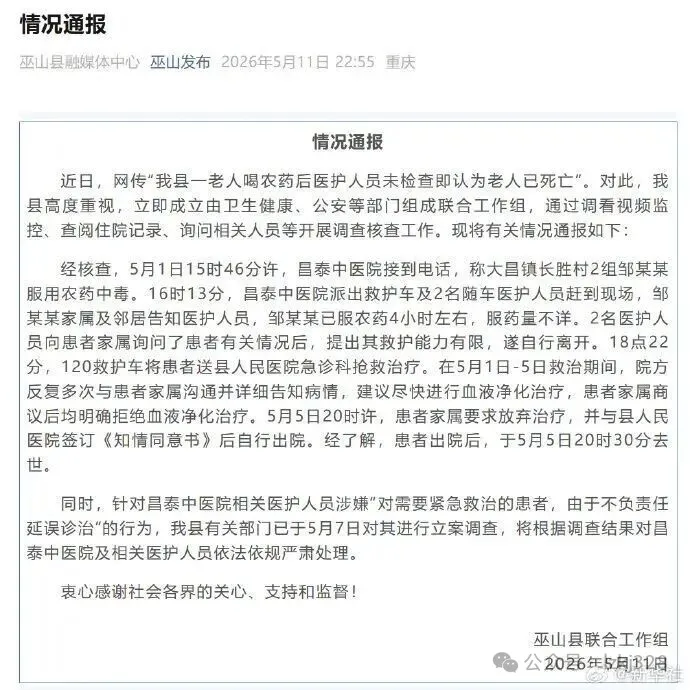
On May 1st, after an elderly person who had taken pesticide called for emergency assistance from their family, two medical staff members dispatched by Changtai Traditional Chinese Medicine Hospital arrived at the scene. Without a detailed examination, they left on their own, citing "limited rescue capabilities."
Later, when the family was preparing for the funeral, they found the elderly person still breathing and called for emergency assistance again. The elderly person was eventually sent to the hospital but passed away on May 5th. On May 11th, the Wushan County Joint Working Group released a situation report, stating that local authorities had launched an investigation into the hospital and the relevant medical staff.
The reason this incident is shocking is not only because it touches the bottom line of medical ethics, but also because it exposes the indifference to life and the lack of professional responsibility of some grassroots emergency personnel. Faced with a critically ill patient who had taken pesticide, the medical staff did not conduct any substantive examination after arriving at the scene. They only made a judgment of "limited capabilities" based on the family's verbal account and withdrew. This behavior, in any case, can hardly be lightly dismissed with the words "negligence."
The first principle of emergency medicine is "save the life first, then diagnose the illness." For patients poisoned by pesticides, time is life, and every minute of delay may mean the distance between life and death. The medical staff arrived at the scene at 16:13, and the elderly person was finally sent to the hospital at 18:22. This two-hour window is precisely the most precious rescue window for poisoned patients. Even if, as the report stated, the elderly person had taken the medication about 4 hours earlier, this by no means implies that on-site assessment can be omitted. The assessment of vital signs, the assessment of the degree of poisoning, and the implementation of basic life support are all the most basic responsibilities of emergency personnel, not options that can be arbitrarily abandoned due to "limited capabilities."
This incident exposes the loopholes in the construction of the emergency system in some grassroots medical institutions. Why did the medical staff of Changtai Traditional Chinese Medicine Hospital "leave on their own"? Is it a serious lack of personal professional quality, or a long-term lax management mechanism of the hospital? Or is it "helplessness" caused by insufficient allocation of grassroots emergency resources? These questions all need to be answered by the investigation. But regardless of the reason, a basic fact is clear: in the face of patients who need emergency treatment, medical staff have a legal obligation to provide assistance, and any excuse of "limited capabilities" cannot be a reason to abandon the rescue.
The official report used the expression "suspected of delaying treatment due to irresponsible behavior towards patients who need emergency treatment," which is not just a criticism of medical ethics, but also points to the determination of legal responsibility.
According to relevant regulations such as the "Practicing Physicians Law," physicians who fail to take emergency treatment measures for critically ill patients in their practice activities, resulting in serious consequences, will face administrative penalties such as warnings, suspension of practice, or even revocation of their practicing certificates; if the circumstances are serious, they may even involve criminal liability. Whether the medical staff involved are "irresponsible" depends on whether their behavior clearly violates the diagnostic and treatment norms, and whether they could have taken basic rescue measures under the circumstances at the time but did not.
This incident also reflects the shortcomings in the standardization and normalization of the grassroots emergency system. After emergency personnel arrive at the scene, what assessment process should they follow? When judging "insufficient capabilities," is there a clear referral or support mechanism? Instead of simply saying "leave on their own" and disregarding the patient's life and death. The Wushan County report shows that the elderly person was later sent to the county People's Hospital for rescue by a 120 ambulance, which indicates that the subsequent treatment channel exists. Then the question is, why didn't the first batch of medical staff activate this channel?
In addition, there is a poignant detail in the incident: during the treatment of the elderly person from May 1st to May 5th, the family repeatedly refused the hospital's recommendation for blood purification treatment. This is certainly the family's choice, but it also reminds us that emergency popularization and doctor-patient communication in rural areas are still a long way to go. However, this cannot exonerate the first batch of medical staff's dereliction of duty, because the two-hour delay occurred before the family's decision.
Currently, the local government has established a joint working group to conduct an investigation, which is a necessary correction procedure, but the investigation cannot stop at pursuing individual responsibility. For the public, what they hope to see more is how the hospital involved and the entire region's emergency system will be rectified, how to ensure that absurd incidents like "judging death without examination" will not happen again, and whether there are systemic deficiencies in the training of emergency personnel's capabilities and professional ethics education? These questions all need a responsible explanation.
In the face of life, there is no "small probability." The stethoscope in the hands of emergency personnel carries the last hope of patients and their families. When this hope is easily shattered by the four words "limited capabilities," it not only hurts the feelings of a family, but also damages the trust of the entire society in the medical system.
We look forward to the Wushan County investigation being strict and practical, giving the deceased an explanation, and also giving a reassuring answer to all those who may face emergency situations. (Author: Bin Yu) (Bin Yue Yu Yun WeChat Official Account: lzkj328)
Source | Bin Yue Yu Yun ID: lzkj328
Editor | Xia He
Reviewer | Bin Yu
Produced by | Bin Yue Yu Yun ID: lzkj328