


According to data on international balance of payments released by China's State Administration of Foreign Exchange on August 9, the direct investment of foreign-funded enterprises showed negative growth for the first time in three quarters. Foreign companies reduced their direct investment in China by $14.8 billion. 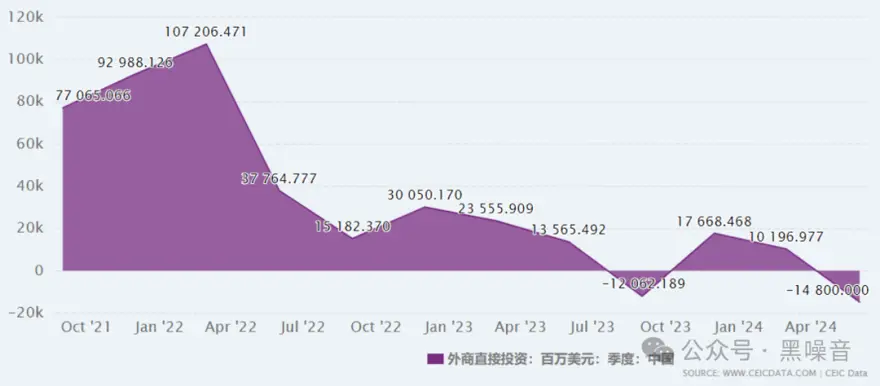 This data is not only negative growth, but also the lowest in history since the statistics were available. In fact, the sharp decline in foreign direct investment has been a trend for a long time. Data released by the State Administration of Foreign Exchange on February 18, 2024, showed that in 2023, China's net inflow of foreign direct investment (i.e., the liability side of direct investment, also known as direct investment in China) was $33 billion, a further decline of 81.7% after a year-on-year decrease of 47.6% in 2022, and the net inflow scale dropped to the lowest level since 1994. It is worth noting that in 2023, the foreign shareholder loans in foreign direct investment changed from a net inflow of $20.5 billion in the previous year to a net outflow of $29.1 billion, which was the first annual net outflow since data were available in 1982. In the detailed items of foreign direct investment data for April-June this year, the funds used for factory construction and mergers and acquisitions (M&A) flowed out more than the inflow. From these two data, it can be seen that the sharp decline in new investment enterprises and new factories by foreign investors in mainland China is an important reason for the decline in foreign investment.
 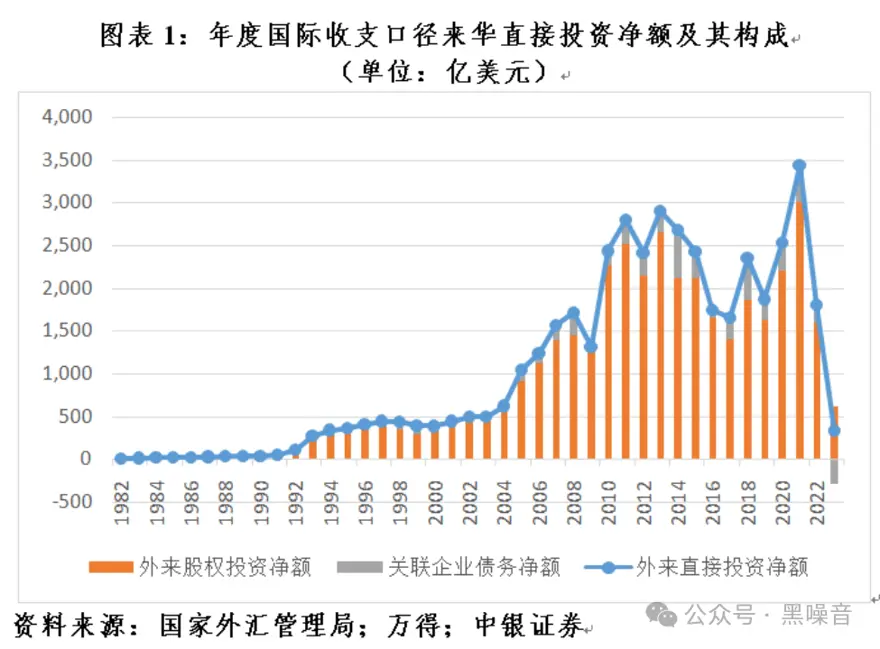 Considering the combined effects of cyclical fluctuations in domestic and foreign market demand, the US dollar interest rate hike cycle, and the easing policy of the RMB, foreign-funded enterprises have a large amount of retained earnings repatriation, which is also one of the direct reasons for the sharp decline in this data. Many people also say that the reason for the sharp decline in foreign investment is that foreign companies in China cannot compete with the booming domestic enterprises, resulting in an overall decline in profits. However, according to data from the National Bureau of Statistics, among industrial enterprises above designated size in 2023, the total profits realized by foreign-funded and Hong Kong, Macao and Taiwan-funded enterprises decreased by 6.7% year-on-year. Therefore, this decline is not enough to explain the 81.7% year-on-year decline in foreign investment in 2023. Another explanation is that the surge in investment in China caused by the epidemic has overdrawn the growth space, and now it is just a natural cyclical decline, so there is no need to worry. Then let's look at the data: In 2020, the new crown epidemic led to global economic obstruction, and the net inflow of direct investment in China in terms of international balance of payments increased by 35%. In 2021, the net inflow of direct investment in China in terms of international balance of payments increased by 36%. These two years did see a significant increase. But then came what I mentioned at the beginning: In 2022, direct investment in China in terms of international balance of payments began to decline, with a drop of 47.6%. In 2023, the year-on-year decline was as high as 81.7%. In April-June 2024, it was even negative growth, with a decrease of $14.8 billion. In fact, the first negative growth of this data was not this year, but a decrease of $12.1 billion in July-September 2023.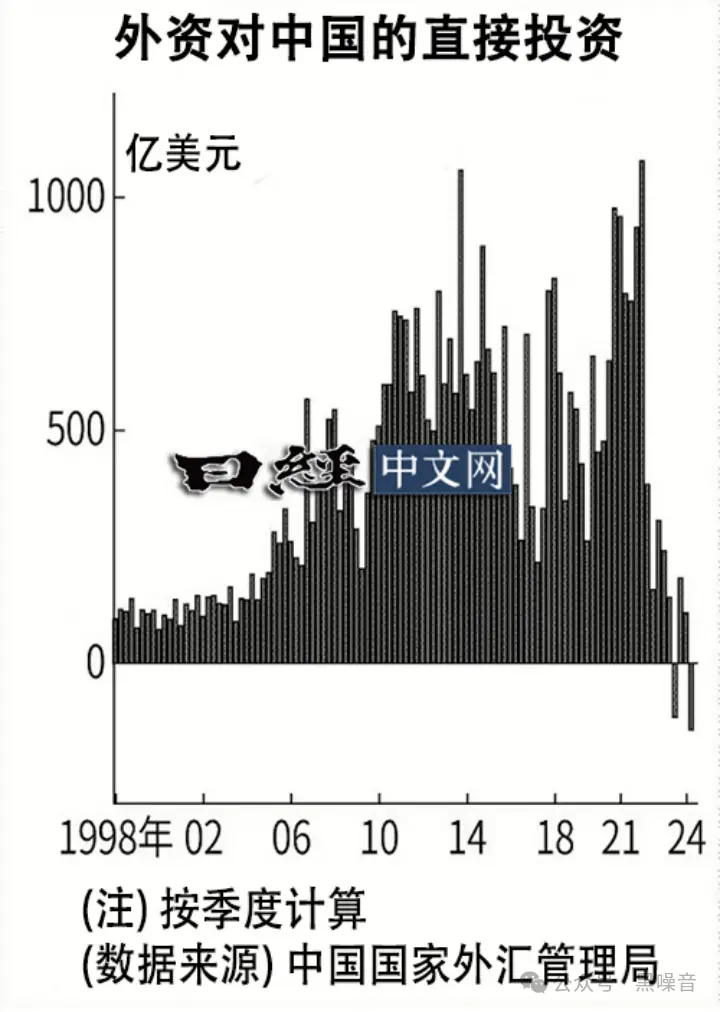
Judging from the above data, although cyclical factors of overseas demand, the US dollar interest rate hike, and the interest rate spread between China and the US are all reasons for capital outflow, they are not enough to explain the depth of the current decline, let alone the emergence of negative growth. If it is a normal cyclical decline, it is almost the same to fall back to the average value around 2008, but now it has directly fallen back to the level of the early 1990s, so we must seriously consider the reasons. I think that the economic confidence slump and geopolitics are the real reasons for capital outflow. The lack of confidence leads foreign investors to feel confused about the prospects of investing in China, especially the potential risks caused by the sluggish real estate and domestic demand, which makes foreign investors hesitate. In comparison, countries such as India and Mexico have become the new "sweet potatoes" for foreign investment. In addition to the decline in investment caused by the US advocating "near-shoring" instead of "far-shoring", how have the East Asian neighbors, who have always had huge investments in China, performed in the past two years? According to a survey, most Japanese companies have reduced their investment in China or kept it flat, and most companies are not optimistic about the prospects for 2024. Japanese companies' investment in China last year was the lowest in a decade, with only 2.2% of Japan's new overseas investment flowing to mainland China. This figure is even lower than the investment in Vietnam or India, and is only equivalent to a quarter of the investment in Australia. South Korean companies are also reducing their investment in China. The new foreign direct investment in the first nine months of 2023 decreased by as much as 91% compared with the same period in 2022, falling to the lowest level since 2002. Under the depression, the only highlight comes from the European Union. In 2023, Germany's investment in China accounted for 10.3% of Germany's total overseas direct investment, which is the highest value since 2014. But this trend is obviously related to the industrial trend - in terms of new energy vehicles, Germany hopes to maintain close cooperation with China. For example, BMW increased its investment in Shenyang by tens of billions of RMB this year, and Volkswagen also added billions of euros in new energy vehicle investment in China this year. But this is entirely because of "self-help". German automakers who want to carry out new energy vehicle technology transformation and avoid being completely replaced by BYD and others urgently need to cooperate with Chinese companies to improve their technology iteration capabilities and intelligence level. It should be noted that Europe's attitude towards electric vehicles has begun to cool down gradually. The delay and hesitation of the ban on fuel vehicles reflect the complex mood of Europe in this strategy. 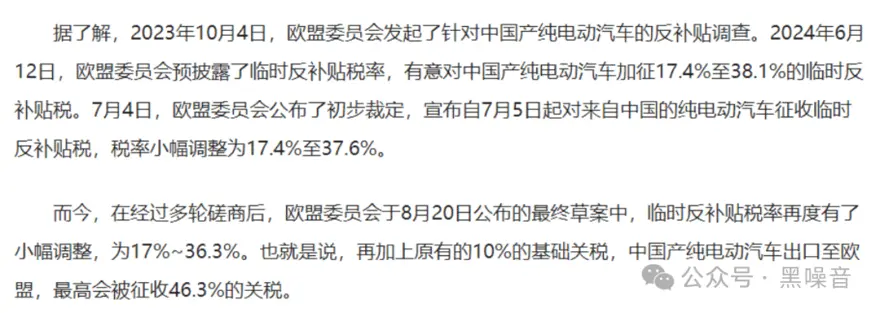 So will German automakers continue to increase their investment in China in the future? This is questionable. In addition, the increase in investment in one industry is only a small factor in the context of the decline in foreign investment in China. Overall, although we cannot be overly pessimistic about the sharp decline in foreign investment data in China, we must also fully recognize that the economic downturn and the cooling of global geopolitics (especially the impact of the war in Ukraine) have indeed affected foreign investors' confidence in investing in China. Under the trend of sluggish domestic demand, it will not be a good thing if foreign investment continues to cool down. This article is compiled from mainstream financial media and official data.